
🚀 Try our newly launched Conversational Search tool

Registers of Scotland empowers non-technical staff with low-code digital tools

Registers of Scotland transformed its digital presence, reducing the volume of web form inquiries while reducing dependency on specialized developers.

Lorna Hegarty

Lorna Hegarty 17 Dec 2025

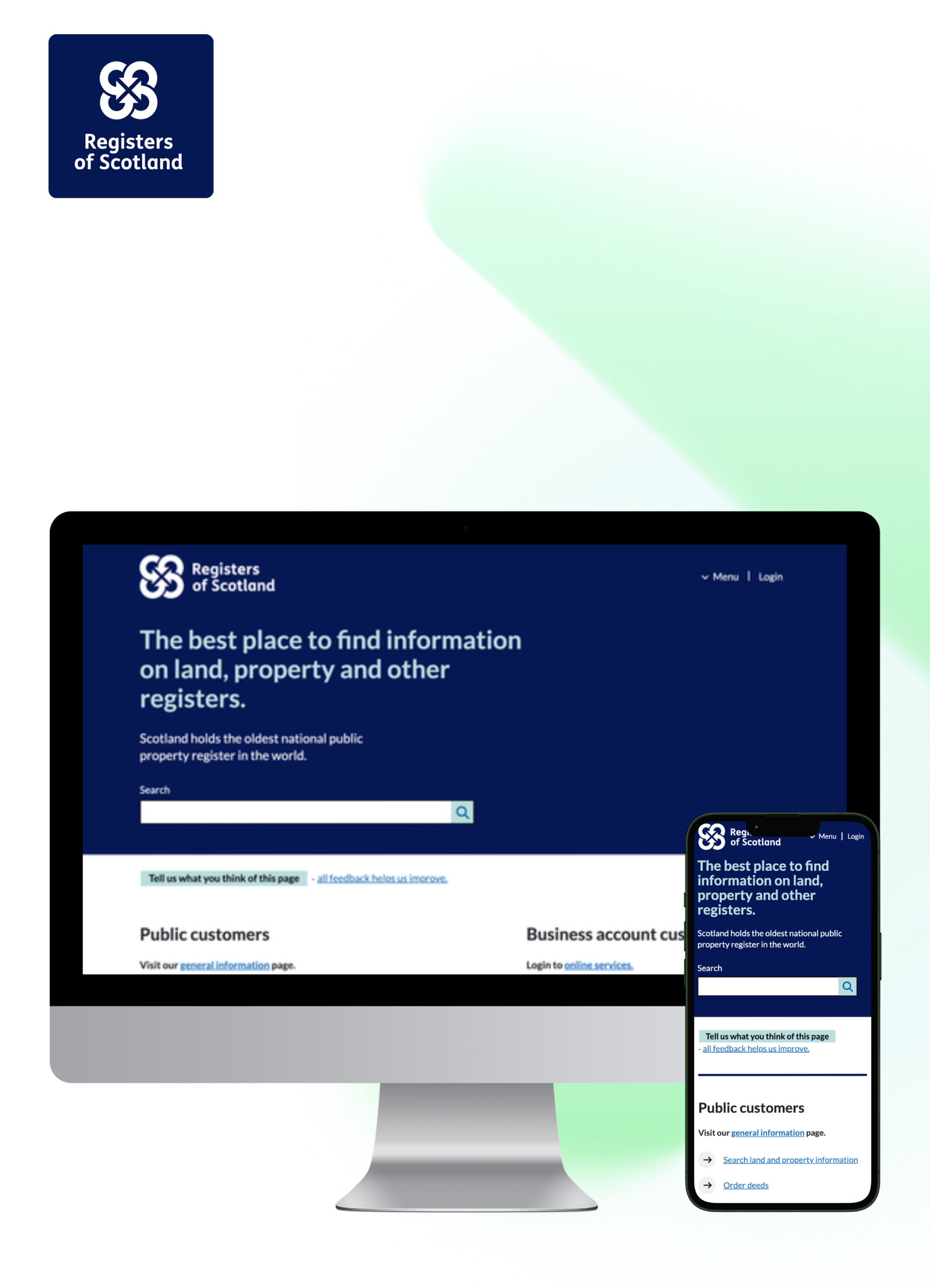
Image of Registers of Scotland homepage

Registers of Scotland

Registers of Scotland (RoS) is a government department responsible for maintaining Scotland's land and property registers and other legal documents. They manage critical legal documentation for both professionals and citizens.

Industry

Government

Products

CMS

Key takeaways

  • Content management: From single developer dependency → Multiple non-technical staff empowered
  • User experience: From complex legal terminology → Accessible, government-compliant interface
  • Call center pressure: From expensive call center reliance → Reduced volume and costs through self-service
  • Development speed: From bottlenecked updates → Rapid iteration with low-code tools

The challenge

COVID-19 created an unprecedented digital shift

The pandemic didn't just change how RoS operated; it transformed who they served. For decades, this government department's website primarily served legal professionals. But during COVID, that all changed.

"During COVID, we saw a huge influx of citizen users visiting our website. People were at home, searching family histories, exploring boundaries and downloading property deeds to resolve issues." – Innes Zenati, Senior Digital Communications Manager

In just months, their audience shifted from 20% citizen users and 80% business users to 67% public users, compared to 33% business users. But the website wasn’t fit for purpose, its complicated IA was dated, meaning it wasn’t ready to handle this shift in audience.

And there were deeper challenges brewing. Insights from the spring 2024 customer satisfaction index showed a decline in customer experience. The corporate website homepage hadn't been updated since late 2017, a time when UK smartphone adoption was only at 76% compared to the 95% it had reached by 2024. It was clear the site required a refresh, which would better serve their customers.

Four challenges emerged:

  1. Content barrier: Website content written for professionals created barriers for citizen users navigating the website.
  2. Operational pressure: RoS faced what Innes describes as "massive reliance" on their call center, with mounting costs as users couldn't self-serve online.
  3. Technical bottleneck: Critical "single point of failure" problem where any website updates required specialized development skills.
  4. Analytics gap: Couldn’t understand website user behavior, search patterns, or optimization opportunities.

RoS needed a solution that would allow them to:

  1. Understand what the public required from the site and how to structure it effectively
  2. Enable non-technical employees to update and manage the website independently
  3. Allow both citizen and professional users to self-serve
  4. Reduce the mounting pressure on their call center and operational costs

The solution

Foundation: Squiz DXP implementation

Squiz introduced its new digital experience platform (DXP) at a time when the RoS team was evolving, and this new platform would give them features and tools to redesign their website following government digital standards.

RoS implemented the Squiz DXP to access capabilities that would democratize content management across their team. The component service would allow them access to GOV.UK reusable components to redesign their website without the need for a developer.

"The DXP has given us the inspiration to know that we can redesign our website using GDS-compliant components, track user journeys, enable A/B testing, and then personalize the experience. It's opened up possibilities that weren't available to us before." – Innes Zenati, Senior Digital Communications Manager

Phase 1: User journey mapping with "cake slice" strategy

To truly understand what users needed, RoS worked with Squiz consultants on comprehensive user journey mapping workshops - creating an extensive user journey mapping document that RoS could use to understand the different journeys users take when visiting the website.

This capability allowed the team to see where users drop off and identify blockers before deciding how to build new journeys.

The team decided to focus on one journey at a time, a process Squiz has coined as the "cake slice approach," rather than attempting simultaneous fixes across the entire site.

This allowed the team to break the work into manageable chunks, meaning they wouldn't get overwhelmed and could take learnings from each project and apply them to the next.

Three priority journeys were identified:

  1. Ordering deeds
  2. Searching land and property
  3. "Paid off my mortgage" guidance

These remain the top user paths today, continuously monitored through monthly reviews.

Phase 2: Homepage redesign with a user-centered approach

To adapt to their increasing citizen user base, the team needed to start by redesigning their homepage. The page was previously filled with confusing journeys and legal jargon, which made it difficult for citizens to find information.

The methodology:

Before the team began the redesign of their homepage, they interrogated several data sets, which included Hotjar, Google Analytics, the Squiz Funnelback Search Analytics, in-page feedback and CSI results, and a deep dive into specific user journeys. This allowed them to gain a deeper understanding of customer behavior and their needs, enabling them to design content with the user in mind and ultimately enhance their overall experience.

The user experience team led user research sessions with citizens to observe how they interacted and used the website. This would then allow them to tailor content, improve search, user journeys and the overall layout and design

"After using testing groups that included those who were visually impaired, we saw the difficulties they were having navigating any page," explains Innes. The team went beyond compliance requirements to ensure genuine accessibility.

The site has undergone a full visual redesign, enhanced with RoS branding. This has been a huge team effort and due to the hard work from communications, UCD and front-facing teams within RoS, the homepage is now easier to navigate and guides users into distinct business and citizen journeys.

Phase 3: Low-code development capabilities

Component Service

The DXP implementation also means the RoS team has access to Squiz Component Service, allowing RoS to create and reuse components that align the rest of its website to the GOV.UK design system.

Adoption of GOV.UK design system components ensure consistency with broader government digital standards while maintaining the organization's specific requirements, supporting full WCAG 2.2 compliance for inclusive digital services.

"We previously didn't have a way of linking our CMS to the GOV.UK design system. The Component Service has filled that gap." – Innes Zenati, Senior Digital Communications Manager

Quick tip: What is a design system? A collection of reusable design components, styles, templates, and guidelines ensuring consistent, accessible, and efficient website design, content management, and user experience.

These component libraries are low-code, meaning non-technical users can build and iterate quickly, removing the need for specialized development skills while ensuring government compliance.

Advanced Forms

Innes and the team also have access to low-code Advanced Forms. These forms have begun to replace their previous PDF-based data collection with the ability to create and publish forms with an intuitive, drag-and-drop interface that non-technical staff can manage.

"Before, if anyone wanted to create a form within Registers of Scotland, it had to go through one person. Now, with tools like Advanced Forms, they can set up templates that anyone can use, removing that single point of failure." – Jenny Archibald, Account Director at Squiz

Results

User experience transformation

  • Accessibility achievement: The team improved layouts across the site and optimized content for accessibility. The web accessibility score is now close to 100%, meaning they comply with WCAG 2.2, helping ensure their services meet the needs of everyone.
  • Government standard compliance: Alignment with GOV.UK design system components ensure compliance with the broader government standards and consistency for users of sites across the GOV.UK space.

End-to-end user journey tracking

Enhanced understanding of user behavior: The team can now track user journeys and continuously optimize based on real data, with top user paths continuously monitored and optimized.

"I've mapped out around 10 to 12 different journeys and I can view these very easily via the DXP." – Innes Zenati, Senior Digital Communications Manager

Measurable performance improvements

Specific metrics:

  • Reduction in overall in-page feedback and specifically negative feedback
  • Reduction in email form submissions
  • Engagement uplift
  • Improved bounce rates
  • Time savings across the team

Beyond the hard metrics around engagement and bounce rates, the team is seeing a reduction in overall in-page feedback and specifically negative feedback. This tells them that more customers are understanding the content now. It's clearer, more intuitive, and meets their needs.

When combined with the reduction in email form submissions and the engagement uplift, it creates a complete picture of a site that's genuinely working better for people who use it.

Technical capabilities unlocked

  • Reduced developer dependency: Non-technical users can now build and iterate quickly without specialized development skills. Working with Squiz to deliver these improvements has been incredibly positive, all of which are managed through an intuitive user interface, allowing content editors to create engaging content.
  • Low-code tools: Component Service enables easy webpage building, while Advanced Forms empowers staff with "simple drag and drop” functionality.
  • Eliminated single points of failure: Where there was previously a single point of failure for the website, the Squiz DXP has allowed the team to get quickly upskilled and able to make updates and improvements independently.

Partnership excellence

RoS has been working with Squiz for over a decade. What makes them such a fantastic partner is their genuine innovation and early adoption.

"Working with Innes and the team at Registers of Scotland has been brilliant. What impresses me most is that they don't just accept the status quo. They're constantly asking, 'How can we do this better for our customers?' That mindset, combined with their willingness to adopt new technologies and their understanding that their customers deserve great digital experiences, make them a real standout." -- Tom, Digital Experience Consultant at Squiz

They don't just accept what Squiz offers as an off-the-shelf solution. They actively embrace new technologies and tools within the platform. When Squiz introduces something like user journey mapping tools or personalization capabilities, they're ready to dive in and make the most of it.

Wrap up

Registers of Scotland's transformation demonstrates what's possible when organizations embrace low-code solutions and user-centered design.

The key to their success was democratizing digital capabilities across their team. By removing dependency on specialized developers, RoS empowered non-technical staff to respond quickly to user needs while maintaining government compliance standards.

The team will continue to use analytics, search results, and customer feedback, and with the help from Squiz, they can monitor changes in the landscape to further improve and iterate their corporate website aimed at helping customers.