
✨ NEW Content Intelligence is here! Make your content unmissable to AI search
Squiz Customer Image LSBU

Transforming student experiences for LSBU

London South Bank University (LSBU) partnered with Squiz to modernize its digital infrastructure, focusing on two critical student recruitment initiatives.

London South Bank University

London South Bank University (LSBU) is a public university in London, founded in 1892. Now focused on practical, career-oriented higher education.

Industry
Higher education
Products
DXP

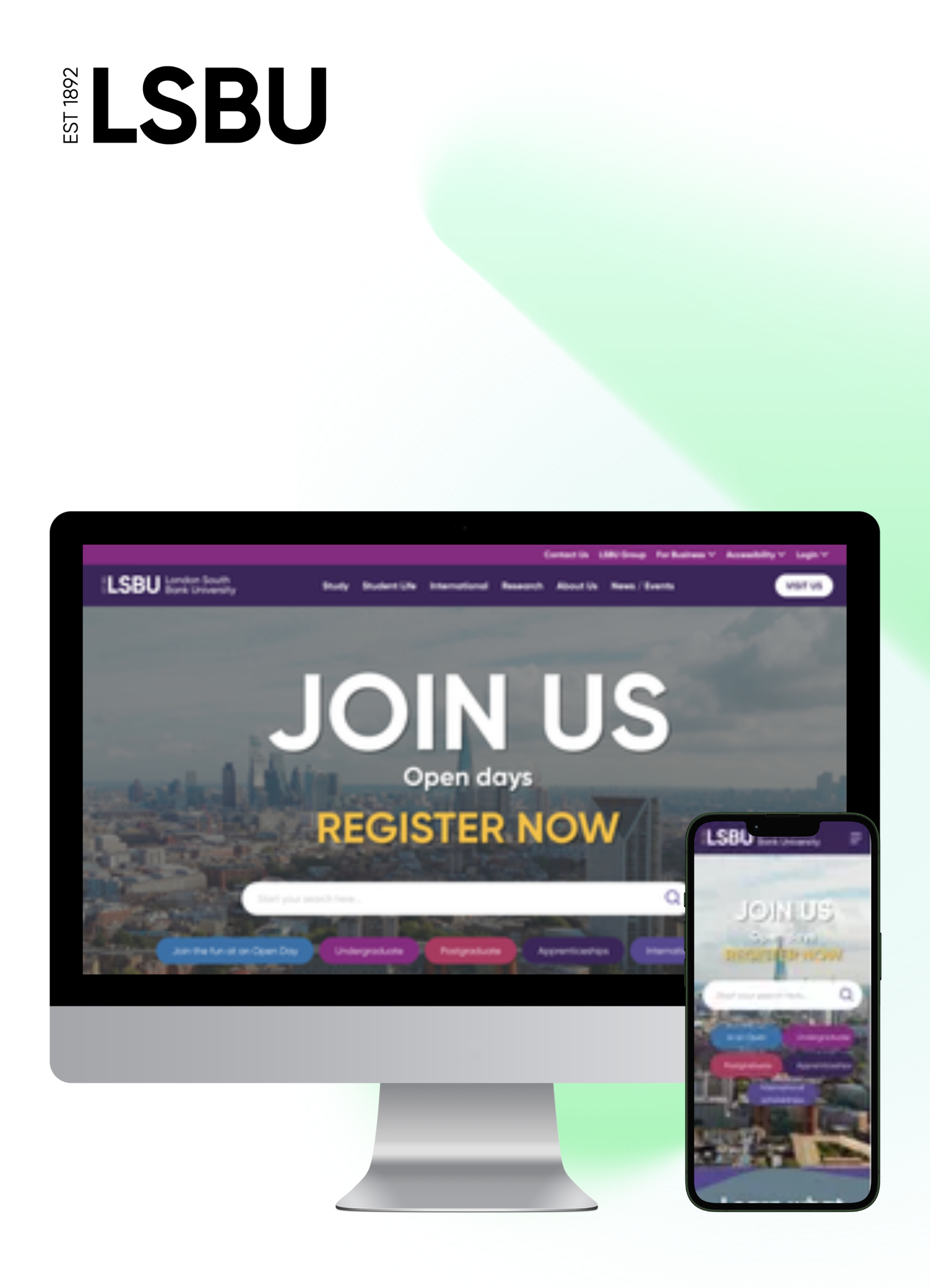
London South Bank University (LSBU) partnered with Squiz to modernize its digital infrastructure through the implementation of Squiz DXP, focusing on two critical student recruitment initiatives: a Clearing landing page and a comprehensive course page template.

This case study demonstrates how component-based design and visual page builder capabilities can streamline content management while improving user experience at peak recruitment moments.

The challenge

London South Bank University's digital team faced mounting operational challenges that were impacting their efficiency and ability to serve prospective students effectively.

The university's marketing team was heavily reliant on external support for routine updates, generating a significant volume of support tickets that created bottlenecks in their workflow.

Content management was particularly time-intensive. Each course page, for example, required individual, manual creation without any reusable component framework. With over 200 course pages on the site and growing, this manual approach was no longer sustainable.

The annual Clearing campaign also presented unique pressures. LSBU needed effective Clearing pages that could be updated rapidly during this fast-moving period, but their previous approach required complete page rebuilds each year.

LSBU needed a solution that would reduce their reliance on external support, accelerate time-to-market for critical campaigns, enable their marketing team to work autonomously, and improve the student experience during high-stakes periods like Clearing.

The solution

As part of LSBU's migration to Squiz DXP, Squiz committed to redeveloping key user journeys using a component-based architecture and leveraging Squiz's Component Service capability. Rather than simply lifting and shifting their existing content, this strategic approach would give LSBU a head start with ready-to-use, professionally designed components that could accelerate their digital transformation.

Building for Clearing: Phase one

The first priority was redesigning and refreshing the Clearing hub to serve as the primary landing page for the time-sensitive recruitment campaign. The Clearing hub would need to serve as both a destination for paid campaigns and the go-to resource for students receiving their results on Clearing day itself.

The Squiz team built this over the course of 8 weeks, successfully completing the project in July, before the Clearing period kicked off in August. The implementation was done using a mix of custom components tailored to LSBU's specific needs and out-of-the-box DXP components that provided proven functionality.

This created a reusable component library that LSBU could leverage for future projects, while enabling their marketing team to populate content independently using the Visual Page Builder feature of Squiz's content management capability.

Scaling success: The course page template

With the Clearing hub successfully delivered, attention turned to phase two: creating a standardized course page template using reusable components. This initiative targeted an initial focus on the university's top 20 courses, with a clear rollout plan to eventually cover the full course catalogue.

The template approach meant that instead of building each page individually, LSBU's team could now leverage pre-built components and populate them with course-specific content. This dramatically reduced the time required to create and update course pages while giving the marketing team true self-service capability.

The technology foundation

At the heart of this solution was Squiz DXP's Component Service, which enabled the creation of reusable, modular design elements that could be deployed across multiple pages and user journeys. The Visual Page Builder gave LSBU's marketing team an intuitive interface for content management, removing the technical barriers that had previously slowed them down.

Looking to the future

The partnership between LSBU and Squiz continues to evolve. With capabilities such as the Customer Data Platform in line for rollout next, which will allow for personalization that will further enhance the student experience.

Also, the introduction of conversational search capabilities that could transform how prospective students discover information on the site.

The outcomes

A transformation in team efficiency

The team has experienced a significant decrease in support ticket volume since the DXP migration, as they're now empowered to manage content independently. This shift from a support-heavy relationship to strategic collaboration has freed up both teams to focus on innovation rather than maintenance.

The introduction of reusable components will dramatically reduce content creation time. Where previously each course page was a time-intensive individual project, the marketing team will now be able to rapidly populate courses using the new template approach.

Clearing campaign 2025: The proof point

The 2025 Clearing campaign provided an early opportunity to measure the impact of the new Clearing hub. Based on analytics data from the Clearing period, the results showed notable improvements in how prospective students engaged with LSBU's digital content.

Key metrics from the peak Clearing period, during the week of results day:

  • 30% increase in Clearing-related page views week-over-week
  • 32% increase in interactions (2024 compared to new hub in 2025), this included a 29% increase in scrolls and a 42% increase in clicks
  • 12% increase in organic traffic

The data suggests that students were navigating more efficiently through the site, with the multiple clear calls-to-action contributing to a one-minute decrease in average session duration as users found what they needed and took action more quickly.

Another key improvement in the 2025 Clearing Hub was the introduction of new, flexible components that supported richer media content, particularly in video form.

The refresh allowed the team to embed YouTube Shorts directly into the Clearing journey, with videos focusing on the Clearing process, results day reassurance and next steps.

In addition, the hub featured an increased number of student testimonials. This helped prospective students relate to real experiences during Clearing and gain reassurance through peers.

This shift towards a more visual-first feel made the Clearing Hub a more engaging visit, especially on mobile devices, which form a significant proportion of Clearing traffic (around 50-60%).

User analytics and behavioural signals suggest that this more dynamic content contributed to higher engagement with key sections of the page and more confident progression through the Clearing journey.

Building for the future

The component-based approach has created a foundation that extends beyond the Clearing and course page initiatives. Components developed for these user journeys are now reusable across the entire website, opening possibilities for news pages and other content types.

The Clearing hub has proven effective as a landing page for future Clearing-related campaigns, successfully directing students to relevant information during results day.

Although more formal user testing was limited during the Clearing period, some feedback from both current and prospective students pointed to improvements in clarity and generally ease of navigation. This included:

  • Information felt easier to process in a visual format, particularly through the YouTube shorts and structured content blocks, making it less overwhelming
  • Students reported feeling more prepared in advance of results day, having already explored courses and next steps

Heat maps and analytics also provide strong evidence that users were more effectively completing the tasks they came to do. The heat maps showed greater interaction with primary CTAs, including course search and Priority Clearing sign-up prior to results day. They also showed more consistent attention across the page content, with a later drop-off around text-dense areas seen in 2024.

Additionally, user journey analysis highlighted a shift in how prospective students navigated the Clearing experience, with user journeys in 2025 leaning more decisively toward searching for courses, applying, or signing up for Priority Clearing (LSBU's key CTAs).

In contrast to 2024, where content-heavy pages and less prominent FAQs led to confusion and increased session duration and calls, the new hub supported faster, more confident, self-service journeys.

A strategic partnership evolves

LSBU has been partnering with Squiz since 2013 and, having moved to the DXP in 2024, is embracing the power and efficiency the platform now offers its marketing team. LSBU is a forward-thinking customer, open to testing new capabilities as they become available and, as such, benefits from the significant advantages that it can offer.

With CDP implementation planned and Conversational AI Search on the roadmap, the university is taking a progressive approach to modernizing additional user journeys.

What made this work

Several factors contributed to the success of LSBU's digital transformation with Squiz DXP:

  • Phased approach: Tackling user journeys sequentially allowed focused attention and measurable progress
  • Component-based design: Reusable components provided the foundation for scalable content management
  • Team empowerment: Visual Page Builder enabled LSBU's marketing team to work autonomously
  • Strong partnership: Regular communication and mutual trust between LSBU and Squiz teams
  • Strategic timing: Clearing landing page delivered in time for the critical 2025 recruitment season

This combination of smart planning, the right technology, and collaborative execution created an environment where challenges could be addressed quickly and opportunities seized proactively.