





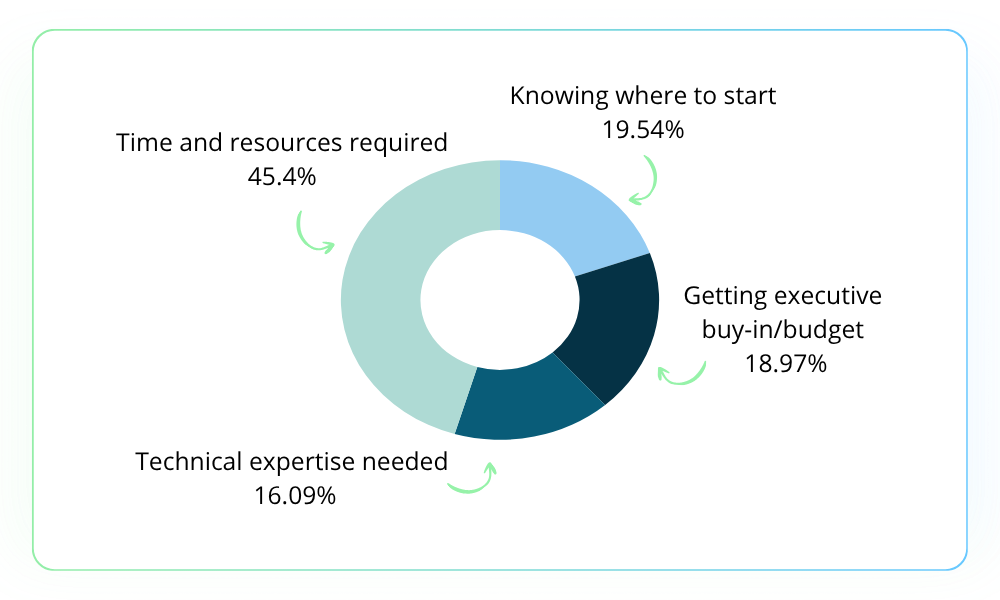
Poll: What is your biggest barrier to content optimization?
Time and resources required – 45.4%
Knowing where to start – 19.54%
Getting executive buy-in/budget – 18.97%
Technical expertise needed – 16.09%
Content discovery has become increasingly complex. Marketing teams are now responsible for ensuring content can be found by users not just on their own websites, but also in AI-powered search environments like ChatGPT and Perplexity. Watch this webinar to learn how you can make your content discoverable across all search channels, efficiently.

Video: Content discovery without clicks. Captions and transcript available on playback.
Learn how content discovery is shifting beyond websites, and how to optimise for both AI and search while improving engagement, efficiency, and measurable business outcomes.
Time and resources required – 45.4%
Knowing where to start – 19.54%
Getting executive buy-in/budget – 18.97%
Technical expertise needed – 16.09%
In practice, having a proper content structure means:
Crawlers don't look at visual elements on your page, they're reading the code behind it. So even if your content looks clear visually, if the underlying structure isn't there, AI won't understand it properly.
Machine-readable structure primarily refers to schema markup, i.e. structured data that helps make your content less confusing to AI crawlers.
Here's a practical example: Imagine you have a picture showing someone holding a microphone at a concert. Humans might recognize the band and venue, but a crawler won't know that from an image alone. Schema markup explicitly identifies the content type (event type: concert, performer, venue details) to remove that ambiguity.
Not necessarily. While LLMs do tend to prefer FAQ structures, you don't need to force all your content into question-format headings just to be AI-ready.
Machine-readability is more about the underlying code structure than the visible heading format. This means:
Well-structured content with answer-statement headings (like "How to apply" or "Application process") can still be AI-ready if the underlying structure and markup are solid. The format matters less than ensuring your content clearly addresses user questions and is properly structured.
This is something our content auditing tools will address in the future. They'll help you identify where your content needs optimization to be AI-ready, rather than forcing all your content into FAQ formats.
While there isn't a single unified standard across all AI platforms, the principles discussed in the webinar apply broadly across major players. The key is that well-structured, machine-readable content performs better across all AI systems, whether that’s Google AI Overviews, ChatGPT, Perplexity, or other LLMs.
The best standards, while not specific to AI, are still schema.org and JSON-LD. If you use those standards, most AI models will read them best.
Choose schema types that match the purpose of your content. For example:
Where multiple schema types apply, you can nest or combine them - for example, a Service page might also include Organization and BreadcrumbList markup. The goal is to make each page's intent clear to AI systems and search engines, so they can identify you as the authoritative source on that topic.
How to test if you've got it right: Prompt an LLM to explain your page back to you and see how accurate the response is. If it's not as accurate as you'd like, improve the schema markup.
Here’s an example prompt you could use: "Act as an SEO and structured data specialist. Review the schema markup on [link to your website]. Identify what schema types are currently in use, whether they are valid and aligned with Google’s Rich Results guidelines, and where improvements can be made. Recommend additional schema types that would strengthen entity recognition, Answer Engine Optimisation (AEO), and visibility in AI-powered search. Suggest concrete changes (e.g. adding Organization, Service, FAQ, Article, BreadcrumbList) and explain why each matters for discoverability and performance. Highlight risks of over- or mis-use of schema. Present your findings as: Current State, Gaps, Recommendations, and Next Actions."
When it comes to your own website's search experience, PDFs will work well, as Squiz Conversational Search will soon be able to handle unstructured data like PDFs effectively. However, for broader AI discoverability across external platforms like ChatGPT, Perplexity, and Google AI Overviews, HTML web pages are preferred because they allow for proper semantic structure, schema markup, and accessibility features that these AI systems rely on.
If discoverability across the broader AI ecosystem is important for that content, consider publishing it as a web page in addition to (or instead of) a PDF.
Starting from scratch isn't realistic for most teams, and honestly not necessary. We recommend starting with just a "slice" of your website: choose a high-impact content area and optimize that first, rather than tackling your entire website at once.
Look for content areas that are important to your audience but lower-risk to experiment with. Think of areas like student life content, community resources, or general information pages, i.e. valuable content that supports your goals without being your most critical conversion pages. The goal is to start somewhere that will deliver value without putting high-stakes pages at risk while you're learning.
This approach works because:
When you're starting out, the sweet spot is content that's high-value but low-risk, i.e. meaningful to your audience without being business-critical. This gives you space to learn and refine your approach before tackling your most important pages.
Take student life content at a university as an example. It includes information about accommodation, clubs and societies, health services, and general facilities – all important to prospective and current students. But unlike admissions or scholarship pages, if something doesn't work perfectly during optimization, it won't stop students from applying or enrolling. That makes it ideal for testing and learning.
The same logic applies across industries. Look for content areas that:
Use your analytics and content audit tools to identify these areas, but also consider what's manageable for your team to tackle as a first project.
This is a challenge that we see time and time again – for organizations of this size, trying to optimize everything at once is overwhelming and not realistic.
We would suggest:
1. Use auditing tools to get a comprehensive view of where problems exist across your content. A good auditor will not just flag the issues, but also give you the right information to help you prioritize fixes:
This gives you a scalable way to assess content quality across large volumes without manual review.
2. Use the slice approach
Don't try to fix everything at once. Focus on one high-impact content area or user journey, optimize that, measure results, then move to the next slice. This makes the work manageable, gives you concrete data on effort required, and lets you scale based on what you learn from the first slice.
The key is to use tools to identify priority areas, start with one slice, and build your optimization approach iteratively rather than trying to tackle everything upfront.
The shift is from optimizing for keywords to optimizing for questions and answers. Focus on the questions your audience is actually asking in your search analytics, and ensure your content provides clear, well-structured answers that AI can easily interpret and cite, using the principles we've discussed above around structure, clarity, and machine-readability.
Testing is key. The best way to know if your content is AI-ready is to test it against actual AI models with real user questions. For Squiz customers, we're developing auditing tools that simulate how AI search will use your content to answer common FAQs, pinpointing exactly which fragments in your content need to be optimized. You can test, learn, optimize, and repeat until you're happy with the answers that are surfaced. By testing against an actual AI model (in our case, Anthropic Claude), the improvements in content quality will help you perform better across other AI platforms as well, whether it’s ChatGPT, Perplexity, or Gemini.
The best source for real user questions is your own search analytics. We recommend looking at what users are actually searching for on your site - these queries tell you exactly what questions matter to your audience.
If you have conversational search implemented (like Squiz Conversational Search), your admins will also have access to conversation history showing the actual questions users are asking in natural language. This gives you invaluable insight into how people phrase their questions, what information they're looking for, and where gaps might exist in your content.
We recommend that you start with your existing search data, identify the most common queries and questions, and use those as the basis for your content audit. This ensures you're optimizing for questions that real users are actually asking, not just what you think they might ask.
It's less about changing the content itself and more about considering the user journey as a whole.
Because users are arriving on your site more informed and ready to take action, your content should have clear pathways for these highly qualified leads to get directly to what they're trying to do. Of course, your content still needs to work well for humans - i.e. it needs to be clear, helpful, and accurate - but the focus shifts to making it easy for informed visitors to take the next step.
You're in a great position! Starting from scratch means you can build with dual search in mind from day one, without needing to audit and fix existing content.
Here’s what we recommend:
Most importantly, we want to emphasize that you should treat this as an ongoing experiment, not a one-off build. The way AI systems surface and summarize content is evolving fast, so make testing part of your routine. Regularly prompt tools like ChatGPT, Perplexity, and Gemini to describe your site or specific pages back to you, and see if they capture your intended message. If they don’t, refine your structure, language, or schema. Think of it as training both humans and machines to understand your brand the way you want them to.
Full question: As we learn more about how AI prioritizes its sources (e.g., ranking Reddit highly), and with evidence showing that AI ranks what people say about you higher than your own content, how should we account for that in our content organization? This is particularly concerning from a government perspective, where ensuring accurate information reaches the public is critical.
LLMs tend to give more weight to official, trustworthy sources, especially for things like government information, legal content, or policy guidelines. However, as you’ve noticed, it’s not quite as simple as that. LLMs don’t just rank content by credibility; they look at context, intent, and consensus.
If someone asks a factual question like “What’s the official guidance on X?”, the model will usually surface government or institutional sources. But if the question leans more toward opinion or interpretation, e.g. “What do people think about policy X?”, then discussions on Reddit, LinkedIn, or in the media can rise higher, because that’s where the broader public conversation lives. And to the model, that conversation equals relevance.
That being said, here are some of the steps you can take (beyond the machine-readability and schema markup we discussed in the webinar):
The key shift is that authority now comes from a combination of your own well-structured content plus credible mentions and citations across the ecosystem.
Full question: How can we compete to have our information prioritized by AI over other websites? I work in local government, and building construction rules are sometimes pulled by AI from a builder's website instead of ours, which can display incorrect information.
As mentioned in the previous question about government information, LLMs weigh both credibility and context - looking at where information is discussed and cited across the web, not just at official sources.
In addition to the content structure and schema principles covered in the webinar, there are specific steps you can take to establish yourself as the authoritative source:
You can also signal quality to AI platforms by ensuring fast page loads, HTTPS, and clean metadata.
Our slice approach at Squiz goes beyond just auditing and optimizing, and also involves setting up conversational search on your website. In our experience, this generally takes 6-8 weeks for the first slice – but it may be shorter or longer depending on the topic's scope and the current state of your content.
However, this is just the first slice when your team is still learning the process, so it should get quicker as you scale to additional content areas.
Yes, absolutely! The slice approach we've discussed is designed specifically for teams with resource constraints. You don't need to hire a large team to get started.
The key is strategic focus:
Many successful optimization projects are run by small, focused teams. The difference isn't team size, it's having a clear strategy and taking an iterative approach.
There's no silver bullet, but these strategies work:
The most effective approach combines all three: building capability, maintaining clear standards, and leveraging technology to make consistency easier to achieve.
Testing and measurement
No, the 90% statistic refers specifically to ChatGPT citations, not Google's AI summaries.
Google's AI Overviews typically pull from pages that are already ranking well in traditional search results. This is different from ChatGPT, which often cites pages outside Google's top 20 results.
Our Product team at Squiz are building comprehensive auditing tools that help in two key ways:
Together, this gives you visibility into any problems with your content so you know exactly what needs to be addressed.
The best way to validate your content is by testing it against actual AI models with real user questions.
For Squiz customers, we're developing auditing tools that simulate how AI search will use your content to answer common FAQs, pinpointing exactly which fragments in your content are performing well and which need further optimization. You can test, learn, optimize, and repeat until you're happy with the answers that are surfaced.
By testing against an actual AI model (in our case, Anthropic Claude), the improvements in content quality will help you perform better across other AI platforms as well, whether it’s ChatGPT, Perplexity, or Gemini.
The most direct way to measure this is through user satisfaction metrics. If you have conversational search implemented, you can track:
Beyond conversational search, you can look at:
While efficiency gains can be hard to quantify directly, user satisfaction scores and support ticket trends can give you tangible indicators that staff are finding information faster.
Full question: We have noticed that ChatGPT is not accessing some fairly important types of content pages on our site. We plan to add schema to these pages. If we do this, how soon should we start to see changes to how ChatGPT finds them?
The timing is uncertain and varies by platform. Unlike traditional search engines that crawl websites regularly, AI platforms such as ChatGPT are updated periodically with new web data but don’t publish specific schedules for those updates. As a result, any changes you make won’t be reflected immediately in AI-generated responses.
However, here is what you can do:
Because AI update cycles are unpredictable, investing in broad content quality and technical accuracy, rather than trying to optimize for a single platform’s timing, is the most sustainable approach.
Yes! You can check out our own implementation of Conversational Search on squiz.net – you can ask it anything about the Conversational Search feature.
If you’d like to see additional examples, please reach out to your account manager who can share relevant customer implementations with you. Alternatively, let us know at ask@squiz.net.
Full question: In terms of schemas/machine readable structure, does Squiz have any built-in structure that exports to AI industry standard/best practice to provide that context etc.? Or is that for us to create based on the likes of schema.org?
We don’t currently have a built-in structure that automatically exports to AI standards. This is something our content auditing tools will address in the future – they’ll help you identify where your content needs optimization to be AI-ready, rather than forcing all your content into FAQ formats.
In the meantime, for schema markup specifically, you’ll want to implement this based on your content types using standards like schema.org.
Squiz offers Conversational AI Search for your website, allowing users to ask questions in natural language and get answers drawn from your content.
We've learned a lot from implementing this on our own site and working through it with customers, and we've developed a 5-step framework that our consulting team uses to guide you through the process.
If you'd like to chat about how this could work for your site, reach out to your account manager or book a call with us.