
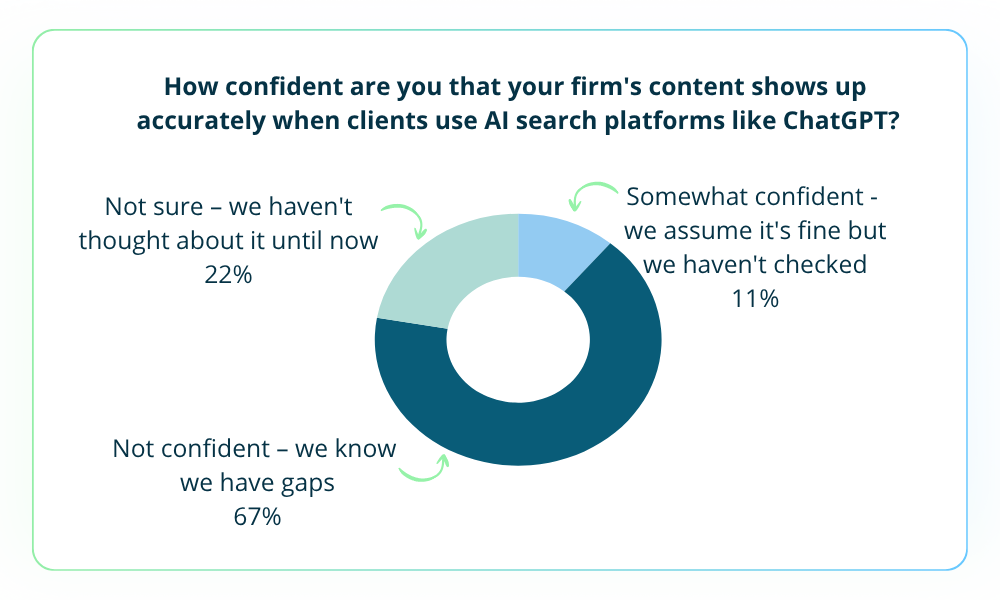
Not sure – we haven't thought about it until now – 22%
Feature description
In this 45-minute session, we explore how AI is transforming the way clients find and evaluate professional services firms – and what digital teams need to do about it.
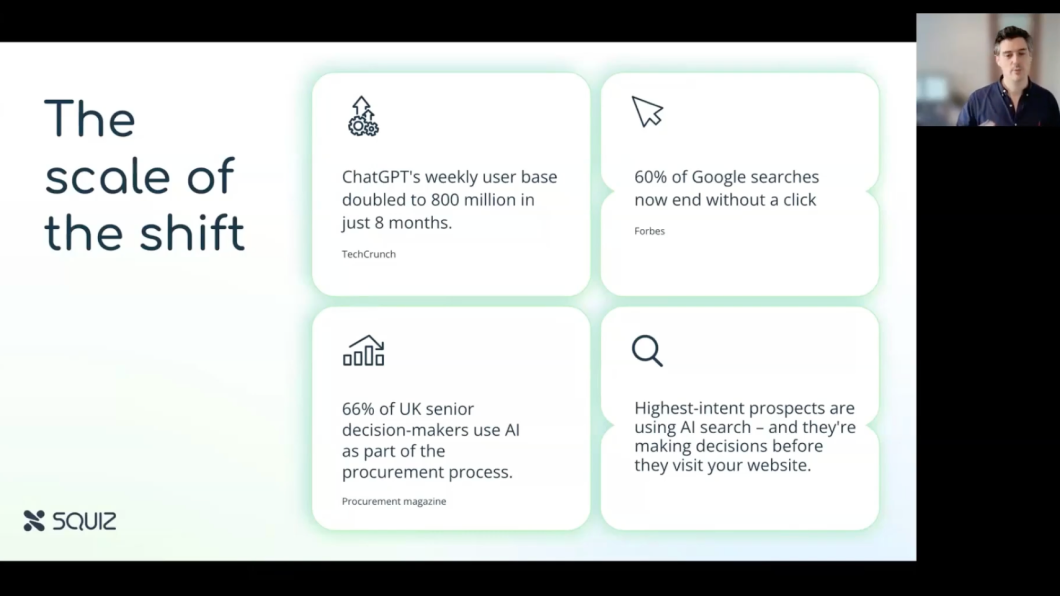
Video: Making Your Content Discoverable. Captions and transcript available on playback.
Learn how AI is reshaping digital discovery and why structured, accessible content matters. This session explores practical steps to improve visibility, drive conversions, and stay competitive in an AI-driven landscape.
All right, welcome everybody to today’s session. We’re going to be talking about navigating the AI reckoning and some practical next steps for professional services organisations. You’ll notice that many of the examples we use are set within that professional services environment, but if you’re joining from another industry, the insights we share will be just as relevant.
My name is Kat, and I’m a Principal Strategy Consultant here at Squiz. I’m joined today by Rory Grant, our Chief Growth Officer. Before we get started, just a bit of housekeeping. We are recording today’s session, and we’ll share that via email afterwards so you can rewatch or pass it on.
We’ll also have time for questions at the end. If you have any, please add them to the Q&A section (not the chat), and we’ll keep an eye on them throughout. If we don’t get to all questions live, we’ll follow up with answers afterwards. If you run into any technical issues, just drop a note in the chat and we’ll help you out.
For those who may not be familiar with Squiz, we are an AI-powered Digital Experience Platform (DXP) designed to make marketers’ day-to-day work easier, while still providing the technical depth developers need to create exceptional digital experiences. We work with organisations across professional services, higher education, and government globally. While today isn’t specifically about our platform, the insights we’ll share come directly from that experience.
Today, we’re going to take you from understanding the problem—the shift AI is creating in the digital space—through to practical solutions you can apply to succeed in this new environment. I’ll now hand over to Rory to set the scene.
There are many important trends shaping the digital environment right now, but one underpins everything: content. Content, paired with accessibility, is critical in 2026. AI is changing how users discover organisations, and we’re seeing decreases in website traffic alongside increases in conversion rates.
Many of you may be hearing from stakeholders asking where leads are coming from, with answers like, “We found you through AI.” People are now searching tools like ChatGPT or Google AI overviews in the same way they once searched Google.
This means your content must be structured so AI can read and surface it. Accessibility is equally important—not just for compliance, but because AI relies on accessible structures to crawl and interpret your content. If your site isn’t accessible, AI can’t effectively reach or understand it.
We’re also seeing massive growth in AI usage. For example, ChatGPT reached hundreds of millions of users rapidly, and around 60% of Google searches now end without a click. Users get answers directly from AI summaries without visiting websites.
The key takeaway is this: AI is reading your content, even if users never visit your site. Your content must work for both humans and machines.
At the same time, client expectations are shifting. AI is embedded into workflows, changing how research and procurement happen. Organisations that don’t adapt are already falling behind.
To make this more concrete, let’s look at a real-world scenario. Imagine two similar firms—Firm A and Firm B. Both specialise in competition law, have modern websites, and operate in similar markets.
Now consider Jane, a general counsel looking for legal advice on a merger. Instead of using Google or her network, she asks an AI tool like ChatGPT for recommendations.
The AI returns a shortlist—Firm B appears at the top, while Firm A is missing entirely. Firm A isn’t just ranked lower; it’s invisible. Jane builds her shortlist from this result, and Firm A never even knows they were excluded.
This highlights a major challenge: AI-driven discovery lacks the visibility traditional analytics provided. Organisations may not realise they’re missing out on high-value opportunities.
Importantly, traffic from AI tools tends to be highly qualified—studies suggest users arriving via AI are significantly more likely to convert. Missing this visibility means missing high-intent prospects.
To understand why this happens, it helps to look at how large language models (LLMs) work. Think of an LLM as having two parts: a “professor” and a “research assistant.”
The professor is the model itself, trained on vast amounts of data. It breaks content into small pieces (tokens), maps relationships between topics, and builds a knowledge structure. However, this knowledge is frozen at a point in time.
The research assistant handles real-time queries. When a user asks a question, it searches sources like Google or Bing, retrieves relevant information, and feeds it back to the model.
AI doesn’t truly “understand”—it predicts. It generates responses by assembling tokens based on probability and context. It also performs “query fan-out,” generating many related questions behind the scenes to validate its answer.
This process requires clear, structured, and comprehensive content. If your content is unclear, fragmented, or difficult to interpret, AI may ignore it altogether.
There are several common issues that reduce AI visibility. First, jargon and acronyms can create confusion. While humans may understand them, AI struggles—especially when acronyms have multiple meanings.
Second, PDFs can be problematic, particularly when text is embedded in images. AI can read text-based PDFs, but HTML content is far more accessible.
Third, fragmented content makes it harder for AI to connect information. If key details are spread across multiple pages, AI may not piece them together effectively.
Clear, structured content is essential. Think of it like directions—simple, direct instructions are far more effective than complex, ambiguous ones.
When writing for AI, specificity and clarity matter. Compare a vague statement like “market-leading team” with a detailed one that specifies sectors, services, and outcomes.
AI needs explicit information to assess expertise, relevance, and trustworthiness. It asks many “why” and “how” questions behind the scenes, so your content must answer them clearly.
One of the most practical ways to improve AI visibility is by focusing on accessibility. AI doesn’t “see” your website like a human—it reads the underlying code. Elements like heading structures, alt text, semantic markup, and descriptive links help AI understand your content.
Interestingly, these are the same elements that improve accessibility for users with assistive technologies. Improving accessibility therefore benefits both human users and AI discoverability.
For example, descriptive links (“Read more about our antitrust experience”) are far more useful than generic ones (“Click here”). Improving accessibility is one of the fastest ways to improve AI visibility.
A helpful framework to guide content improvements is E-E-A-T: Expertise, Experience, Authority, and Trust.
This can be broken down into five practical areas: consistency, avoiding conflicting information; specificity, clearly defining what you do and where; completeness, ensuring all relevant information is present; consolidation, keeping related content in one place; and freshness, keeping content up to date.
Professional services firms often fall short by relying on high-level claims without supporting detail, using anonymous examples, or omitting timestamps and context.
To get started, it’s important not to try to fix everything at once. Instead, choose a small number of priority areas—ideally those tied to revenue or competitive advantage.
From there, create a repeatable process: identify key questions your audience is asking, audit and improve your content, ensure it is structured and accessible, and continuously monitor and refine it over time.
Dig deeper into practical frameworks, implementation checklists, and insights from digital leaders navigating the AI reckoning.
Feature description
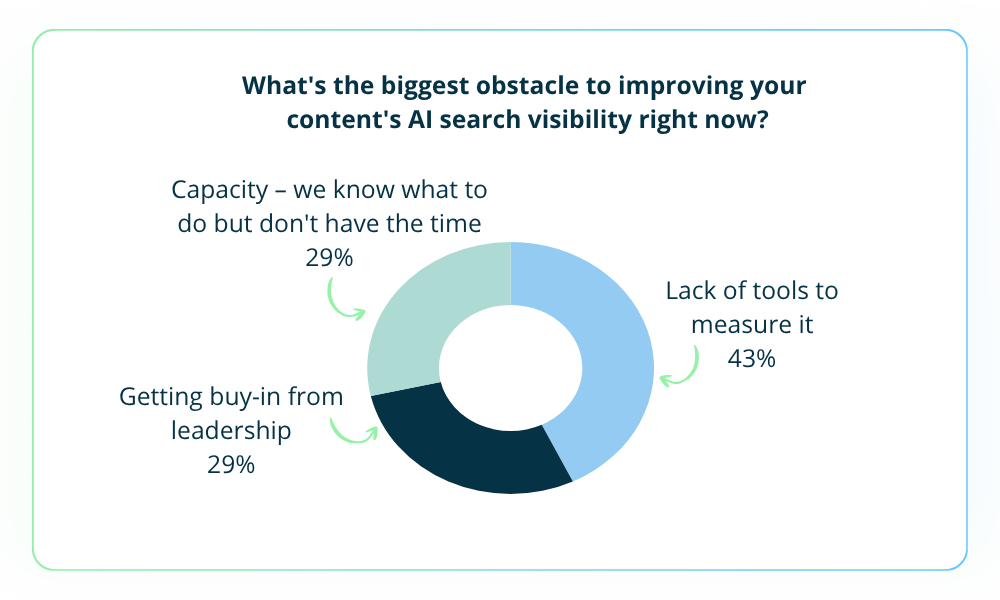
Not knowing where to start – 0%
Lack of tools to measure it – 43%
Getting buy-in from leadership – 29%
Capacity – we know what to do but don't have the time – 29%
Content is spread across too many teams to fix quickly – 0%
A good starting point is to run your own tests – search for your firm on tools like ChatGPT or Gemini the way a prospective client might, and see what comes back.
But that only tells you part of the story. Many AI search platforms don’t rely on a single query – they often expand and reinterpret questions behind the scenes, retrieving information from multiple angles to build a response. That means your visibility isn’t just about ranking for one term, but about how well your content covers the broader set of questions and signals the AI is drawing on.
Replicating that manually isn’t realistic, which is where an auditing tool can help. It can systematically assess your content across those dimensions and highlight gaps, so you know where to focus.
It’s related, but not the same. SEO is primarily concerned with visibility in search engine results – optimising for the signals that traditional search engines like Google use to decide what to show. AI search visibility is about whether your content can be understood, trusted, and used by AI search platforms when they generate a response.
Many of the principles that underpin good SEO – clear, well-structured content, logical page hierarchy, and relevance to what people are searching for – are the same foundations that AI search visibility builds on. The difference is one of emphasis: rather than focusing on rankings alone, the focus shifts to how clearly your content answers questions and how easily those answers can be extracted and used in an AI-generated answer.
The practical implication is that if your SEO fundamentals are in good shape, you are already closer to AI-ready than you might think. The additional work is about ensuring your content is complete, consistent, and explicitly answers the questions your audience is asking.
Start with a focused area rather than trying to tackle everything at once. Look at where the business stakes are highest – which practice areas drive the most revenue, or where you have the strongest competitive position. Improving your AI search visibility in three to five priority areas will deliver more impact than spreading effort across the whole site.
From there, follow a repeatable process: understand what questions your audience is asking about that topic, assess whether your content answers them, fix any gaps, and then move to the next area – adjusting priorities as you learn. With the right auditing tool to surface issues and help prioritise fixes, this can become a regular workflow rather than a one-off project.
Less than you might expect – and it doesn't have to happen all at once.
Rather than treating this as a large upfront project, the goal is to build content improvement into your regular workflow by starting with a focused section of your site, making progress there, then moving to the next. It's manageable, incremental work rather than a major resource commitment.
Having the right auditing tool makes a significant difference – it does the heavy lifting of identifying issues and prioritising what to fix first, so your team's time is spent on the work that actually moves the needle rather than manually assessing hundreds of pages.
For traditional search engines, SEO improvements can take a couple of weeks to filter through. AI is less predictable.
AI search platforms don’t publish schedules for when they update their models or incorporate new content. That means changes you make won’t necessarily appear in AI-generated answers immediately, and there’s no reliable way to know exactly when they will.
The most practical approach is to focus on consistent, ongoing improvement rather than waiting to see results from a single change. Well-structured, accurate content that directly answers questions is the strongest signal you can provide, and the more of it you have in place when your content is next incorporated into an AI search platform’s retrieval or training pipeline, the more likely it is to be reflected accurately.