





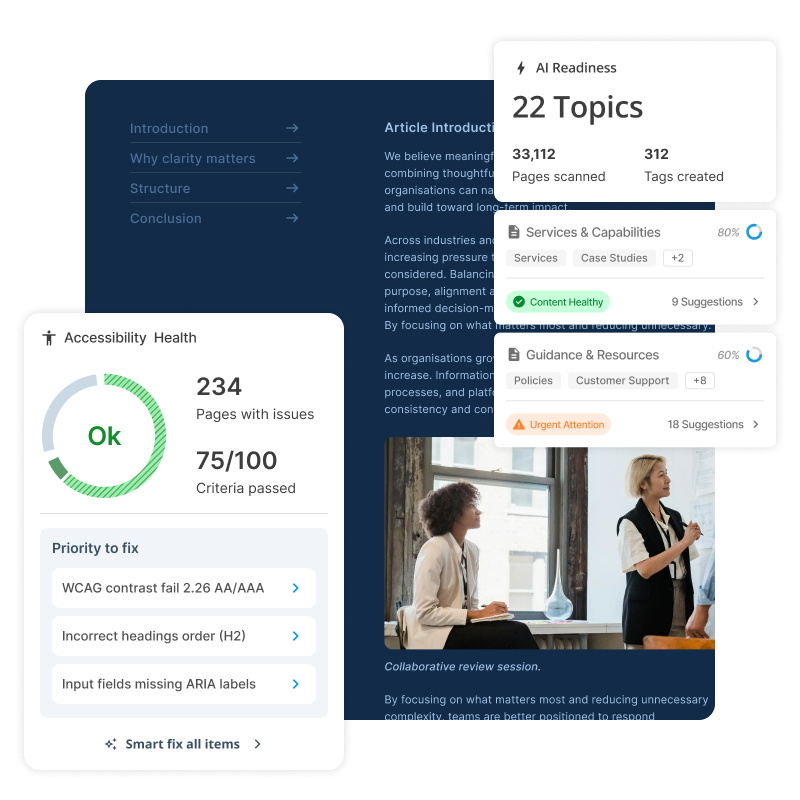
The real value of AI for digital teams
Looking beyond GEO to how modern digital experiences are created, managed and improved.
This session looks at where AI adds genuine value for digital teams, what has to be true before it does, and how to take a first step that is manageable.
Website ready for what comes next? Take our two-minute assessment to find out →
Watch the Australia & New Zealand webinar
Transcript: Watch the webinar (ANZ)
Welcome and introductions
Lorna Hegarty [00:02]
Hello, everybody. Welcome. Welcome. We're just going to give it maybe one more minute and see if we can wait until a few more people have joined, and then we will jump in. So I'll just throw it to Megan and Kat to do some interpretive dance while we wait, Megan.
Lorna Hegarty [00:38]
All right, I think we will jump on in. So thank you everyone for joining today's webinar. The Real Value of AI for Digital Teams. So during today's session, we're going to be discussing the fact that for a lot of digital teams, AI has really arrived as pressure to just show up well in AI answer engines. So we'll explore how, although that really does matter, and we have talked a lot about that at Squiz, and if you've missed any previous webinars, go back and check the on-demand ones, because we've talked about the value of it and how you can really help to influence it.
But we also want to talk about how you can only really control the systems that… You need to be able to control the systems that represent you that you have control of. So you can only really influence those AI answer engines. Right? But you have your own systems that you can also control. So the bigger opportunity is to look at how AI can actually help you to create, manage and improve your own digital estate. And to do that, you need to get the digital foundations right first.
So I am joined by the wonderful Megan Andrews and Kat Barrow again today from Squiz. So thank you both for being here.
Kat / Megan [01:45]
Good to be here. Yeah. Thank you.
Lorna Hegarty [01:47]
Very disappointed with the lack of dancing, but…
I'm sure you'll make up for it in your next… We'll save that for later.
Lorna Hegarty [01:54]
But, yeah, I'm really looking forward to picking your brains today to find out where AI really does add genuine value. But what has to be present before it does and how you really take that first step and how you make that manageable for your teams. We'll be adding a few frameworks and checklists to the screen as we go, so everyone attending will be able to take something practical away and back to their teams following the session. As always, we'll have time for Q&A at the end, but we also really would like this to be an interactive session.
So if you have questions as we go, please just pop them in the Q&A panel, if we can, we'll all be keeping an eye on that. So if we can pick those out as we go and there's a good moment to jump into them, we will. So just add them as they come to you. So with all of that said, Megan and Kat, as I mentioned, most of the AI pressure is coming from this desire to show up in AI search engines.
So we talk about that as GEO or AEO, and that's a fair thing to worry about. Right? But what's your take on the fact that GEO, let's call it, is really only one part of that picture?
GEO and the intelligence era
Kat Barrow [02:57]
Yeah. Absolutely. I think it's really interesting because as you said, Lorna, we've spent a lot of time talking about this as well. It’s very [unclear in captions] focused on optimising your content to drive performance in external LLMs. And I think it's really just the first sign that we are moving into a new era in digital experiences. It's the first kind of tangible change that we've started to see happen, but it's not the whole story. And we really talk about it in terms of a new era deliberately because era is a big change.
It's a step change. This is not an incremental change that we're seeing in digital experiences. AI is really driving a fundamental shift in the way that we find information online and engage with information online. And we've christened that the intelligence era. And I think, the context there is that for the last sort of three decades or so, possibly four decades, actually, I'm just thinking about how old I am, it's probably more like four decades, we've been creating experiences that are very fixed and very controlled.
So if you think all the way back to sort of command line interfaces in the eighties through the different evolutions of digital experiences over the years, the thing that they have in common, although we've gotten closer to the user and we've started to kind of explore concepts of personalisation and things like that, the thing that they have in common is that they're fixed experiences. We sit there and plan and analyse and decide where we're going to put that button and how that form is going to flow.
We create these fixed destinations that people have to come to and then figure out how to use. With the intelligence era, we're moving much more into a world where your digital experience is building around you personally in that moment, in that context. And so, yes, GEO is very important. Yes, optimising your content for AI is important. But it's only one part of the puzzle. In order to be able to really thrive in the intelligence era, you've got to have the underlying systems and ways of working in place to be able to generate these kinds of experiences.
Megan Andrews [05:03]
Yeah. It's such an interesting thing to think about this as a shift in a full era because I think it's easy to get stuck incremental change. I think for these teams, for technical and marketing teams now, confronting this and actually admitting this and embracing this is a really big opportunity because you're going to have to do things differently than you did before. And I think that allows your teams once you have that understanding to kind of have a handshake on like, all right, well, let's experiment now and let's learn this together.
I think that's going to be one of the defining qualities of this time as well for successful teams is not just what's available to us, but how can we do it in a way where we can test and learn and be really dynamic on our own decisions? Because we are all learning what users are going to be doing next. Right?
Kat Barrow [05:57]
A 100%. And this is a conversation I have very often, actually, where, I'll be talking to clients and they'll say, what is happening in the future? Where are we going? Am I going to need a website? Am I not going to need a website? And the answer is no one has those answers. Right? But we do know that things are changing, and they're changing rapidly. And so that culture of kind of build, measure, test, learn, experiment, be agile is going to be so critical.
And in terms of whether you need a website or not, I think we've talked about this a lot in our previous sessions, but we really are at a point now where your website is serving two purposes, and it's serving two audiences. And I think that's only going to continue to evolve.
Megan Andrews [06:38]
It's one of those things too you really think about even in your personal life, but, translate this over to the web and your strategy. Control what you can control. Right? And to that point, Kat, if your website is what you've got control over, then invest in that. What can you do in that way? Look at your content, your digital experiences, all the different, services that you're connecting in, and understand what your strategy is around those, and then influence what you can off of your own website.
Right?
Poll 1: What is driving AI adoption?
Lorna Hegarty [07:09]
Yeah. Yep. So, yeah, summarising, you can influence how those answer engines show you up, but you can then really build and improve on those pieces that you control. Okay. So, before we jump into more of the meat of the session, I'm going to throw to our attendees. We're going to do a quick poll. And what we want to find out is really what the motivators or catalysts are for driving adoption at your organisation right now. So you should see a number of options on the screen there.
We've got pressure to show up in AI answer engines, as we've discussed, improving on-site search and answers, reducing manual content and build work, and a mandate to do something with AI. Now that mandate piece, I often think it sounds… it's almost, I guess, laughable, but this is a real thing. Right?
Kat Barrow [08:00]
Oh. Yeah. Yep. Absolutely. Like, I see this really often with customers. And, as we were talking about earlier, what that ends up causing is a lot of kind of fractured AI implementations. We've got a lot of little kind of pilots and things happening all over the place, but not necessarily, a very clear strategy on how that's going to grow and scale over time. I don't know if you're seeing similar things, Megan.
Megan Andrews [08:23]
Absolutely. Lots of teams coming up with their own solutions, and it's really difficult when you think about the long term impact of how they're all connected together. So even when you're thinking about tools right now, have that in mind. Can this connect across different areas of our site, not just our own unit? Things matter in the decision making phase.
Lorna Hegarty [08:44]
I think we've probably got most of our answers in there. Someone said the poll needs all of the above as an answer.
Lorna Hegarty [08:58]
But that's exactly the point. Right? Like, whichever one of these you selected, these are all things that we're hearing. And they all kind of lead back to the same question of, well, where do you actually kind of get started? What are the foundations you need in place? I guess from your guys' perspective, what are the foundations that any AI initiative really depends on?
Three foundations for reliable AI experiences
Kat Barrow [09:18]
Yeah, absolutely. Look, when we're thinking about the intelligence era, one of the things I often talk about is this kind of shift from designing websites as a destination to thinking about them more as a system, and a system that is going to be able to generate experiences dynamically on the fly in response to intent from someone. And for that to be able to happen successfully, there's really, I like to think of sort of three foundations that underpin that. The first is content, and as we've talked about, that's something we've covered a lot.
But your content does need to be trustworthy. It needs to be authoritative. It needs to be optimised because it is really the single source of truth that is driving the experience and driving the system that is creating those experiences. But as we said, it's only one part of the puzzle. The other part of it is really that you need to be able to present experiences on your website that respond to intent. So when someone lands on your site and puts in a question, you need to have a way to be able to generate those dynamic experiences that are personalised, that are contextual, and that are pulling together the power and speed and low cognitive load of AI-driven, conversational search, and combining that with the ability to direct people's attention to where you want them to go or where they should be going to complete their tasks.
So the ability to direct them towards a form or a call to action or a particular piece of information that is going to further their goals. So having a system that allows you to generate and present those experiences is a really critical foundation both to being able to present these kinds of experiences on your own website, but ultimately in the future to be able to do that inside third-party environments as well. And then I think the third really important part, and this kind of ties back to the whole conversation we were just having around the AI mandate, right, is you need to have a governed, integrated foundation.
And what by that is you can imagine that if you start to try to create a system that is going to generate experiences for you, and you're pulling together tons of different tools and content sources and integrations and plugins and all sorts of things, you're very quickly creating something that is very fragile, is not particularly scalable, and is very difficult to maintain long term. So you need something that is going to allow you to be able to pull together your content, your services, your forms, your data, your integrations into something that drives that kind of dynamic experience that people are looking for.
And I think the most important word potentially in that governed foundation piece is actually governed. Because the reality is that when you're moving from a situation where we're building fixed experiences to one where you have a system that's generating experiences for you, The only way that you can do that confidently is if that there are best practices and guardrails and governance in place and that the system is enforcing them on your behalf. That's what allows you to trust that system. That's what allows you to step from being fully in control to just being the human in the loop and allowing the system to generate those experiences for you.
Megan Andrews [12:30]
And, Kat, I think it's interesting because on that note, I've talked to a lot of clients recently who are curious about building their own solutions.
Kat Barrow [12:40]
Yes.
Megan Andrews [12:40]
tech savvy people who now have the power of AI augmented coding at their fingertips.
Megan Andrews [12:48]
So it's tempting to vibe-code a solution and put something in place that could patch together different things on your site. And I think that's an interesting playground for a lot of people right now. But to your point, down the line and certainly as you're scaling different experiences, you very quickly will see that vibe coding is great. And then as soon as it's live, there might be some holes in the framework there. You need to trust it.
Kat Barrow [13:19]
Yeah. No. You're totally… And, we've just seen, obviously, the whole, schmozzle with PHP this week, from a security perspective as well. So, yeah, you're right. you can absolutely vibe code something. But from a scalability perspective and also from a security perspective, there's so much more nuance that goes into creating a system that is going to serve you well and is something that you can trust. And I think it's really… at the end of the day, these foundations are coming together to create a digital experience that is leaning into the expectations that people have these days and is providing them access to the answers and the actions that they need.
And I think, one of the things to really keep in mind as well is that there is a cost associated to not leaning into those expectations. as we start to see more and more people adopting AI-driven experiences, as we start to see more of the sort of, like, hyper personalisation, if you're not leaning into those experiences, your end users are still stuck in that environment where they're clicking around, they're trying to find things, they're bouncing, potentially off your website and into your call centre or into your email support or into your live chat support.
And so there's a very real business cost associated with not having these foundations in place as well.
Assessing readiness and turning answers into action
Lorna Hegarty [14:40]
Yeah. So if we are recommending people avoid the temptation of vibe coding and they're thinking, yeah, these foundations all make sense, but how do I sense check where I'm at? What would you say? What are some of the things they should be looking at?
Megan Andrews [14:56]
First and foremost, make sure your content's in order. I think if your content is clear and accurate, you've got to dust off all the corners. We've been saying this for a while now that we could get away more or less with some of those dust covered corners before with SEO and we just chuck some keywords in place on different pages and hope for good rankings. But right now we don't have insight into how the rankings and appearances are happening in all these large language platforms.
What we can control is how our content is. Is it in good shape? It's time for those audits. It's time to put tooling in place, right? That'll help you right size and optimize that content to get seen off of your site.
Kat Barrow [15:43]
Yeah. Absolutely. And I think, as we were talking about as well, the other foundation that I think is really critical here is being able to turn your website into something that, yes, gives people answers, but also drives action. At the end of the day, whether you are selling something online or you're providing a service online, you're a government organisation, you're higher education, whatever the case may be, AI is presenting us with a very unique opportunity to turn our content into something that is actionable.
So once you've got all the dusty corners swept out so to speak, and you're giving people the right answers and the things that they want to know, how do you then drive people towards the next best action? And I think that's something that's really critical when you're assessing your readiness is do you have a mechanism on your website right now that's going to allow you to turn the power of that AI conversational answer that you've just generated into something that is going to drive action?
Megan Andrews [16:43]
It's actually a really good point. We talk about this a lot right now that it goes way beyond just fixing and optimising. It is thinking in a new framework of really what are the outcomes we are hoping to achieve, not what is the fixed journey that we're driving people towards. Actually, our Chief Product Officer, Julie Brettle, was in San Francisco last week, which is where I'm based. And so we got together and I was driving into San Francisco and when you go over the bridge, there's all these billboards.
You won't be surprised they're all covered with AI companies and technologies. It's an interesting cultural experience, but think about it this way. I was going to meet her at a specific place in a neighborhood. There's one way to get there. I know I need to get there to meet her. But if I were able to talk into my phone in real time and say, Only take me on side streets. I know these two streets are always busiest right now. I'm a local.
And take me along the waterfront. So all those different ways that I could hyper personalize, I'm still getting to a destination, but it's right sized for me. I thought about that. Yeah. So I was driving there and, like, this is what websites now need to become.
Kat Barrow [17:48]
Absolutely. Just that, like, hyper level of personalisation. And I think it has some really interesting implications for how we work moving forward as well. Like, my background is user experience design. I very much see there as sort of being an emerging space around conversational experience design. How do you design for an experience that is that fluid, that is that hyper personalised? How do you, create experiences that work for everyone but also work for a very specific person in a very specific context with all of those factors considered?
I think it's a very fascinating space.
Megan Andrews [18:24]
And I do think that's where you get to this maybe the bottom layer here of just the governed foundation. Right? So it's really great to be able to add these tools and create these different new experiences. You have to trust that you can do that in a way, again, that's using the content is there. Maybe the components you've already got within your CMS, these bricks that you can pull into an experience, but you've laid the bricks. Yes. Right? And then they're going to help build themselves what their experience will be.
Kat Barrow [18:52]
Absolutely.
Audience question: Does messy content need fixing first?
Lorna Hegarty [18:53]
I think as you were talking about content, Megan, we got a question submitted about content. The question being, this is all this is all well and good, but our content's a bit of a mess. Do we need to focus on that first? Interesting… Interestingly, you were saying, yes, you do need to focus on that first. I guess, is there a kind of short one line reassurance that you can give people to say, even if your content's a bit of a mess, you can still do this?
Megan Andrews [19:17]
Oh, absolutely. You just said it, Lorna. Think the take the leap, take the step and see how it looks. You might be surprised. You might think your content's a mess, but have you seen how a large language model actually interprets it? That's where these tools can come in handy. Put it to the test and, take off the shield and see what you're working with first. And, you've worked with a lot of customers. What are what are customers thinking about with this?
Kat Barrow [19:43]
Yeah, absolutely. As you said, it's… Some of it is just ripping off the Band Aid. I think what we're learning as the space evolves, and it is evolving very quickly, is that, yes, content optimisation is very important. But not all content is as important. Right? So you might have, 57,000 pages like one of my customers that I'm working with at the moment. Right? Of those 57,000 pages, once we actually switched on conversational search and started using it, the ones that are critical, the ones that are driving most of the [unclear in captions] are the ones that we can then focus on and optimise.
And you don't actually need to get stuck in the weeds of optimising every single one of those 57,000 pages. And so, we've been really working through it in terms of slices of content, high value priority use cases, but also just switching it on, as you said. Just switching it on and having a play around and seeing where is the AI getting most of its information from. And is that content, your really critical content that is, an attractive source of information for AI, is that optimised?
Is that accurate? Is that where it needs to be? Rather than starting from the, ground level and working through every last blog post on your website.
Lorna Hegarty [20:57]
Phew. Yeah. That's really helpful…
Kat Barrow [20:59]
Don't recommend that approach.
Readiness assessment and the changing role of digital teams
Lorna Hegarty [21:03]
So they were really helpful criteria. And, actually, there are a few of the criteria that are covered in an online assessment tool that we've developed. So we're going to drop the link to the tool in the in the chat. But, essentially, you can go on there, answer the questions, and find out kind of where your website's sitting in terms of being ready to address the expectations of this new era that's coming in now. So we will pop that assessment in there.
Go and have a play and see where you're sitting and then have a chat to us about what that actually means for you. So we have covered what needs to be in place. I want to spend a few minutes now on what this does to the day job of the digital teams that we're talking to today, because I guess that's the thing that people are going to be most worried about. AI is coming in, I need to be able to adopt it.
What does that actually look like for me and my team if I'm trying to develop this new looking and feeling digital experience for our users?
Kat Barrow [21:58]
Yeah. Yeah. It's interesting. I've been I've been talking about this a lot, as you can imagine. And we are moving into a new era. It is a pretty significant shift. And I think what's interesting is that it changes everything and nothing, basically, at the same time. And what by that is, as we were talking about for the last three or four decades, we've been optimising for building pages. Right? We've had entire teams of people who are crafting the content down to the last word, who are working out the exact colour of the button and where it's going and the flow of the page and, optimising all of those sorts of things.
Again, said, my background is in user experience, so I was that person doing the A/B testing and the user testing and trying to preempt how we could make a site that was going to work for most people and work effectively. Whereas now, as I said, we're moving into the space where we're creating a system instead. And so I think what's shifting is a few things. One is that the focus is now going from building and optimising pages to building and optimising the system itself and the building blocks within that system.
So making sure that your content is up to date, making sure that your design system is really healthy and scalable, and you've got all those UI components that are going to be the foundations of that experience, making sure that you've got that governed foundation and it's all integrated and all of those things. That's kind of in terms of the hands on work. I think that's where that's going to shift to. But I also think a lot of the shift is going to be moving into more of the governance side of things and more of the strategy side of things.
It's effectively like, congratulations. We've all been promoted to leaders, and now we're leading a team of AI. And so the shift moves from the doing to the directing. And so when I say nothing changes, it's because the core foundation of what we've always been doing as people building digital experiences is optimising and learning and experimenting and A/B testing and using data to help us understand what is driving the most effective experiences that are helping our end users achieve their goals and our organisation achieve its goals.
That core hasn't changed. I think what does change is the way that we are achieving it. And so we're moving into the space where we are defining strategy. We're setting guardrails. We're setting goals and measurements and tracking our data and all of that sort of thing as opposed to spending a lot of time on where exactly on the page should this button go.
Conversational search and first-party insight
Lorna Hegarty [24:26]
And there's kind of an upside, right, from all of this that people might not expect when they go into utilising AI in the sort of way that we're talking about here today, once they are allowing people to ask for what they need in their own words, they can actually sort of work out what to improve next. So I guess from your experience, what do people start to see once they do start to understand what people are actually looking for in their own words rather than just sort of the keyword searches that they would have been doing previously?
Megan Andrews [24:56]
Well, I think it's interesting to consider that right now there's only a few companies in the world that could answer that because they're capturing all this natural language and that is the essence of their platform. You haven't seen yet as many sites of organisations and companies rolling out that same technology, but it's happening fast. So that's the key is if you can shift your experience and invite conversation on your site, you are going to get just wealth of knowledge around how users are actually asking questions, right?
Right now we can look at page views and we can look at clicks and we can get signals around maybe what people are trying to do, but we don't actually know. But if somebody's in a conversational format and they're saying, I'm enrolling in this programme, I need assistance with financial aid. And then immediately afterwards, they're asking about a specific grant or scholarship opportunity. It's all captured in one place for you. You don't have to piece things together, right? And I think, Kat, that for all the user intent studies and things that you've done, how do you see language and natural language layering into that?
Kat Barrow [26:15]
Yeah. It's really interesting. I was I was talking to somebody about this the other day. This idea that, generations, probably our generation, have been trained to search with keyword strings. So we don't put a lot of conversational intent behind those keyword strings. It's kind of what we've learned over the years works, throw in some qualifier keywords and things in there. Whereas these days, especially younger generations, there's a lot of really interesting research on how they are being conversational, and they are being detailed and very explicit in their direction.
So they're going, not just like Italian restaurant near me, Brisbane. They're going, I'm looking for, a cozy Italian restaurant for a first date. I want this kind of vibe. I'm allergic to peanuts, whatever. And so the amount of really, really detailed information and intent that we're getting is going to drive a level of insight into our users and our customers that we have just never had before. And I think the other thing that's really important, and I think you mentioned this already, Megan, but I'm just going to reinforce it, is that at the moment we don't get any of that data from the LLM environment.
Right? So people can be asking that exact very explicit question about your Italian restaurant, and you could be optimising for peanut allergies, but you don't know that they're asking that on ChatGPT or Claude. And this goes all the way back to Lorna's point at the beginning is we can only control what we can control. Right? Implementing conversational search on your own website gives you direct access to that first-party data. You can see exactly what people are asking. And, yes, it may only be a portion of all the questions that are being asked about you across all the different platforms, but it's still incredibly, incredibly valuable data.
Megan Andrews [28:05]
I think something else. I was working with a customer here in New York, and something we discovered in doing all this was actually that one of their keyword… Their top keyword search term was careers. And they thought, well, what careers? Are careers outcomes, programmes for careers, careers at our [sentence incomplete in captions]. So this was a great opportunity to embed a conversational search option on a career page and start to understand, okay, not just careers and we'll see where it takes us, but what are they actually going to ask about?
Yeah. And that's, it's not just an interesting, oh, how cool is this sort of exercise? This is foundational to driving enrolment, driving revenue for your institution or your organisation. Those outcomes have a very vast impact beyond just being cool marketing things that we get to do, right?
Lorna Hegarty [29:06]
I felt very… Well, I do like a cool marketing thing every now and then.
Who doesn't like a cool marketing thing? Yeah.
Taking a practical first step
Lorna Hegarty [29:15]
Was going to play like Cat. I felt very seen by your keyword string Italian restaurant insert location. As a millennial, that is definitely the approach I would still probably take. The thing that we often get asked about or that we want to make sure that people take away from a session like this is what is the practical first step? So it's not like people are short on ideas. They look at everything that they could be doing to improve and try and work out where to start, but it can actually be super overwhelming when you kind of look at all the options.
So if a team is looking at everything that could be done and doesn't know where to start, what should they pick and what should they actually avoid as well?
Kat Barrow [29:56]
Yeah. Look, I think Megan was speaking to it earlier, really, is, the best way to get started, the best sort of practical way to get started is to start. And I know that sounds really silly, but, we can get lost in a lot of analysis paralysis when it comes to our content particularly, especially if it is something that's been sitting in a corner for a long time and you haven't touched it. This kind of need to optimize everything first can get in the way of a lot of progress.
So what we have really been doing very effectively with a lot of our customers at the moment is going, let's pick one really high value use case, and let's frame it as a hypothesis. Because, again, if we go back to that, a mandate to do things with AI, like, is a lot of interest for a lot of organisations in doing something. And the key is being able to show the value in doing it and the trade off between, the effort that it took to implement the AI tool and the value that you're getting.
And so, yeah, what we've been doing is let's create a hypothesis. Let's really embrace this kind of build, measure, learn mentality that we're going to need to be able to succeed in a very swiftly changing world. And let's go. This is the use case. So, for example, we're trying to drive more career submissions at that university that you're talking to, Megan. So, this is our value hypothesis. We believe that if we implement conversational search on the careers page, we're going to be able to drive people more effectively through to the right career for them resulting in higher career submissions, for example.
And it can be as simple as that. You don't need to start big. You don't need to start overly ambitious. But what you do need to do is pick something that's high value to the organisation and to users. Ideally, I… Number two, we were talking about this the other day, Megan. I… And I agree wholeheartedly, like, it's painful today. It's something that is difficult at the moment or it's costly at the moment. It's… You're ending up with a lot of calls in your call centre about it.
Pick something that is causing the organisation pain. And those two things really give you a good premise to start because you're going, hey. I can solve a problem here, and I can measure the value of solving that problem.
Megan Andrews [32:02]
Yeah. And these last two points are where it really helps to cooperate across to look for opportunities to cooperate across your organisation as well. So you may work in an environment that's fairly decentralized, right? Where sometimes you have a central marketing or communications department and then lots of different content folks spread across different areas. But the thing holding you all together is this content piece. So that source material, hopefully at least who owns it, right? And you can start with, maybe it is if you're a university, a high value place like admissions, and there's an opportunity to work cross functionally with your admissions team and work with them, help them improve their content.
Everyone's looking for these answers. Now that you own it, I think that's the opportunity for everyone to learn together what this new era brings. So tools that can help you do that across the organisation. And then this measurable piece, you'd be surprised how many conversations I'm having right now. Even just this morning, had one with someone who hasn't implemented any tools yet, and they're working with a design firm. They have a whole new homepage design laid out. And actually, they're thinking about removing the little top right corner magnifying glass for search and driving everything through conversation on their page.
And so we were talking about some trade offs and benefits there. But I said, just as a start, how many page visits do you have and how many users are going to search? And she wasn't sure. And it's like, well, let's take a baseline measurement. Let's understand what that is now. And then we'll implement some changes and see what the impact is. So I think making sure even simple things are measurable so you just understand If something has worked.
Kat Barrow [33:55]
Yeah. And I think keeping the measurable sort of goals simple as well. I think, we can get really lost in the weeds of trying to measure everything, particularly if you are a large organisation. Obviously, we work with higher education a lot. And there's a lot of touch points on a journey all the way from, landing on the website to actually being accepted into a degree. Sometimes, again, if we think about the sort of analysis paralysis, we can get stuck in trying to measure every touch point.
And did my conversational search actually result in more people, being accepted for law degrees? Sometimes that's not necessarily… You don't have to go all the way down that journey. You can just go, the primary goal of this particular implementation is to drive more submissions on this one form, for example, And keep it really, really simple because it makes it easier to tell a compelling story. When you start getting into, traffic attribution and all of this kind of stuff, it can get really difficult and muddy, the purpose of what you're trying to do.
So I think, yeah, measurable and just simple.
Measuring value in terms the organisation understands
Lorna Hegarty [34:57]
Yep. Good point. To that point, I think measurable is probably the key thing that people will be like, I just… I need to be able to show to people who aren't in the sort of inner mechanics of the AI solution because they're not the ones implementing it. So say, your finance lead or your exec sponsor, someone that needs to know what it is that you're going to be showing them to demonstrate that it works. How would you boil that down? So you've mentioned a couple of bits there, Kat, but how would you boil it down to sort of three or four things that people should be measuring it on?
Kat Barrow [35:30]
Yeah. What I always suggest our customers focus on is things that the business already understands. And that comes, a little bit from my user experience days because I became a UX designer back in the day when no one even knew… I didn't even know what UX was, to be honest, when I first became a UX designer. And so a lot of the battle back in the day with user experience was translating the value of UX into business value that businesses could understand.
And to be honest, the same still often applies. Right? The easiest way for us to tell a compelling story is to measure things that are going to resonate with the broader organisation. So if your organisation is already focused on cost out efficiencies, for example, which was something that was a big focus when I was in… Working in finance, then focus on things like call centre reduction and cost to serve reductions. If you're an organisation that's really focused on acquisition, like a higher education organisation, then focus on those metrics and tie it back to that.
I don't know what you think, Megan, but those are certainly some of the ones that I've seen resonate well.
Megan Andrews [36:35]
Yeah, I was speaking with a school for younger non college age students. So all the way in The US, call it kindergarten through senior year, twelfth grade. And they actually had identified that the biggest outcome driver for them in any part of their funnel was getting students on campus for a tour. So actually most everything was designed around driving to that outcome. And sure, other things could be important, but the way that they thought about it was if even one extra student enrols in our school because we made it easier for them to get to a tour, we know the tour is the driver.
Once we have them here, we have a great success rate bringing them into [sentence incomplete in captions]. So I think some of it could just be identifying to your point earlier, where are the pain points and where are the real opportunities and finding those specific parts of the funnel to focus on.
Poll 2: What would make the biggest difference?
Lorna Hegarty [37:32]
Yeah. Nice. Right. Well, we have got one last poll before we wrap things up and take everyone's questions. We should have five minutes or so at the end to still run through some of those questions that have been coming in. So if you've got any more, please do pop them in the Q&A section. But for our last poll, we're going be just thinking about everything we've covered. Which of these four options would make the biggest difference to your team within the next six months?
So again, you've got those four options there. Clearer, more trustworthy content, search and experiences that understand intent, better connected technology and services, and stronger governance, permissions, and ownership. I feel like we should have, like, a countdown clock here. Is that a… Is that too British a reference, or does that resonate with everyone? I won't sing it.
Kat Barrow [38:51]
It is interesting, actually. I won't speak too soon because it's still moving around. But so many of the conversations we've had recently have been more focused on the content side of things. It's quite interesting to see that shift. And I think, we were talking about content and content optimisation being sort of the first cab off the rank, so to speak, in this broader shift in experiences. And so maybe we're starting to enter, the awareness stage of that second shift now That people are more focused on the search and experiences.
That's very exciting. Yeah.
Key takeaways and evolving roles
Lorna Hegarty [39:27]
Right. I am conscious of time. So I'm going to assume… I think we've got all our answers there. That is really interesting. But I think what we should quickly do is a quick recap of everything we've talked about. I'd love to hear the key takeaways from you both, and then we'll just make sure that we've got a few minutes at the end to just dig into some of these questions that we've had.
Kat Barrow [39:47]
Yeah. Sure. look, I think the first key takeaway really is what you started the whole conversation with, Lorna, which is, we can control what we can control. There is a lot of pressure, and I understand that, speaking to our customers to show up well in ChatGPT and to, show up well in Claude. And there's a lot of anxiety that goes alongside that as well. But what we have seen time and again is that by controlling the experiences on your own website, a, you're getting all of the benefit of that.
You're making your experiences actionable. You're getting all of that insight and data. But you're also really laying very important foundations for you to be able to thrive in those third-party environments, whether that is by optimising your content or whether it's by creating the systems and the building blocks and things that are going to allow you to generate experiences in third-party environments in the future. So really focusing on what you can control now, I think, is really, really critical, especially to kind of break through that analysis paralysis that we're all facing at the moment.
And then the second thing, as I was just saying, is having those foundations in place. Having your content ready to go, having a way to generate those dynamic conversationally driven experiences, and having that sort of governed foundation that's going to allow you to bring everything together and create a really scalable system.
Megan Andrews [41:14]
Yeah. And, Kat, I loved how you… I love how much your background speaks to this whole experience too around how we can. We can do it. We can let go of these really controlled journeys that we've put users on, and we can think about, yes, we built different things, but really guiding that in that dynamic capacity, allowing users, right, to find their way.
Kat Barrow [41:38]
Yeah. And I saw… It… It's disappeared off my screen now, but someone had made a comment there around, tech roles that are going to be gone or replaced in the future. And I think… look. There's always that kind of, AI is going to take our jobs narrative, and for some people, that is a real narrative, so I'm not downplaying that. But I think, as I was saying before, the essence of what we do doesn't change. I think the way that we apply it is going to change.
So maybe if you were a user experience designer, you're going to, move into conversational experience design. You're taking those same principles with you, just applying them differently.
Megan Andrews [42:17]
And that's an opportunity too for everyone in each of their roles. Again, because we're all learning this together and users are changing and technology is changing so rapidly, this last point of start small and prove it is really exciting, and it's an opportunity for everybody in their current role or if there's a new role they're evolving into. It's also true that if your job does shift, you start to define what is part of that role, what is going to drive these new experiences.
So I think keeping that open mind of the problem solving, the systems, as you were saying, Kat, and just applying new systems and seeing what happens. That's an exciting time, if nothing else. There's a lot going on. Right?
Audience Q&A: Who should own this?
Lorna Hegarty [43:06]
It certainly is. It's keeping us all on our toes.
Lorna Hegarty [43:08]
So, yes, we've got a couple of minutes. I'm just going to dive into a couple of questions at random here. Obviously any that we don't get to just now, we will cover and follow-up. So just keep an eye out for that. But one of the ones I thought that was interesting is who should own this? Someone said, who should own this, marketing, digital, or IT?
Megan Andrews [43:27]
Oh. Remember we had an all of the above earlier option? Yeah. I vote for that one. What about you, Kat?
Kat Barrow [43:36]
Yeah. Look. I think there's… I tend to agree, and I know that's not a very helpful answer necessarily because it's always nice to have, like, a clear one person owning it. But there's a role to play for everybody there. And that's where, it starts to, again, become this system, and a system has multiple users and multiple stakeholders. I do think it's helpful to engage with marketing as a sort of first port of call, particularly because they often have a really good sort of line of sight to how you justify the value and how you kind of set up that value hypothesis.
Also, they're really great at kind of telling that story and being able to kind of share the successes that you're making. And we've had a lot of success with engaging marketing, particularly in sort of higher education or comms in government as well. But it's really critical that you're taking all three of those groups on the journey. And I've seen what happens if you don't, and it gets very messy very quickly because that system requires IT people to help, manage the data and the integrations.
It requires digital people to help build those building blocks, your interface and your design system and all of those sorts of things. It requires marketing to be part of the conversation as well. So I do tend to agree with Megan. It's very much all three, unfortunately.
Lorna Hegarty [44:59]
Perfect. It's not a cop out. It's the right answer. It's the it's the true answer. It's the true answer even if it's the messy answer.
Closing remarks
Lorna Hegarty [45:06]
Alright. Well, unfortunately, we are going to have to leave it there. We are at time. There are lots of questions there, and apologies that we didn't get to them all. We will answer them all in follow-up. So keep an eye out for the follow-up comms and we'll get to those in that. So thank you everyone for joining us. You'll see on screen now a QR code, which will also take you to the assessment tool we mentioned earlier in the session. Make sure you scan that quickly now, jump onto the tool and give that a go.
See what score you come out with and give us a shout to chat through that with you. Thank you so much again, Megan and Kat, for your time. I've loved picking your brains and really hearing all the examples. You're talking to people every day about all of this. That's fantastic to hear all the practical use cases that you're seeing for this new era.
Kat / Megan [45:55]
Yep. Yeah. That was awesome. Thank you. Thanks, everyone. Thank you. Bye. Bye.
Video: Watch the webinar (ANZ). Captions and transcript available on playback.
Poll Results
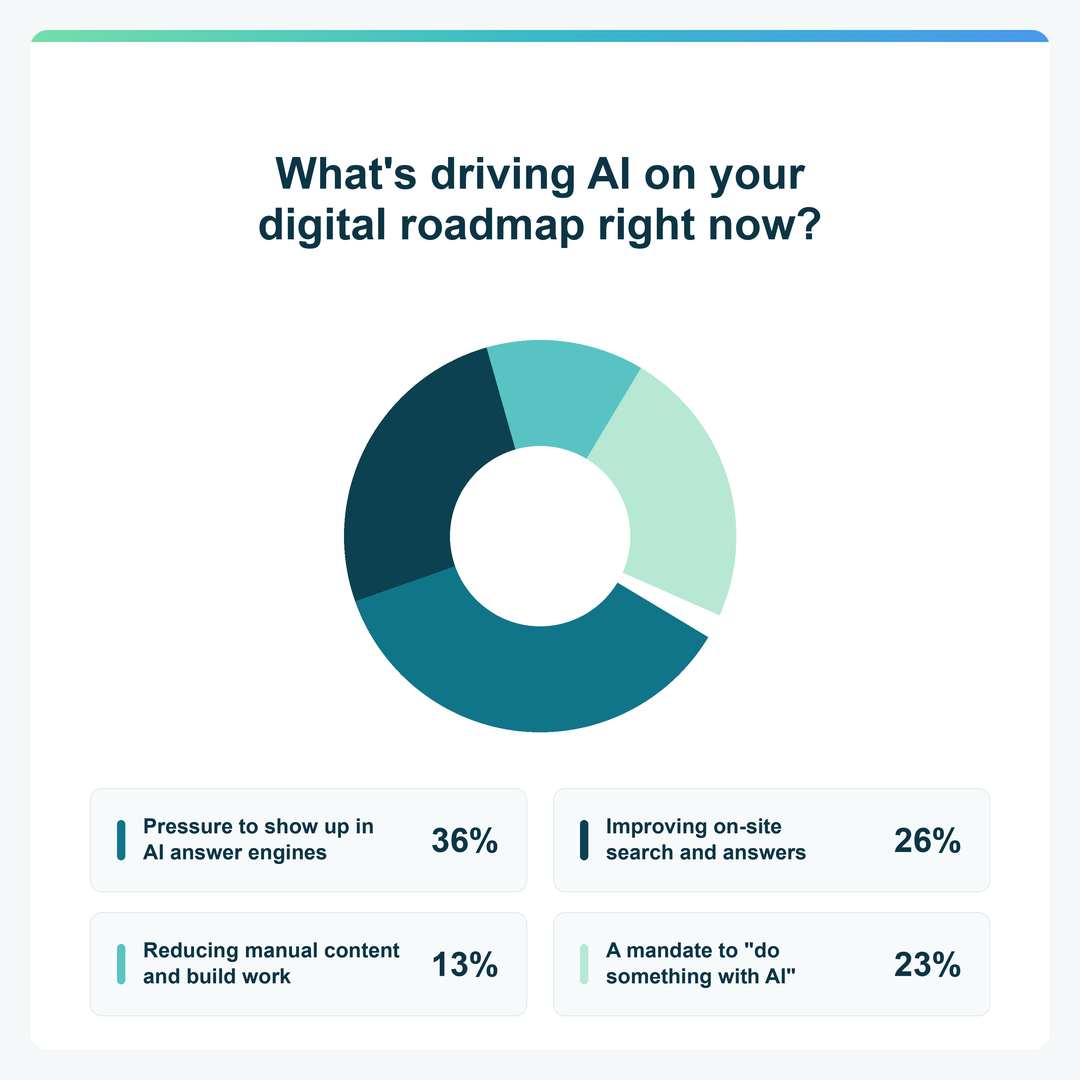
- Pressure to show up in AI answer engines – 36%
- Improving on-site search and answers – 26%
- Reducing manual content and build work – 13%
- A mandate to "do something with AI" – 23%
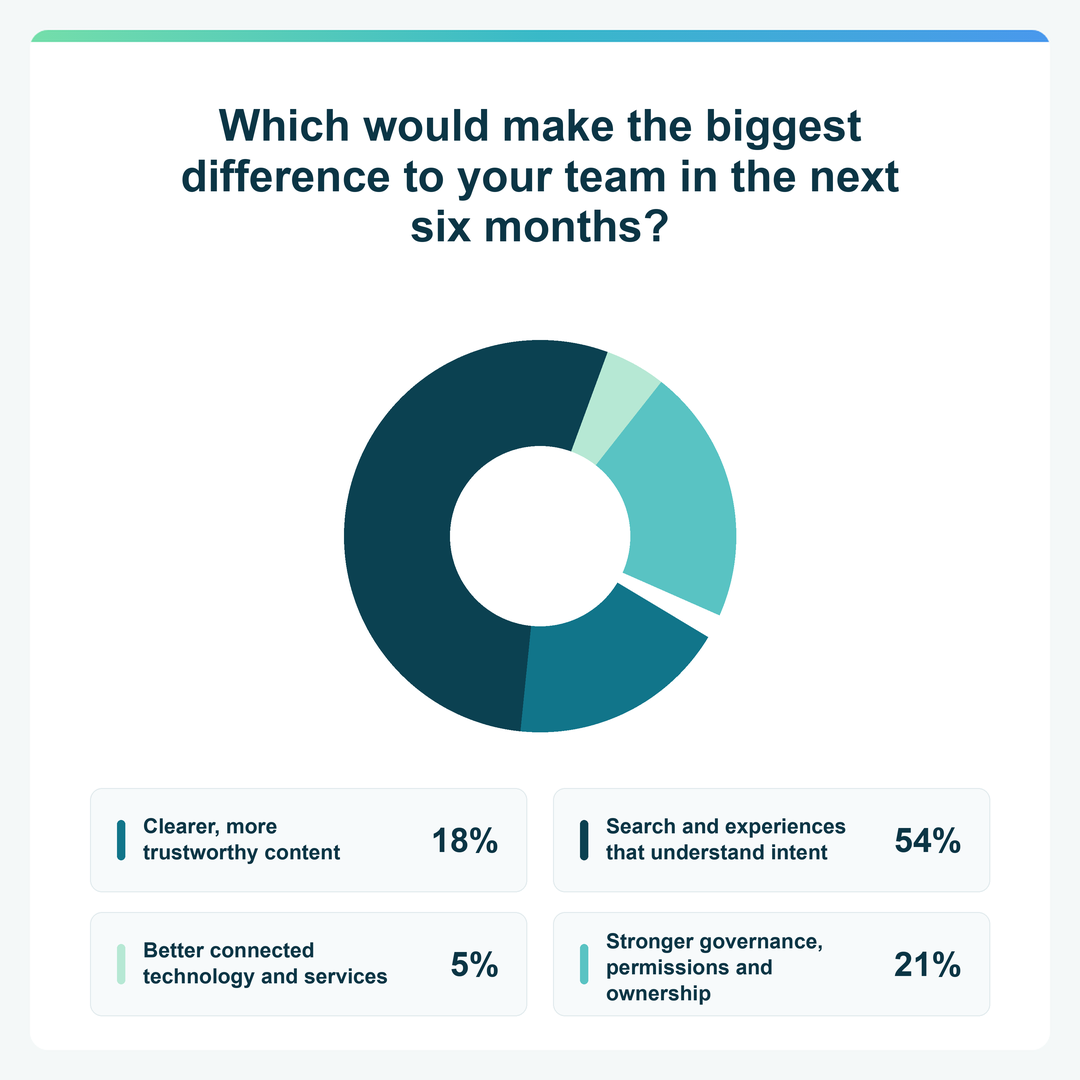
- Clearer, more trustworthy content – 18%
- Search and experiences that understand intent – 54%
- Better connected technology and services – 5%
- Stronger governance, permissions and ownership – 21%
Watch the Europe webinar
Transcript: Watch the webinar (UK)
Welcome and introductions
Joel Goodman
Good afternoon, and welcome to our webinar today.
We are excited to speak with you about, what what happens after GEO, all of this pressure that we're sitting here having? My name is Joel Goodman. I'm VP of growth strategy here at Squiz. With me are Toby Margetts and Jamie Liechty.
And we are just keenly aware of how much pressure digital teams are under to make their websites and their content show up in AI search. And, it seems to have dominated a lot of the discourse around marketing offices. And, throughout the Internet and anywhere you go on LinkedIn, you're hearing this pressure.
And today, we just kinda wanna look at, you know, the the realities of getting your content to show up in AI search, but also the gaps that, that really don't get talked about within the the discourse that we're seeing across the Internet. So we're gonna look at where AI can add genuine value to the work that you're doing as marketers, and, you know, what has to be true before it can actually achieve that sort of value, and then how you can take those first steps to become, or to make it actually manageable for your team to to sustain going forward long term.
So let's let's dive in because we have a lot to talk about today.
GEO and the shift to intent-driven experiences
Joel Goodman
So as I said, most of this pressure is landing on digital teams. You're being told to show up in answer engines and figure out how many times you're being cited in AI search and, seeing your traffic drop probably on your website due to research and and exploration happening in other places.
But I think it's kinda worth separating the things that you can influence from the things that you can actually control in this new landscape. So today, let's start there.
I don't know. Toby, Jamie, who wants to take it first? But let's, dive into, all of the all the discourse that we're talking about. Why is generative engine optimization and showing up in AI search really only part of the picture, and what are some of the gaps that, we're noticing as we work with these tools every day?
Jamie Liechty
Yeah. I'll I'll jump in there. So first of all, thanks, Joel, for having us. Always fun to have a conversation.
I also want to say marketing teams, we see you, we hear you, we understand your pain points, as Joel already mentioned. We talk to marketing teams all day, every day. I come from the partner lens, I'm VP partnerships here at Squiz, so I work with a lot of partners digital agencies who work with marketing teams, and the pressures are real and we see it all the time. And again, we understand the pressures you're under.
So it's a fun conversation to talk about and also a little daunting at the same time. But to answer your question, Joel, I think really when I think about GEO and AEO and AI and all the things, I think it really comes down to, from a marketing team's perspective, what can you control versus what is out of your control? And I think a lot of pressures from probably management that you're seeing that marketing teams are getting is, hey. We need to do something with AI and and figure this out.
And it's kind of this blanket statement, and then, like, what does that actually mean?
And I think sitting in a marketer's shoes, I would think, okay. What can I actually control versus what is under my control? You can't control how people are going to search, for you, whether they come to your site, whether they go to LLMs, you can't control that. What you can control is how you feed those LLMs via your content. So as long as there's solid content and there's a story behind that content and it makes sense and it's fluid and it's your brand voice and all the things that you wanna make sure that is prevalent, then it's really feeding what are the right answers to the questions that people are searching. So I think that's what I always think about is like that foundational principle of, you can't control the uncontrollables as an old mentor of mine used to say, you can really just control what you can. And I think content is again that principle, so.
Toby Margetts
Yeah, think it's a really good point. You've kind of both touched on it, this idea of control versus influence and what you can do and what you can't do. I think one of the really interesting things as well is if you think about how websites have kind of broadly worked over the last twenty, thirty years or so, We've essentially had, I think, pretty fixed experiences. We've created pages, navigation structures, and thought very deeply about user journeys, and then just expected people to figure out what they need, but I think AI is changing that pretty fundamentally, particularly amongst maybe younger demographics, and I think people are getting really used to the idea of just asking what they want in their own words and getting something relevant back, And I think they're gonna expect that same level of of experience when we're actually dealing with general websites.
Right? That's gonna become, I think, a really normalized experience people expect to have. So, yeah, I I think it's not really kind of about putting a chatbot on a website, and instead of chatbot can be a bit of a dirty word, it's really about, I think, using AI to improve that underlying content that you have and to connect people with the right info and services to actually help them get things done. So I think for me, GEO is a really kind of important part of the conversation, but I don't think we need to get too caught up in the acronyms that you mentioned it, Jamie, like, hey, yo, GEO, like an absolute ton of acronyms, and I think we can kind of distill it down to a question, which is, are we actually helping people find accurate information and understand the options that they have and how they can take that next step?
Jamie Liechty
Yeah, I totally agree, and I think also the conversation and kind of what you pointed out, Toby, in terms of like this personalized, I'm visiting this site, so I want the information that I'm seeing on that site fed to me specifically for my needs at and that right time, at that right moment and all of that versus just, yeah, this broad stroke website of here's what we do, here's who we are kind of thing. Having that conversational experience on your site, I think we're seeing a trend that it's it's definitely moving, of course, in that direction. And I know, Joel, you've... You and I have talked about this a lot where, if you're not conversational on your site and if it's not personalized and and fed to that specific user, you'll likely lose them because they're not gonna find the information they want or they're not gonna find it fast enough.
Toby Margetts
That's super exciting as well, right? That brings in a whole ability to deliver what feel like incredibly personalized experiences, I think.
If we can match up, a, here's a great answer to your question where we've clearly really understood the intent of what you're asking, along with some really simple, straightforward next steps around how to progress and how to go and do the thing that you're here to do, that then is like... That feels like magic. Right? That's the next kind of, era of, of user experience, I think.
Jamie Liechty
Yeah. And then I think it comes to the point of what questions are actually being asked, and do I have the right content to feed those questions, to actually answer those questions. And I think that's that's really hard. That's really hard for marketers to pie in the sky, like, how many questions is someone going to ask about my site or my content on my site? Like, that is really, really hard and guessing at those questions. So if there's a way to identify what those are or themes of the questions, then you can again write that content and that foundational principle of the right information on your site for for the user journey, really.
Poll 1: What is driving AI adoption?
Joel Goodman
Let's launch a poll real quick since we're here at the beginning and kinda level set with the rest of, the people joining us today. We're wondering what's driving AI on your digital road map right now. What is it that you're hearing from leadership within your organization? What are the things that are on your mind as you work through how to integrate AI into your workflows, but also just how to address your content showing up on AI search and other places.
As we get into this, I think...
I I just wanna reiterate where there are things that you can control. That's the content on your website, and then there are those things that you can influence via your content. But it's similar to kind of the the old days of building a brand on, like, a social media platform. You can't really control those algorithms very well.
You can't really, you can't really game AI systems. And so in this case, like, we're looking at, where should you put your efforts? And I think the the difference is that if you're looking at doing purely, like, citation tracking, you're not getting a full picture of the questions people are actually asking of your content, and you're not getting a full picture of of the volume, I think, really, because a lot of that is down to specific context for that individual person and and the, you know, their AI chat and the history that they're...
They've already done with other websites and other research projects. You can't control that stuff. And so it's a little bit more, of a risk to spin your wheels trying to make something happen there than really digging into the content across your site and making sure that it's ready for these, these kind of variable, malleable experiences. You know, making sure your content can answer those questions no matter who is asking it, what is asking it, where it's being asked, and that's the thing that you can actually control here.
So looking at our poll results here, yeah, this is not surprising. Right? We we are all seeing we're...
I mean, maybe it's a little surprising. I would have expected maybe more than 50% where, we're we're we're seeing pressure on how to show up in answer engines, but, it's...
It seems that we've got a good percentage of people that are working through the process of refining that and trying to show up in those answer engines in different ways going forward. Toby or Jamie, any any comments on the on the data we've seen here?
Toby Margetts
One thing I'm really glad the one at the bottom is pretty low, because that feels like not a good reason to be going ahead and doing cool things with AI, right? Even though in the background there is, I think, this mandate amongst all organizations like, hey, we should be doing something. We don't necessarily know what it is, which I guess gets to the crux of what we're talking a lot about today. But I think what's interesting is, yeah, the idea around pressure to show up in AI answer engines, it's like, is that actually necessarily even the right question?
So if you turn around and say, Hey, why do we need to show up in answer engines? Why do we need to be the one that is top of the list when somebody says, Hey, what's the best university for x? The answer to that, I guess, is kind of obvious. You want to be up there.
I think what's more crucial and what we're gonna touch on, more and more is people, I think, increasingly will expect to see and have those experiences on the individual organization's website, and that may even be deemed a little bit more more trustworthy. People do trust things like ChatGPT and Gemini, but we know they're fallible, they're open to hallucinations, they don't necessarily have the level of guardrail and control that may be sufficient when you're getting really into the nitty gritty of needing very factual and accurate answers.
There's a lot going on, and people I think are under a lot of pressure to do things well and to do things right, and it's really, it's an obvious thing, right, to go, hey. I wanna go to ChatGPT, type in something, and I wanna see my name at the at the top. If I'm not, I'm not happy. That may not necessarily be the right question to ask, and I think it's gonna be interesting as we go through today to to, explain a little bit more about about why, I think.
Speaker unclear
Oh, sorry, [unclear in transcript].
Jamie Liechty
Just say one thing real quick, Joel. I do want to touch on one thing you said, Toby, is the trust and the trust signals. I mean, I think that's so huge, obviously, you want your brand to be trusted in all areas on digital, whether that's your own site or whether that is an LLM. But I think that's a big piece is so many users are trusting exactly what they see from their question and then the answer that they see. And is it accurate? And that's kind of... It's kind of scary, right, for a marketer to know or to think of is that accurate? So I think any way you can help shape that answer is definitely the steps to take.
Three foundations for reliable AI experiences
Joel Goodman
So what are the foundations that we've been seeing inside Squiz as we've been working with, our tools internally, but also just the the general research that we do across the industry, that we think an AI initiative kinda depends on? Like, what are what are those kinda key things that, those of us that have joined us today should be looking at with their own organizations and and putting their focus on?
Toby Margetts
Yeah. Good question. I think I think I would say there are probably three things, the first being probably the most obvious one, which is content.
Ultimately, AI is only ever gonna be as useful as the information that it's working with. It's not magic, right? It needs good content to perform well. If your content's out of date, if it's inconsistent, if it's structured badly, if it's spread across multiple different systems, putting a really great intelligent interface over the top isn't gonna suddenly fix all of those problems, so yeah, absolutely getting your content in a good place and making sure it's accurate is really fundamental to this. I would say the second thing is probably the experience itself. It's not just about someone asking a question and getting an answer back. We've kind of touched on this already, but it's actually about understanding what that person is really trying to achieve and bringing together the information and the options and the next steps that are actually gonna be really relevant to them in terms of the journey that they're on.
So I guess rather than someone having to search through five different pages, piece together all of that information themselves, and then work out what to do next, we curate and do all of that hard work for them.
Then I'd say third of the three things is the underlying tech and governance, so making sure that actually your content, data, and services can all work together with the right permissions and having the right controls in place.
I guess ultimately, it depends on what someone wants to do, but if they're there to check their eligibility for something, they wanna book an event, download a prospectus, start an application, whatever it is, the experience needs to actually be able to connect all of those different things, and a lot of what people want to do touches on lots of different systems.
But what I would say, I think, is broadly the mistake maybe some organizations make is treating those three things as separate projects. You need to look at them, I think, holistically. The real value, I think, comes when you bring those three things together, so trusted content and experience that responds to what someone actually needs, and ultimately, the technology that helps them do something about it, I would say.
Jamie Liechty
Yeah. I think... Well well said, Toby. I feel like I don't have much to add because I think you nailed that. But I... Yeah. I think, again, it comes down to that what is trusted, What's the intent behind the search? And how are you monitoring that on your site?
Toby Margetts
I love them, Jamie. I love... You mentioned earlier around the trust. A question I often ask people is how often do you, when you go and use an LLM, how often do you go and look at the sources or the citations of the answer you get? And it's really rare, but nobody looks at it. Even though it's sort of fundamentally think it should be important, and it is important where the answer is coming from, And we found that as well in things that we're building, we always will put forward the sources and will say, hey, this is where it came from, but nobody really checks it, and it is kind of amazing how trust has sort of almost been built into this system, something that you think people would be very, very wary of. Tend to be pretty trusting of it, which is really interesting.
Jamie Liechty
Yeah, and especially if you're sitting side by side, Toby, if you and I are sitting side by side and we search the exact same thing on our separate devices, we're likely gonna get some differences and some nuances in those answers. And so it's interesting that you see the answer and you read it as face value and that it's true. And to your point, I don't think a lot of people are looking at the sites and going back to the sites and confirming the truth to it. I think they just take it as face value.
Assessing readiness: Trusted content
Joel Goodman
Yeah. Totally agree. So let's let's break down these three foundations a little bit and kinda look at some of the questions that our, our our our, I don't know, our guests here today and the people joining us here today might think about as they're as they're thinking through, how to put these things in place.
Who wants to take trusted content?
Jamie Liechty
Yeah. Sure. I'll I'll take that one.
So I think I'm just gonna read this, and then we can talk about it. So is your content accurate, current, and clearly owned? Really good because if it's not accurate, obviously, it's not good content. It's not trusted.
It's not viable. It doesn't make sense to the to the user. Or maybe it does, but it's wrong. And so that's that's definitely a risk.
I think when you look at...
Or when you think about, again, searching on LLMs, like, that is a brand moment, and those are brand moments you can have. And, again, if you're not feeding it that right, you know, accurate content, you're you're gonna lose that moment. So I think that that makes a lot of sense to me. The second point is, is your content structured and accessible for people in AI?
This is something we've been talking about for quite some time now here at Squiz is, are you talking... Is your content feeding humans or the AI or both? And I think that's where marketing teams have a really challenging job is how do you feed both in the same content and how do you help the AI and the LLMs find your content and feed it into their answers, from an AI perspective, but also how do you write it in the way that a human wants to actually read it and consume the content. So I think that's really challenging. And so I think if if there's a way that you can make it accessible, which is how the AIs, in the LLMs feed and and read that is fantastic, but also you need to have that human touch. So I think that trusted piece again is a little tough, I think, for marketers. And so again, we feel your pain marketers, because it's hard to make sure that it is both human and AI, recognized.
Assessing readiness: Intent-driven experiences
Joel Goodman
And and, Toby, you've been doing a lot of direct work with intent driven experiences, a lot of experimentation, a lot of work with, our newest, our newest features within, Squiz Funnelback Search.
What are what are you seeing really drives the best, the best experiences through through that sort of intent interaction, that that might happen? Like, how do we define this to someone that doesn't understand what intent driven means at this point in time?
Toby Margetts
Yeah, it's a really good question. It's, I think, rethinking how we thought about those kind of user journeys or traditional user journeys, which, as I kind of mentioned a bit earlier, for twenty, thirty years, that's been pretty fixed, and it's like yeah, we create a bunch of static pages and we try and link those together and send them off to the appropriate page at the right time, which for twenty, thirty years, as I say, we've just accepted as the way forward, and people broadly across the web have come up with some really great and interesting ways of doing that, but I think this has just really changed the game, because AI is so good at being able to understand intent and being able to understand multi intent questions as well.
So even with the best content and will in the world, if somebody comes and asks a question that includes a bunch of different facets and says, hey, I'm interested in studying this particular course, but I don't want to come and live on campus, but I do wanna do this. And it's like a keyword search and lots of different pages, that's really hard to pull all of that content and aggregate it all into one thing.
AI is great at doing that. AI is so good at really understanding what the intent of that question is, then pulling all of the information from the sources that are required, which often will exist for understandable reasons in lots of different places, and then presenting it to the user alongside calls to action and things that drive the next step.
Yeah, that's just a really hard thing to do without AI, and as we've been saying, people are very quickly, I think, getting used to those experiences being really good, and it will become, I think, a bit frustrating when you have to go to a website and you go, I've got to do all the hard work, I've got to go to six, seven different pages, find the information, and figure out what to do with it. I almost feel like that will feel old fashioned really quickly if not already.
Joel Goodman
So it is sort of getting ahead of the curve and and kind of... I don't know. I think I think a lot of marketing, teams felt a little bit on the back foot when AI kinda took over. It seemed to happen really, really quickly even though it had been growing, you know, and all of these demands kind of came up.
Maybe they weren't so fast, but they feel extremely urgent. Urgency always makes it feel like it was it was sudden and quick. So this is a way to start thinking about how does, your content adapt to that individual person on your website or wherever they're searching for and interacting with your brand, versus, kinda forcing them into a single journey or the the traditional kind of navigation information architecture structures that we've put in place for the last, what, fifteen, twenty years. And I think all of that comes from having a governed foundation.
A governed foundation without added complexity
Joel Goodman
Ironically or maybe not so ironically, I think all of all of this, your your content being, trusted, and your content being flexible enough, comes from being able to have this this governance foundation underneath the content across your content estate, your your... All of the websites that you possibly have. But even more importantly, as as we're doing this for marketers, right, this whole webinar, you gotta make sure whatever you put into place to manage that governance doesn't add additional complexity to your team, doesn't add, you know, additional time commitments, and we're all we're all overworked. Right? We all have plenty of plenty of stuff on our on our plates that we have to deal with.
Adding one more thing that is as complex as having our content adapt and mold itself to the person that's on the other side of the computer is something that we have to find ways to do without dragging down the rest of the work that we do.
Readiness assessment and the changing role of digital teams
Joel Goodman
Alright.
Let's move on from this. I just wanna say this is kind of...
We we have a readiness, checklist. It's it's kind of a two minute assessment. There's a QR code and a link that'll go into the chat, but, this is just half of it. If you wanna kinda get a sense of where your, your organization or your institution is at in this process, it's a really good quick way to kinda just do a self a self check of where your processes are and where your content is sitting at this point.
But from here, like, we really wanna dive into what the role of our digital teams are and how that's changing with this new approach to content. So we've, we've talked about what needs to be in place. We've spent a little bit of time on what this does to your day job and hopefully not too much, too much extra work.
And now we wanna dig into how if, these experiences are being, created and and assembled and put together around intent. What what does change? Like, how does that thinking change for the person that's managing this this content, and how should they start to think about writing content, creating pages, building out their their future web experiences?
Toby Margetts
Jamie, do wanna go?
Jamie Liechty
Go for it.
Speaker unclear
Go for Okay.
I'll I'll...
Toby Margetts
Yeah. Sure. I'll I'll jump in. I'm sure you'll probably have something better, than I have to add around this, but I think it's a really interesting part of the conversation, because it's not...
This isn't just about introducing new technology, right? It is, like you mentioned, Joel, it's about kind of fundamentally changing how teams work and how they think about work, and I think if you think about how most teams, most marketing teams, content teams operate today, a huge amount of time gets sunk into maintaining individual pages, designing those user journeys that we talked about, updating content, and actually trying to anticipate all of the different things that somebody might want to do and having static experiences that can meet those needs. I don't think that stuff just goes away entirely, but I do think the balance starts to shift, and I think rather than having to design every possible user journey in advance, teams can spend more of their time defining actually what a good experience looks like, and again, it goes back to what we were saying a bit earlier, what are we actually trying to help people achieve, what information can we trust, what rules and guardrails need to be in place, all of those questions, and then I think we can use AI to start doing more of the work to bring those things together based on what the individual is actually really trying to achieve, and that feels like quite a liberating thing to me, so content people and marketing people I think don't want to be down in the nitty gritty of that kind of stuff.
They know their users really well, they know what they're trying to achieve, they haven't yet had the tools to be able to make that stuff really easy, but AI is making the ability to understand their intent really good, so I think then it becomes really exciting to think about the possibilities of what you can provide to them at the time in which they need that information to help them take the next step and to help them have the experience that you want to to give them.
Yeah. Don't know, Jamie, if you've got anything to add to that.
Jamie Liechty
Yeah. Yeah. I think I I think...
Yeah. Basically...
Or not basically, but I think what you're saying is definitely, like, what are the goals and what's the call to action? Like, what's the purpose of this content and and where is it going to go from there? So I think you...
Utilizing your website, of course, and the personalized journeys on your site, whether it's LLL or on your site is where do we want to take this experience and what does that mean for that specific user at that specific time? So I think that's really exciting because you can really pinpoint like what that is and have multiple different user journeys and whatever that may look like for whatever you wanna do on your specific site. But I think you're right, Toby, you used the word liberating. And I think that's really true because I think as daunting as it is and as daunting as it is to think about like, how am I gonna use and leverage AI in all my daily work and my site and all those things, it's also really exciting time.
It's really exciting to think in creative time of like, okay, we can really get granular of how we want this journey to flow and where we want to take that next step and what is that CTA. So I think that to me is really exciting as well.
I was actually talking to a law firm a couple weeks ago and someone in marketing business development, and she was saying how her lawyers are searching on LLMs, they're like, Hey, I went to Brown University and this guy went to Yale, how come he's showing up and I'm not showing up? And it's like, well, I don't know if the user is really searching for that. You might care about that as the lawyer, but does your audience care about that? So let's feed the questions and let's have the right content to help that journey. So I think, again, it comes down to the lawyer thought that was exactly what people are gonna search for and he wanted to make sure that on their website, all of that content was there to, of course, feed into the LLM, but users aren't searching that. They're searching for what kind of law do you practice or whatever they're searching for. So I think the intent behind it, to your point, Toby, I think, and the goals behind that is definitely a place to start.
Conversational search and first-party insight
Toby Margetts
I love that analogy. This probably touches on something I know we've spoken about before, Jamie, around one of the big benefits is marketers, content people being able to get a really, really good understanding of actually what's missing, what people are looking for, because now the expectation is I can go to a website and I can type in exactly what I want in my own words, natural language, I might find that actually we don't have the content to support a good answer to that question, but that's absolute gold dust for those people that work in those teams, where historically they would have measured page views and bounce rate, which is fine and is interesting, but that's nowhere near as good as somebody coming to your website and saying, This is who I am and this is what I want.
Us being able to see, we can't really give a very good answer at the moment, but we really should because we're seeing a ton of people ask this same kind of question or go down the same line of questioning, so it's a really exciting time, I think, in terms of learning as well and being able to continually improve.
And we're not suggesting people are gonna get this right from the get go, right? You're not gonna create something potentially that does a 100% brilliant job of answering every conceivable thing, because yeah, you'll have blind spots, you'll have gaps in your content, And this is a great way of figuring out what those are and generating the content that's going to give you those really great answers going forward.
Joel Goodman
And to disambiguate this, there isn't a way for us to get those questions that are being asked on Google AI mode or in ChatGPT or, you know, whatever that tool is that someone's using it. The the best way to get this is, again, to focus on what you can control, which is your own website. And it's it's being able to to replicate that conversational, you know, search and and kinda research practice on your own site, with tools so that then you can create that feedback loop. You can see what people are asking.
You can then, you know, see, like you said, Toby, if the answers are there within your content, learn from whatever that interaction is, and then improve and optimize. It's the same optimization structures we've done with anything else. It's just applying it to these natural language interactions and then applying that back to the content practice that you have to make it more adaptable. So from here, let's dive into some practical steps.
Choosing a practical first use case
Joel Goodman
Right? Getting getting close to the to the end of our time here, but I wanna...
I want us to be able to to send everyone away with some practical steps. So, this is kind of the first part that we get asked about. Right? So, like, lots of ideas happen everywhere.
You know, there's lots of ideas for how to use AI, whether within the teams or above the teams or around the teams. Everyone's trying to figure out what to do.
But if, you know, a team is looking at a a huge web estate and lots and lots of content, how do they figure out where to start? Because there's probably thousands or tens of thousands or hundreds of thousands of options.
What do they pick? How do they, you know, how do they figure out what to avoid within all of the different options that they have?
Jamie Liechty
Yeah. I can start with this. So I think, you know, it kinda goes back to the poll. I kinda think about the poll.
So the bottom question was just do something with AI. Again, I think, Toby, you called it out like so glad that that's not really your because that's kind of crazy. The directive was that top one, right? Of like, let's make sure you're found, we're found on AI.
So I think knowing where you're starting and what, again, is that goal that you wanna start with. So I think that's, to me, kind of where to start is, again, big picture, what's the goal? So we know we wanna get shown up on AA, but how do we do that? So I think Joel just put this up here for tests for the first use case, like start small.
It is daunting. It does seem like a lot. And I talk to agencies all the time, and they're working with brands who don't know where to start. So they start with an audit.
They start small as well. Pick something, pick one user journey, and start there. So I think, these are some really good points, like starting with high value. Like, it matters to the audience and the organization.
So what is the story you're trying to tell from your brand perspective, and what are those brand moments that you really wanna make sure you land on your site and that your audience is really connecting with and what does that look like? So maybe that's where you start is that high value content. Maybe those are the biggest pages. Maybe those are the most visited pages.
Maybe it's... To your point earlier, Toby, when someone searches for, I wanna go to university for X, what are those X areas that you really wanna call out and highlight? So I think that high value makes a lot of sense.
Painful today, that's a good one. What's not working?
What painful that maybe you need to fix and you know you need to fix immediately? Maybe you have content on your site that's contradictory, that's not saying the same story. And so I think that's a really good place to start as as well.
Maybe you have a team that it takes five people to maintain that content or that site versus maybe you only could take one. And so maybe that's another place to look is like what's hard to maintain on those sites.
Toby, do you wanna take the other two, or do you want me to keep rolling?
Toby Margetts
Well, I think one thing before I do that, which I just wanted to kind of touch on, and I think you covered it really well, but I see it a lot kind of every day, is starting small, not being daunted by having a ton of content. That's a really easy thing for me to say. We work with a lot of people who have a lot of content, and when they start thinking about these types of things, it's a daunting thing and you don't know where to begin, so I think my advice would be you'd need to start small and you crucially don't have to have it all figured out. Don't have to have everything across your estate in tip top, amazing condition to be able to get going with something.
You can pick a slice, as you said, Jamie, pick something that's really important and really impactful and going to have, I think, high value, and you can focus in on that, and in a way, if you've got tons of content, which lots of our customers do, that actually makes it a little bit easier to go, Well, yeah, let's disregard 80% of it for now. Let's zoom in on this content, which we know is really impactful. We know that does a great job in getting students do something or getting a citizen to sign up to them. Whatever it might be, my advice would just be to zone in on a slice of your content and start that way, I think.
Jamie Liechty
Yep. Yep.
Yeah, so just to continue on this then, bounded content, the source material is identifiable and ownable.
Who's owning that and who's helping with that? I think one thing you said, Toby, too, is if you feel like you have a lot of content, doesn't mean you have to start over. I mean, you can still absolutely use what you have. It's just finding that right area to start and reusing and maybe just repurposing that content for something else.
So I think that's another thing is just kind of identifying that specific material and then who's gonna own that to create better story, if you will. And then finally, of course, what's measurable. I think that's one thing we hear from marketing teams all the time. And that's also one thing I hear from agency partners all the time is people wanna know, okay, if I fix this, if I do this, what does that mean for my organization?
What's the ROI behind it? What's the call to action that I'm gonna get? What's the...
Whatever that is, whatever your goal is. And so I think figuring that out as well and what you can actually measure, because again, measuring on ChatGPT or Claude is very difficult, but measuring on your site, can absolutely control and and figure out how, how it's performing.
Measuring outcomes and testing the experience
Toby Margetts
To to the earlier point we made as well, Jamie, like GA4 metrics, which people tend to work in and mention it like bounce rate and engagement rate and page views and things like that, which can sometimes feel a little bit kind of like vanity metrics, you create a report every quarter and you go, hey, yeah, we've got a few more page views, and everybody sort of claps and goes, yeah, that's great, I guess, but what actually is that doing for us as an institution? Is it getting us more conversions? Is it whatever our goals might be? Is it actually doing that thing that we want?
And I think AI gives you a really clear picture of that if you, like we said, can combine really great answers along with what's the next step, what's the thing we want this user to actually go ahead and do. We need to make sure that we're thinking very deeply about that and measuring that.
We even recommend to a lot of our customers engaging in this A/B testing that as well, so having your normal regular experience, keep that, keep 50% of your traffic going to it, then let's do something maybe a little bit more innovative. Let's throw a rich experience with an AI answer that provides some augmented content around it and throw 50% of the traffic to to that, and let's see which one actually results in in better outcomes. Like, I would be... And I guess I would say this, but as a betting man, I'd be like the the one that really understands the user's intent and gives them a really concrete next step, that's the one that's gonna get you more of the stuff that that you want.
So, yeah, like, don't don't take our word for it, would be my advice to a lot of our customers. It's like, A/B test it. Throw half your traffic to it and half not, and and we'll see who the winner is.
Joel Goodman
Yep. Yep. Awesome.
Poll 2: What would make the biggest difference?
Joel Goodman
So, as we're getting close to the end here, I wanna do one more poll, and, see where you all are at and and hopefully give you some, some insight into where we're headed, and, and then we'll answer... We'll do some q and a, answer some questions that came up. So which would make the biggest difference to your team in the next six months? Thinking of your goals, thinking of the pressures that you have, which of these things do you think will, would help your team the most?
As these, responses are coming in, any, closing thoughts, Toby or Jamie? Anything we didn't cover that you wanna make sure we cover?
Jamie Liechty
I think really, again, I know you've used the word daunting a few times, but I really think it's a lot, it's a lot, and we understand that in terms of making sure that your site is performing in the way you want it to perform. And so there's a lot that goes into that. And then there's a lot, of course, that goes into, again, as we talked about AO, GO, whatever you wanna call that. So I think it is a lot, but I think what Toby and I were just talking about is start small, start somewhere. You don't have to boil the ocean.
It's getting an audit, understanding where you're at today is always the best place to start is how is my accessibility going? How are the answers looking on my site? How is the content feeding? Who's managing that? So whatever that is for you, just identifying those goals and starting small, I think is probably the best advice we could probably give and something I hear quite often from agency partners.
So Toby, I don't know what you think, but…
Toby Margetts
Yeah, no, I totally agree.
My overarching takeaway, I guess, would be and hopefully, it's been clear from what we've seen. Content is obviously clearly profoundly important to this. It is the foundations that all of this good stuff happen from. That said, to your point, Jamie, then that can feel daunting because you go, Look, we've got a huge estate, and we know it's not great across the board.
That's fine, the fact that you are aware of that probably puts you ahead of the curve versus a lot of your competitors. Then it's a case of, like we said, zoning in on the things that you think are really high value, that are gonna drive conversions, where you can measure things from, and focus there and start trialing things and testing things. You don't have to have everything in absolutely sensational condition before you get going, but yeah, as I say, understanding that you've got issues is often half the battle, and then systematically working through it and creating these really great experiences, that's the way to go, I think.
Joel Goodman
This is a great mix of answers here. And no matter which one you were in, that two minute assessment that I mentioned earlier, is a great place to start. Link is still in the chat. We'll have a QR code here at the end.
But on top of that, we we can help with all of these things. Our digital strategist would love to talk with you about, any of these challenges that you have, so feel free to reach out, or I'm sure you'll get a follow-up email after this webinar with the recording. Share it with a colleague, but reply to that email, and we're happy to to chat with you, going forward. So let's, our key takeaways today look like this.
Key takeaways
Joel Goodman
Oh, I gotta take the poll off. There we go. Our key takeaways look like this. Value comes from the digital estate that you control, not the not the things that you can only just influence a little bit here and there.
So that control helps you influence, but you you really don't have control over those things that are outside of your your own website, your own, your own DXP, your own content. Three foundations here, but one initiative, which really help you move these things forward. Start building, or from...
You're you're moving from building, all of these, fixed kind of journeys to guiding people through to the thing that they want and doing that automatically with, with AI tools, and conversational search. And then start small and then prove it. Take it back to your leadership, your team, and make sure you build a case for yourself. And from there, we are going to take some q and a, the last couple of minutes that we have.
Audience Q&A: How do we address concerns about incorrect AI answers?
Joel Goodman
So let's, let's take this one. Let me pull slide off. And Derek asked this. There appears to be an internal attitude that LMs are getting things wrong, supplying incorrect answers without recognition that they are only as good as the data available to them.
How might we shift this mental model or offer some insights to help move the conversation on?
Toby, you started to talk about this with, kind of the the trust side of, of content being able to to make sure that the answers coming from a model, come from content that is trusted. How would you address this question?
Toby Margetts
Yeah. So it's a really great question, and LLMs are absolutely getting things wrong, I think.
I think there probably needs to be a general acceptance that LLMs are absolutely fallible, for a lot of the reasons we've talked about, right? They are often pulling from all four corners of the internet because they're very people pleasing and they want to provide, good answers, and that then often is at the expense of accuracy and scope, which can be a bit problematic, I think, but in terms of whether that's something we want to go along with, accept that, I don't think we necessarily do. We want to take as much control of the situation as possible. We've mentioned it a couple of times.
We have influence over things like ChatGPT, we have control over our own content. I almost don't think we should treat them as competing priorities. If somebody is more worried about what's being said about them on ChatGPT, focusing in on their own content, I think, has the peripheral benefit of you're much more likely to get good answers on ChatGPT if your content is in really good shape, and of course, if your content is in really good shape, even if somebody gets a bad answer on ChatGPT and ends up coming through to your content to complete the next step or to sign up to whatever the thing is, if your content's in great shape, much better chance that that's gonna happen.
So yeah, that's the way I would think about it.
Audience Q&A: Does structured content benefit site search?
Joel Goodman
Great, and Derek asked another question. Is there any evidence that creating well structured content for humans and AI benefits Site Search? And I think Squiz is actually very well positioned to answer this because of all the work that we've done in site search for the last fifteen plus years, including machine learning, which is what AI is built on top of. Right? And, the way that we've approached this in particular that that is is proving that well structured content for for humans and AI benefit site search is just in terms of how content intelligence works alongside our conversational search products.
So, you know, the the ways that we look across content and use the, methodology behind how large language models and AI interpret content and then proving that out through better answers across the site. And I think that also goes back to the previous question, Toby.
We're able to prove better answers and better quality answers when it's based on the content that's on your site, But the important thing is not to miss that optimization loop that we talked about earlier. You still have to measure what question is someone asking, is our content answering it well, and if it's not, go back and fix it so that you get those better answers. But by in... By taking the approach of studying how large language models interpret content, read it, put it into answers, we're getting a lot closer than just doing citation tracking, which, it has, thousands and thousands of variables that address how the predictive text engine is gonna write that content.
Toby Margetts
Yeah. Absolutely. I I feel like I hear the... Some variation of, like, SEO is dead, and I've been hearing that for about the last twenty years in various different guises.
I think it's pretty clear that what is good for humans and what is good for AI tends to be good for things like SEO and general site search.
In general.
There are probably people far more intelligent than I that would have some really good evidence that supports exactly that, but ultimately, I think if you think about what actually somebody is trying to achieve through site search, they're generally inputting keywords, and they're getting a result that is based on those keywords through some really good metadata tagging and things like that.
If your site is in good shape and it's well structured and the content is there and the metadata is clean and it's all nice and tidy, surely that's gonna bode well for search and better searches.
Yeah, So I think it's all very closely connected. What's good for humans tends to be good for AI, tends to be good for site search, and will almost certainly boost you up the rankings in search results as well. So I think it's all very closely intertwined.
Audience Q&A: Where should a team of three start?
Joel Goodman
And, the one last one, just to reiterate this point, we're a team of three. Where would you start if you were them?
Jamie Liechty
I'll take this one.
We're a team of three. Yeah, again, this kind of goes back to my first point when Joel started introducing us.
We feel your pain marketing teams. There's a lot on your plate. So again, where would you start? Start small, pick one really interesting intent that you're looking to help with and help solve for, and what story you wanna tell your audience and start there, is what I would say. Starting with an audit is absolutely a way to to go see how, as Joel mentioned, it's in it's in the chat here, but understanding where you're at today is always a good thing, whether it's you get really good results back or not so great results, at least you know, and then you can make some decisions from there and prioritize from there.
Closing remarks
Joel Goodman
And with that, we'll close, this webinar. Toby, Jamie, thank you so much for being on today and sharing. For those of you that joined, please, take that two minute assessment. Let us know if you have questions about it.
We would love to, we'd love to talk with you. You'll also get an email with the the recording to this. Again, please share with your your colleagues that that need to need to hear whatever we... Whatever part you think they need to hear and what we talked about today.
We really appreciate you joining us today. Have a wonderful Tuesday.
Toby / Jamie
Thanks. Bye, guys.
Bye bye.
Video: Watch the webinar (UK). Captions and transcript available on playback.
Poll Results
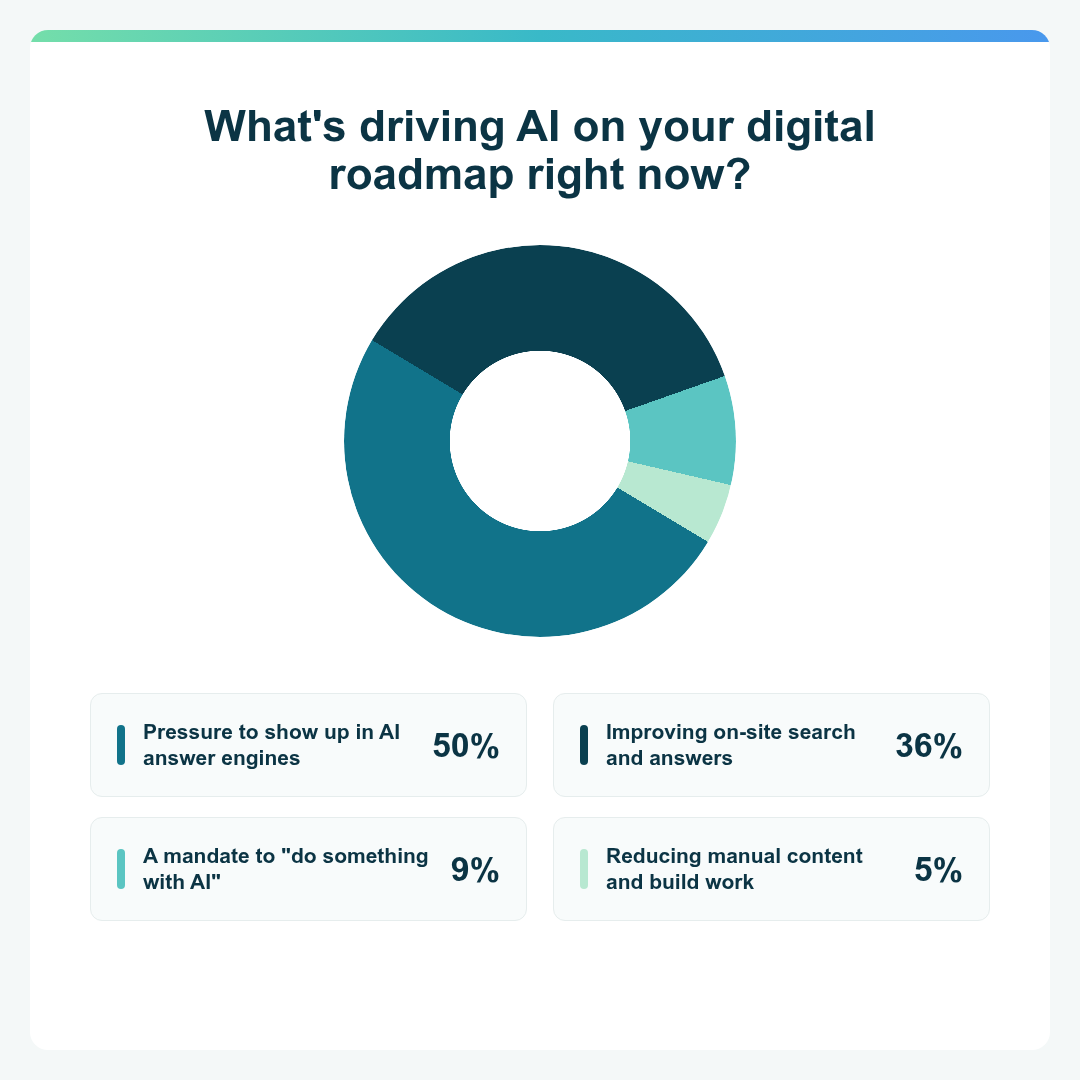
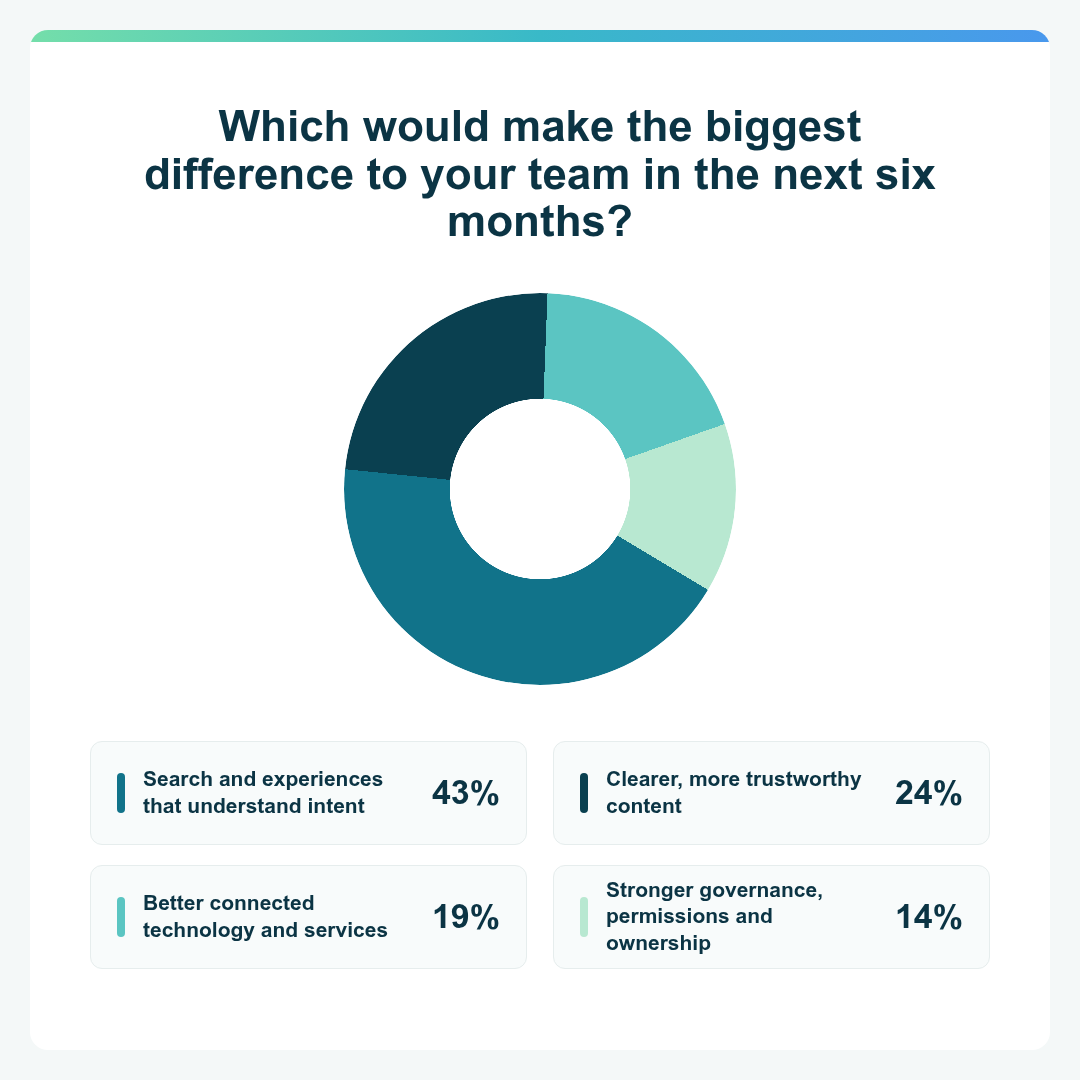
- Pressure to show up in AI answer engines – 50%
- Improving on-site search and answers – 36%
- A mandate to "do something with AI" – 9%
- Reducing manual content and build work – 5%
- Search and experiences that understand intent – 43%
- Clearer, more trustworthy content – 24%
- Better connected technology and services – 19%
- Stronger governance, permissions and ownership – 14%
Watch the US & Canada webinar
Transcript: Watch the webinar (US)
Welcome and introductions
Joel Goodman [00:01]
Hello, everyone. Welcome to this month's Squiz webinar, “The real value of AI for digital teams.” My name is Joel Goodman. I am Vice President for Growth Strategy here at Squiz. With me are my two incredibly smart colleagues, Fran Zablocki and Megan Andrews. Hello, everybody. Thank you for joining me today.
Fran / Megan [00:20]
Hey. Excited to be here.
Joel Goodman [00:23]
I think the major discourse that we're all seeing across the web is how much we need to be showing up in AI search. We've talked about it here on our webinars for a really long time. I was just at a conference; I've heard everyone else talking about it. There's a load of pressure on top of all of us to do more about our content, to show up in more AI search.
What we want to do today is talk through the realities of it, maybe a couple of the myths around it, maybe some of the things people aren't talking about that we should be talking about, and hopefully give you some steps to walk away from this thinking larger than just generative engine optimization.
As we go, feel free to drop your questions in the Q&A. We also have a chat. Leave some comments there. We'll be happy to answer Q&A at the end of this. We'll also have a couple of polls, so stick around. We'd love to hear from you and specifically what your responses are to the things that we're wondering about. With all of that, let's get started because we've got a lot to cover.
GEO and the intelligence era
Joel Goodman [01:29]
As I said earlier, a lot of the pressure that digital teams are facing right now comes down to how well we're showing up in AI search. That means if someone's on an AI tool, ChatGPT or maybe just Google in AI Mode, and they're asking a question, is your brand getting cited? Is your website showing up? Is your content the thing that's being presented to the person in that place?
We're all under pressure to figure out how to show up in AI search better. But as we've gone through a lot of the process with building our own tools and working with Squiz customers, and looking at the different industries and sectors that we work in, we've discovered a few different gaps.
So I want to get started on this by asking Fran and Megan: what's missing from this GEO conversation that we're all having? What are we getting too focused on, and what should we start to consider as we really dig into dealing with all the AI today?
Fran Zablocki [02:32]
I think the first question that comes up from everyone is, “Am I showing up in ChatGPT or AI search?” I think it's right for people to want to know that, but I also think that's the area they have the least or no control over.
The piece that we want to talk most about is your own content and what you can do with that content to make sure people are finding out about you within the context of their experience on your website. Once people actually get to your website, what does it look like? What does it feel like? Are they getting a rich conversational search experience like they started with when they were talking to ChatGPT originally?
That's why we've been talking a lot recently about this feeling that we're on the cusp of a new era in terms of interaction between humans and technology. We've termed it the intelligence era. The way I think about it simply is that instead of things having to be set up ahead of time by content managers and web designers, in anticipation of a hoped-for path or conversation or set of behaviors, things are getting closer and closer to real time. The interaction and conversation are happening in the moment, and the output from all that content on your website is being reassembled in real time, dynamically, in a way that it just hasn't been before.
That's the piece that's worth reemphasizing: the content you've owned for all this time is still the most important thing. It is the input to all of these outputs. It's the input to every ChatGPT query. It's the input to every on-site traditional search query, conversational search query. It's the input to every single human set of eyeballs that is reading a page. It is the source, and that's the thing you own, the thing you have the most agency over, and the thing to focus on.
Megan Andrews [04:49]
Yeah, Fran. I often think of what you can control versus what you can influence, and the bricks we can control. It's kind of cool. I don't know if you all grew up playing with different things, but Construx was something my older brother always had, so you could snap them together and build different things.
In a content world, it's very similar. You're going to have pieces and little bricks you can put together, but now it's this challenge of, “How do we not only optimize this, but then get into that next era of experience on our own sites?” How do we make these blocks fluid enough that it's not this rigid infrastructure where we've decided what the journey shall be?
It is this very cool, dynamic, choose-your-own-adventure vibe. If a user's actually giving you information in real time, you have not only the content that can slide into that experience, but you've set up your site in a way that it can dynamically present to the user. I think this new era is exciting and requires a shift in some of the ways we've been thinking about experience on our own sites.
Fran Zablocki [06:07]
I think, too, the exciting thing about this is that we're going to have so much better an idea of what the true intent of someone's needs and query is because they're going to be telling us in their own words directly. The systems that we're building are going to respond, again, in real time.
We've all talked and got excited about the idea of personalization for years. What is the goal of personalization? It is to make something personalized for somebody. Really, you want to have an audience of one. You want something to be so tailored to somebody that it feels like it's speaking directly to them.
Even with really good personalization execution and engines, that's always been kind of a dream because you can only get to so much nuance through different segmentation, even with the most well-set-up system. But now, where we're headed with this type of conversational search and conversational interface that we're working toward, it's going to feel like you're getting exactly the tailored response you need from the set of content that it's being served from. You're the only one that's going to see that, and you're going to see a different response based on each of the questions that you ask. That's just never been possible up until now.
It makes it really exciting because it will also, in a lot of ways, unveil some of those deep, really important but potentially really hard-to-find bits of information that are part of that answer without having to force anybody to sift through hundreds of pages and a whole huge menu of things. It's just going to be able to pull that right up into the moment when you need it.
It's really exciting to think about the possibilities and where this is heading. We're moving from doing a text-only response to doing a really rich, almost “build the web page as you talk to it” type of experience, where you're bringing in visuals and pulling in data from different sources. It's feeling like a very thorough answer to your question with a lot of different follow-ups. I think it'll fundamentally change how people interact with the content on websites.
But back to that earlier point, the basics are still just how good your content is. We can add all these different layers to it. The conversation just needs to be around how good a job you're doing with your content, and the reassurance that if you've already been trying to address content before all of the AI and LLM conversation even started, then you're probably at least partially set up to address the future that we're headed into. That good work isn't going to necessarily be lost. We just need to build on top of it.
Joel Goodman [08:52]
That's great. To hammer it home, those are the things you can control. You can control the experience on your own website. You can control the content on your own website. You can't control what that experience ends up being outside of your website still.
The control that you have is making sure that large language models, like the ones we use in conversational search and different products across websites, are able to parse that content because that's the source of it. If they can't parse that content, then your own website's experience is going to suffer, as well as any sort of findability outside of it.
The point is that so much emphasis has been placed on, “Does ChatGPT cite us? Does Google AI Mode cite us?” You can't even actually get real answers about how many times you're showing up in citations because it's a walled garden. They don't open that stuff up for us.
It's sort of like building a brand on a social media platform ten years ago and then having it get locked down. You don't control the algorithms. You don't have any control over that. It's similar to this. You don't know what context a prospective student, a prospective customer or anyone doing research has built around the other things they've done, but the AI does, and it's morphing those responses based on a bunch of different inputs you can't control.
Poll 1: What is driving AI adoption?
Joel Goodman [10:23]
With that, let's launch our first poll. We're really interested in finding out from you what is driving AI on your digital roadmap right now. Let me get this up on the stage so we can take a look at it.
We would love to know: do you have pressure to show up in AI answer engines? Are you working to improve on-site search answers? Which of these are priorities for your organization, your business, your institution, whatever it is right now?
Fran, Megan, what do you see as being some of the more important ones out of this list? Or what are you hearing from our customers as you work with them on projects?
Megan Andrews [11:09]
The mandate to do something with AI does come up. Some are more advanced than others in terms of an approach and strategy, but everyone knows they need to do something. In really decentralized environments, because we work with higher education and government so often, those decisions are being made across a lot of different teams and stakeholders. It can take some time to do something, and do something you know will be good strategically. I'd be interested to see where people fall.
Fran Zablocki [11:41]
It's interesting to watch this in real time as people are answering. It's fun. No one has answered “reducing manual content and build work.” Well, someone just did because I said that, probably.
But I will say that's not usually the one people lead with. It is kind of the pleasant surprise of all of these efforts: just how much more time you have available when you can exercise these tools that can really take the scaling effort. Content work can be really labor-intensive. We all know that. In fact, it can be so labor-intensive that we don't have time to even get to the content on all the pages. That conversation is the follow-on one where people are like, “Wow, we can just do so much more with this.”
Joel Goodman [12:28]
Definitely. No matter what project is at the focus, there is some groundwork that we have to lay in order to make any of those things successful. Maybe, Megan, we can jump into what we view as those foundational pieces.
Three foundations for reliable AI experiences
Megan Andrews [12:49]
There's three we're keeping in mind here that could all really help you build that richer experience on your site. Trusted content: we've just talked about it a ton, not to belabor the issue, but it is so key to your success. You don't want that tool hallucinating. You don't want any users getting confused. So start with that.
Then I think this intent-driven experience is really interesting. That's what we're talking about: this more dynamic, evolving experience that can be tailored to the user's actual intent in their own words. Again, not predefined journeys or what we've decided they should do on our site, but helping them really get to exactly where they want to go that's individual to them. Designing in that way that keywords never gave us the opportunity to do.
I was actually giving this webinar yesterday with the Australia and New Zealand crowd. One of our great colleagues, Kat, was talking about how we've all learned how to think in terms of keywords. We have trained our brains to understand which keyword string is going to be most effective to get the result that we want. That's where we've been.
You think about users now, especially younger users: they're not under that same veil. They are just asking the question they have. They're thinking out loud and typing it in a box or saying it into a box. That's a really interesting one to think about as well.
At the most important edge of this, it's foundational, but then all the way through to the edge: this governed foundation. Can you vibe-code and build your own solution and hope that it works and scales with your organization? Sure. Do you want to? Take the risk; let us know how it goes.
But I think there's a balance we need. Just because we can build the tools doesn't mean we necessarily have a way to do it, and an understanding across our whole organization, in a way that we can trust, especially as it scales. Having the ability to govern the content, the user permissions, understand security is not going to be a risk—all those things matter. It matters not just in terms of exposing yourself to risk as an organization, but also your users and their experience. They don't want their information taken advantage of either, or to get the wrong information.
Fran, I'm curious: any thoughts or places you would focus on here?
Fran Zablocki [15:28]
You mentioned governed foundation. That's extremely important. It can be broadened out into a number of different related pieces that need to work in tandem here. I think of these new systems as needing to be content systems aligned with data systems aligned with design systems.
I almost pause on design, not because I think it's not going to be important, but because you need to have the content and the data pieces really working in tandem well. There's so many different facets to that. On the data side, there's privacy and permissions, who can view what, and making sure we're compliant with GDPR and legal needs there.
On the content side, it's how content strategy and content management evolve into a space where you do have the possibility to merge it with really rich databases of information. Who's in charge of all that? How do you make sure it's all aligned and being managed correctly, and that the humans involved with it have a clear understanding of their roles and responsibilities as well?
Of course, AI policy and how to govern the relationship between the humans and the AI who are managing all of this is another aspect of it. It's a big topic, but I think you have to have that kind of conversation. You have to have things pretty well organized on the governance side in order for all this to work in the long run.
Assessing readiness and turning answers into action
Joel Goodman [17:01]
Let's break these three down. We've got a few bullet points with examples that we've pulled out of each of these foundational things. It's just a sample. For those of you who have joined us today, think of this as a checklist or part of a self-assessment of your own content across your websites.
These are a couple of the points that we pulled out. Fran, Megan, which ones stand out to you? I think they're all fairly critical, but which ones are the ones that get skipped over?
Fran Zablocki [17:41]
The one that may not be getting skipped over as much as people think it is, is that second bullet point: “Is your content structured and accessible for people and AI?” If you've been doing a good job with structured content and good content strategy and good metadata, you're already a long way there to being in a good spot for AI. That's really important, but most people who've been paying close attention to this space are already doing a pretty good job there. Obviously, room for improvement.
The one that I think is the big one that I just mentioned is that governed foundation. How are we going to stitch together a whole bunch of disparate systems and data and content and people in a way that's actually going to work functionally and improve things, and not make things more difficult or expensive?
Megan Andrews [18:30]
I would just flag this second point on the intent-driven experience: “Can your website turn answers into action?” As much as some users might love ChatGPT to talk about their personal woes or what this rash means, there's a lot of information going into those large language models.
Your website is designed truly to help you deliver outcomes for your organization. Yes, it's an important part of upgrading that experience for the user, but really, where are you embedding that technology? Where are you driving users to start engaging with that? How easy can you make it? How frictionless can you make it to just get them connected to the action that you want, the outcome that you want? I wouldn't lose sight of that one either.
Governance and the changing role of digital teams
Joel Goodman [19:16]
Fran, you had mentioned during the poll that the idea of reducing complexity in an organization, or making it easier for people to do stuff, isn't really one that people lead with. But within that governance structure, that does seem like an important thing to consider, right?
Fran Zablocki [19:36]
Absolutely. There's a lot of conversation going on right now about whether AI is actually allowing us to do less work or just introducing more work. Ultimately, it's subtly changing the work that we're all doing.
Instead of having to manually do a hundred things, you might have to manually do two things which act as a prompt for an agent to be able to spin up the other 98. But then you have to review those 98, and you've now swapped your copywriter hat for an editor's hat, like an editorial manager's hat.
If you're on the design side, it might have been manually spinning up a whole bunch of different font and color treatments. Now, if you're using AI in something like Figma, you're almost like a creative director, reviewing a whole bunch of things and then making the final call. Same thing with code.
Governance is all about roles and responsibilities and who's doing what. Now that we've introduced this whole layer of what AI can do for you, it is both an exciting possibility but also a change in responsibility for most of us.
The thing I look at in a positive light is that there are things we can do now with AI backing us that we just could not do at scale before. I've worked with content management teams for 20 years, including being in content management teams, and there was never a point during any of those engagements where human beings were able to sit on top of 100% of their content and all the changes happening all the time, be aware of it all the time, and also be able to make strategic decisions based on what they were seeing. It's just too big.
We now have the tools that make that smaller and more manageable to the point where we actually can feel confident that we're getting a sense for what's across our entire content ecosystem. It's allowing human beings to do things they could not do before, but it is shifting what type of work we're doing and what kind of role we are living in.
Joel Goodman [21:47]
Let's dig into this day-to-day part a little bit more. I'm curious about the work or the thinking, a little bit more to what you were talking about, Fran, with this idea that if you're designing in Figma with AI, you're more of a creative director. For a developer, you're more of maybe a code reviewer or something like that.
How does this change the mentality for what teams are doing and how they're doing it as they are approaching content and thinking towards this intent-driven, maybe dynamically assembled version of search results or a web page? How does that thinking have to morph a little bit from our former rigid, strict information architecture, strict journeys for different personas and that sort of stuff?
Fran Zablocki [22:42]
I don't know that I've got one clean answer on this. I've been really mulling this over lately. You mentioned information architecture, so I'll use that example.
You used to only have a couple of different modes to access information. There's always been traditional search with keywords and matching up relevancy. Then there's been on-site navigational structures, interaction design, interface design and menu design to get to that.
With large, complex organizations, there's always been a need for all of those very specific things to live somewhere. They all have to have a place. At scale, as it gets bigger and bigger, an organizational schema that fits everything in there logically just becomes more and more untenable. You can have really thoughtful structures for information architecture, but ultimately there's going to be content that's difficult to find in a linear or hierarchical fashion.
From the information architect's standpoint, this is somewhat liberating in the sense that all we need to do is make sure we have all the right information and that it is somewhat organized on the back end, but the assembly of that information can be so much more contextual than it used to be. While I'm saying that, we still need to have that foundational source really well organized.
Does that mean we now just need to work in the back-end world of taxonomies and relational diagrams, and not worry as much about what a menu looks like, and we can just put a conversational search entry point in? I don't think we're going to take it that far, but I think we're going to see changes to the way people approach IA and design based on this new way of interacting.
Conversational search and first-party insight
Joel Goodman [24:31]
The way we're talking about it here at Squiz is with Squiz Funnelback Search and the conversational search tools on top of it. This idea that people are now, alluding back to what you said, Megan, giving us their intent in real answers—real questions. They're asking full questions of us. They're saying, “This is the thing I'm looking for. I'm asking about this sort of a thing.”
Once people start asking for these things, does that change what we know about them? How does that change the decision-making process for our content creation and how we look at these different experiences?
Megan Andrews [25:10]
It's really timely. Fran and I came across a focus group last week that was pretty interesting. It was a community college, and they had included students in the focus group to better understand their website experience from a student perspective.
There were two different students who consistently were saying that throughout the application process, there was one important piece of the site, or a tab, that they knew they would go to. Then when they couldn't find the information by clicking and going within there, they would just go back to Google and ask the question they had that they weren't finding the information for.
There's something about Google and Gemini: they were indexing that site and pulling information through in a way that the actual website was not doing effectively for them. We asked one of these students, “What exactly were you looking for?” Immediately you get into this pretty tailored response where she's like, “I was applying as a first-year student, but I also had a military background, and I want to know specific benefits for that. I qualified for a certain scholarship where I had to have certain things in place so I would still be eligible for that scholarship.”
There might be 15 or 150 of those types of students; you don't know. But when you're just looking at clicks and trying to amass this understanding of your users, it's really hard to find those threads and stories. If you have a couple of instances in a real conversation and you can say, “It turns out this specific question and series of questions is relevant for a lot of users,” you can then start to drive your content strategy around that.
Don't ever let them go off your site again to check Google for their answers. Create that content on your own site because you've seen that gap based on what they've shared with you.
Choosing a practical first use case
Joel Goodman [27:08]
I think that's great. The big question that's probably coming up: a lot of our websites have hundreds or thousands or tens of thousands of pages across them, and that's a lot to figure out, a lot to get across and get a handle on, in order to figure out how to present this content in a way that is done with intention and built around that person's mode of thinking, those questions they're asking.
Let's get practical here for a minute. Maybe, Fran, you can start with where a team should start, looking across all the content they have on their website, especially if it feels a little bit overwhelming to them.
Fran Zablocki [27:52]
The thing to do is to think about who your most important audience is. That should be pretty evident. If you're a higher education institution, prospective students are your most important audience, or one of them. If you're a business, then your customers obviously are, depending on if they're business-to-business customers, retail or whether you're providing services.
Everyone should have a pretty good idea of who the most important audience is. Then it's a matter of figuring out what their decision-making pathway looks like, and what ultimately you're trying to get them to do. Are you trying to get them to attend your school for a degree, buy your product or service, contact one of your experts to find out more about what you can provide them?
This is the exercise of journey mapping. It can be really in-depth, down to the nth degree, but it can also be pretty high-level: “Here are the major steps people take in our sales funnel or our conversion funnel. What are the pages they are visiting on the site?”
Sometimes you'll have that directly because you'll be looking at analytics. But even if you don't have analytics, you can fairly easily surmise: the homepage and the product page or the program page, then the request-more-information page or the actual purchase point on the site, depending on what kind of business you have.
You map out that journey as best you can across the pages that are critical for that journey to be completed, and that is your starting point. Ten percent of your site, maybe 30% of your site, but that's the most important part. Those are the most important pages on your site, and the content on those pages is the most important content on your site.
Look at those and ask yourself if those pages are answering the key questions people will have for you. In some cases, you're going to find, “Yes, actually, we're doing a pretty good job. The answer is there, and it's good.” In some cases, you're going to find the answer is there, but it's incomplete or maybe not as good as it could be. In other cases, you're going to find the answer is actually scattered all over the site and not where people would expect it to be.
Start with the critical customer path and then build out from there. You might have 10,000 pages on your site, and maybe 500 of them are associated with that critical path. That gives you a nice, smaller, really high-impact, high-value area to start with. Everything else can spread out from there once you get through that core path.
Measuring outcomes and testing the experience
Joel Goodman [30:31]
Excellent. These are the four use-case considerations for someone that's a practitioner in this. What do we do when we need to show that this process works to the wider organization we're working with? Megan, any thoughts?
Megan Andrews [30:49]
Yes, this is my favorite piece because measuring things does work. Especially if you're going to be piloting things or experimenting a little bit, we love an A/B test. It's important to embrace that right now. Hopefully you've done some of this on your own site. If not, don't worry about it. Start now and understand where you're starting, and then that'll help you understand what's having an impact.
The way to design your experiment is to know your baselines. There are these areas you can think about where, if there's something you're trying to resolve—let's say you want to reduce the number of inquiries to your call center or to your advisors—start with, “How many page views are we getting there? How many clicks are we getting? How many calls does that result in? How many people do we have staffing the call center?” Just get a sense of flow. You can even get a sense of a cost-per-call type of thing.
Think about what you're trying to resolve. Is there an operational demand or cost associated with that? What's the content built around it? Get a sense of what you've got existing.
One of my favorite examples recently was a university that really wanted to focus on career outcomes. They noticed one of their top keyword searches was “careers,” but they didn't know what about careers: careers at the university, career outcomes from their programs? We took a look at their site and realized there actually wasn't a substantive place where they talk about careers. It's just something people are searching. Look for your gaps, but also find out where you have content issues or opportunities.
Then build yourself some parameters. What are we trying to achieve? How long do we need to do it? Maybe we run this for three months and experiment. What are the different integrations we might need to consider? What is it going to cost us?
Again, outcome-focused. If it costs us, let's say, $10,000 to do this one pilot, but it drives one extra student enrolling, that could be $250,000 worth of revenue over the course of a number of years. Have in mind that long-term impact as well when you get started.
Joel Goodman [33:17]
I think that's great. Fran, anything to add before we jump into a poll?
Poll 2: What would make the biggest difference?
Joel Goodman [33:23]
All right. Let's jump into our last poll, and then we will move into some Q&A. Again, that Q&A box is open. Please ask us any questions. We would love to answer any of them.
First, let's take a look at this poll. We would love to hear what you think would make the biggest difference for your team in the next six months across these. We've had some interesting answers in other regions where we've run this. We're curious what's resonating with you and your team right now and where your focus is at.
Megan Andrews [33:59]
This is where we get to understand: are we giving you relevant information to consider? Is any of this resonating? Fran, what have you noticed with recent conversations you've had? Which stands out to you?
Fran Zablocki [34:15]
This “better connected technology and services.” There's a lot of conversations around, “Wouldn't it be great if this system talked to this system? Wouldn't it be great if we just had one place where we could have a single source of data, or at least a single view on data that might live in a whole bunch of different places?”
That idea that users and operators need to have a single point of entry into what's ultimately a really complex, interconnected set of databases and services. It can be a pretty tall hill to climb and get to, but that's the ultimate goal. We want to get to a point where we can leverage all these different systems, like customer relationship management systems, or in the case of higher education, a student system or a portal.
That's where we do the most blue-sky discussions, and the thing that's on everybody's wish list as an eventual future state.
Joel Goodman [35:22]
This majority sitting at “clearer, more trustworthy content” is not super surprising, especially considering what we talked about at the top of the webinar. This is the thing that's on everyone's mind.
What's great is that making your content more trustworthy and clearer helps with the experience someone has on your website, whether that's just through traditional reading of the content. Do people still read the content on our pages? Or if it's asking a search input to give it an answer. I guess they still are reading it because AI, if nothing else, has made us read so much more text every day.
This is not surprising. Whichever of these you picked, the checklist we mentioned earlier—there's a link in the chat for it, and we'll have a QR code up here in a second—will help you self-assess where you're at and figure out what areas are in really good shape and what areas you might want to spend a little bit more time on.
We're also very happy to chat with anyone about this. If you have questions about what comes up on that self-assessment, please reach out. You'll get an email from us after this with the recording. If you have extra questions, you can hit reply on those. Right now, we're going to jump into a couple of Q&A questions.
Audience Q&A: Does messy content need fixing first?
Joel Goodman [36:52]
Let's start with this one. Oh, did it go on stage? Hold on. All right: “Our content's a bit of a mess. Can we still do any of this, or do we need to sort that out first?”
Megan Andrews [37:11]
I have an answer, but I'd love Fran's response to it. My answer is don't even think about that. Just turn on a tool or some sort of audit where you can understand your baseline and go from there. Fran, what's your response to that?
Fran Zablocki [37:27]
I think that's right. Before we had Content Intelligence to give you an idea of what questions people are asking, we had tools like Screaming Frog to tell you how many pages you have in general and how many of them are performing well. Definitely leverage technology and tools to get over that initial hump.
You can't possibly just sit there thinking, “Oh my gosh, 10,000 pages to review,” and not get overwhelmed. It's just too much to try to tackle all at once. Like we mentioned before, there's methods to get down to a reasonable number to start with. But use a tool like that.
Content Intelligence, in particular, prioritizes fixes based on how impactful they're going to be. It allows you to have a roadmap for the work you need to do without having to spend too much mental energy putting that roadmap together yourself. Use the tools to get yourself jump-started.
Audience Q&A: Has anyone done this well yet?
Joel Goodman [38:32]
Has anyone actually done this well yet? We've been talking a lot about future stuff. We've been working on this at Squiz, but what are some thoughts on who's doing this well?
Fran Zablocki [38:51]
I don't want to say we're doing it perfectly yet. I think we're doing it pretty well. Oklahoma State University—I'll give them a shout-out on this webinar because they've just launched conversational search on their website with rich conversational experiences, meaning they've paired their website design with the conversational search output.
I'll give them kudos because when we originally did our Content Intelligence scan for them, their content came back majority AI-ready, which is well above the curve. Usually, it's a pretty decent mix of a couple of AI-ready areas, some that need work, and some that really need work. Theirs was really good right out of the gate, and that was one of the reasons we've been able to put them out live as one of the first examples of a rich conversational experience.
We're still iterating. We're still improving on it. As always, I'm never satisfied. You can always do better with things, but it's been a good start. People have real examples of this out in the world that we're happy to talk more about and share. It's not the only one. OSU is just one of several examples that launched in the last couple of weeks.
Joel Goodman [40:15]
I might also point out that this is early technology. No one's really doing this yet. This is a way to focus on your conversion rates. It's a way to take the idea of conversational search, which already has best practice all over the internet—third parties, other people's websites—and turn it into something that's even more powerful and more personalized to that person by bringing in different visual elements and content from across your website instead of just a text-based back-and-forth.
You have the opportunity to actually be the best case, or best in class, with something like this because it is so new and developing so rapidly as we have more access to AI and large language models and information from the people visiting your website.
Megan Andrews [41:11]
Joel, I would love to flag something because I find this interesting. Obviously, we are in this space and we work with lots of customers. But in the last week, what I've seen—and if you want to go look at it, america.gov [as transcribed] is an interesting website right now—is a full conversational search experience.
You think about the vastness. They even have a little blurb on there: “29,000 websites into one experience.” The back end of that tool is vast, but they're trying to simplify the front end.
Similarly, I was talking to a very small law firm yesterday who's considering a redesign of their site. They're not even a customer of ours, but they pulled up the rendering of how they want to design the new homepage for their site, and they're dropping completely into conversational search too.
You're starting to see this from the US government to leading technologies and organizations, all the way down to small organizations. It's happening. It's just the front end of the wave.
Audience Q&A: How do we justify this to leadership?
Joel Goodman [42:12]
Let's look at one more question: “How could I justify a project like this to executive management, VPs, a chancellor, whatever it is in your specific flavor of business?”
Fran Zablocki [42:30]
Megan, your answer earlier was similar and really spot-on. If you look at the example of a single additional enrollee for a school or a single additional customer for a business, what is the value of that customer? Higher education, a four-year degree—I think you said $250,000 or something like that over four years.
Megan Andrews [42:55]
Yeah.
Fran Zablocki [42:55]
Exactly. Or a satisfied customer who's going to come back again and again because they've had such a good experience. Whether you know the exact dollar value of that or have some assumption about it, that's where you want to start here.
The investment cost for implementing these tools and getting this kind of technology on your site is very reasonable. The investment is in the tens of thousands of dollars on average, and the potential upside is immediate and pays for itself within a very short period of time because you're introducing a way to get people answers to the things they need immediately, and it's very quickly spun up as well.
The implementation time isn't particularly long. It's not as if you're going to have to wait six to nine months to even get this up and running. You can do it today, within a couple of weeks. If you're talking to a chief financial officer, you want to be making that case for return on investment and saying, “It's low investment, high impact, really huge potential upside.”
The other thing is to think about what the alternative would look like if you were needing to fix everything. This is oftentimes also the case where, yes, we know we need to improve our content on the website, but we also know we need to do a major overhaul, redesign and rearchitecture of the site. The level of effort that's going to require, and the amount of money that's going to need to be put out to get that done, to get a return on investment.
If you compare what these new tools can do with conversational search and Content Intelligence to that larger effort, it's a no-brainer. You're going to end up with a lot of value very quickly, and not for a particularly large amount of money outlay initially.
Joel's pulling up a two-minute assessment to tell me I need to stop talking.
Closing remarks
Joel Goodman [45:00]
That was a great answer, Fran. But I did want to make sure everyone had the chance to take our two-minute assessment because when you're trying to make that case to executives, or trying to get a handle on where your team is at and what you need to do, this is a great way to figure out where you're at.
Hit the QR code or the link in the chat. Again, reply if you have any questions. We'd love to talk with you about it, show you some of the stuff we've been working on with conversational search and pulling in these different pieces of content.
Fran, Megan, thanks a bunch for joining me. It's always a pleasure to run a webinar with either of you, and now both of you. It was fantastic. Thanks for being here.
Video: Watch the webinar (US). Captions and transcript available on playback.
Poll Results
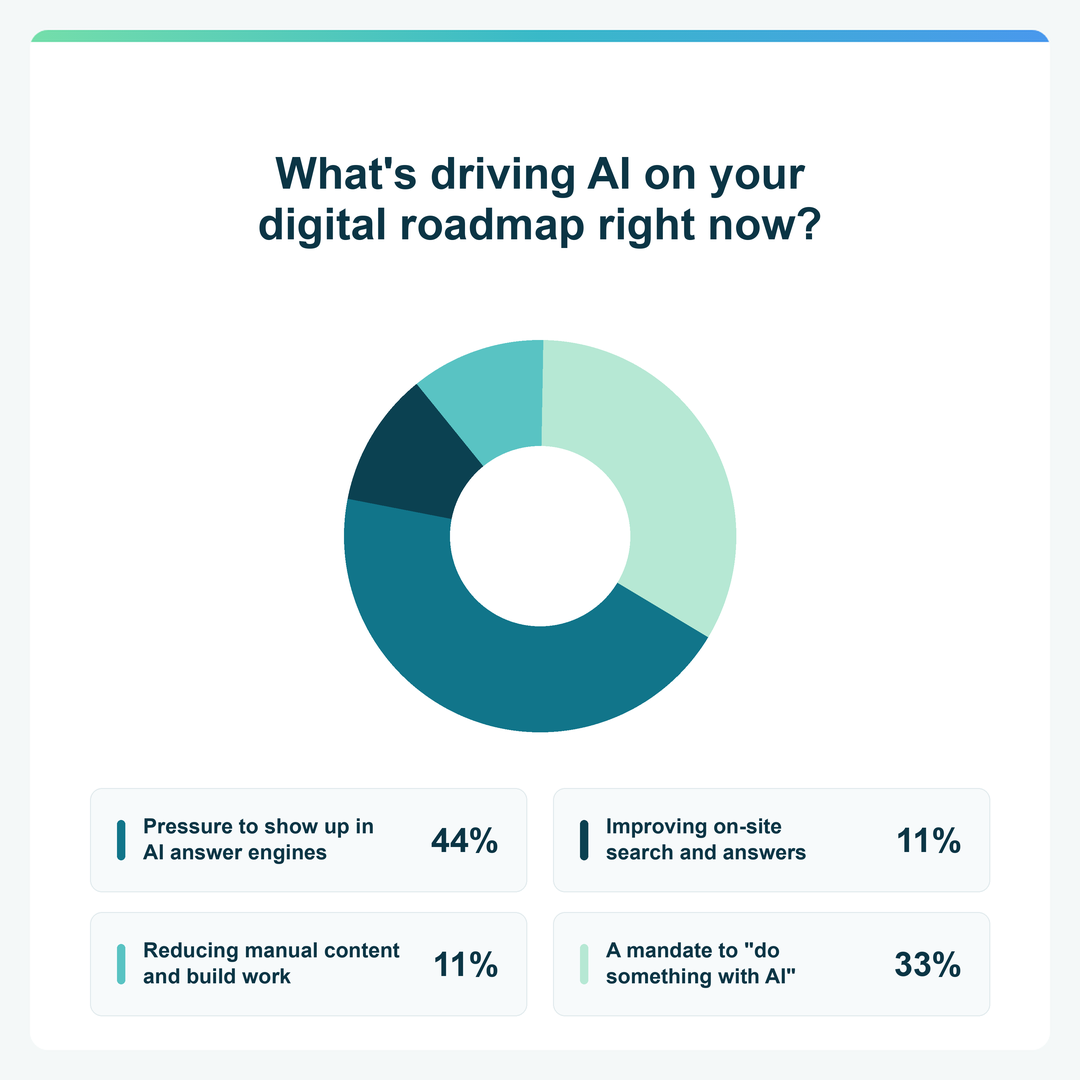
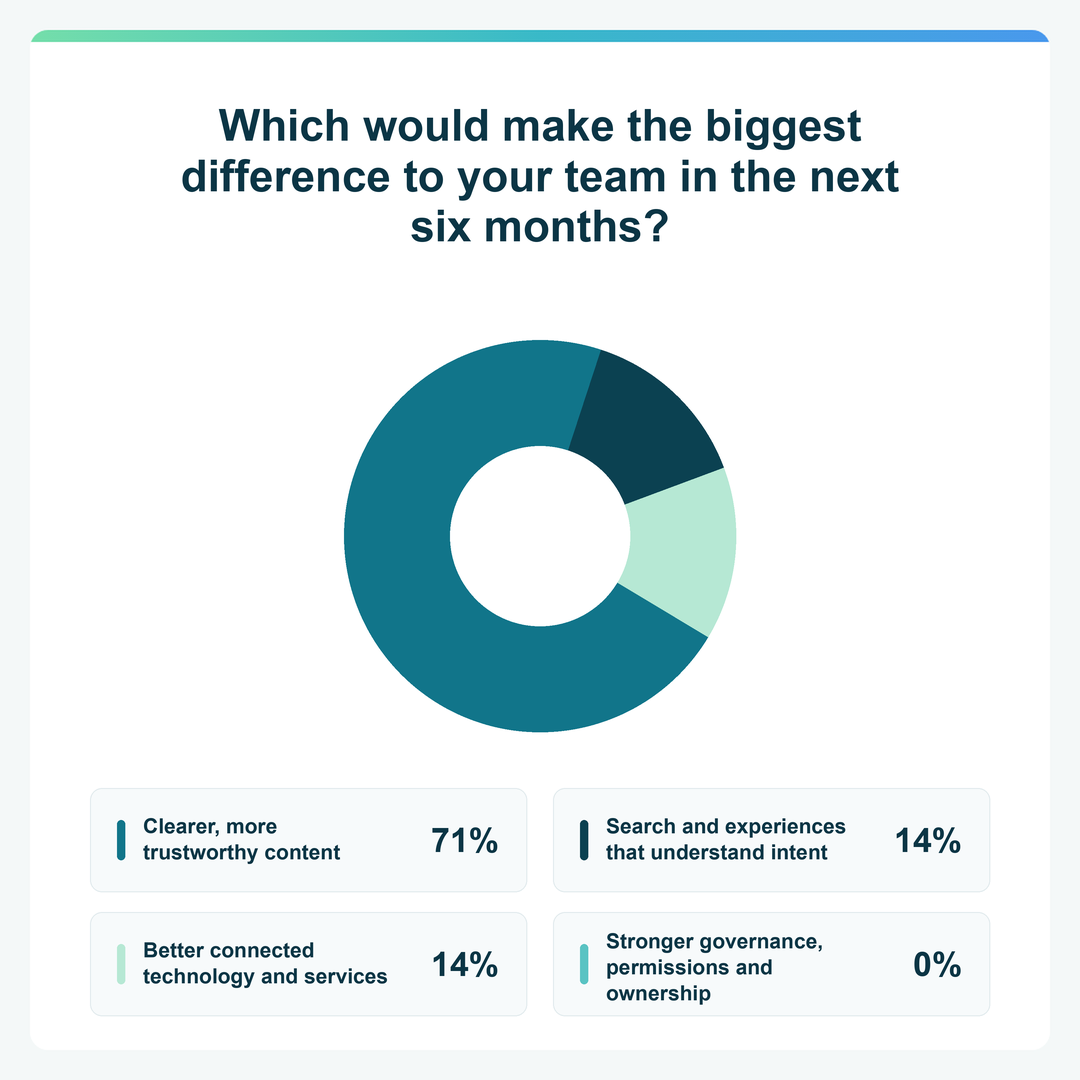
- Pressure to show up in AI answer engines – 44%
- Improving on-site search and answers – 11%
- Reducing manual content and build work – 11%
- A mandate to "do something with AI" – 33%
- Clearer, more trustworthy content – 71%
- Search and experiences that understand intent – 14%
- Better connected technology and services – 14%
- Stronger governance, permissions and ownership – 0%
Webinar Q&A
No. You need trustworthy content for the experience you are launching, but you don’t need to perfect your entire website before you can begin.
The aim is a manageable improvement cycle, not an estate-wide cleanup that delays everything else:
- Start with one high-value audience need and identify the content that supports it
- Check that those pages give clear, current, and consistent answers, with named people responsible for keeping them that way
- Fix the gaps, contradictions, and accessibility issues that affect that use case first
Squiz Content Intelligence can help by grouping content into topics, testing how well it answers likely audience questions, and prioritizing improvements. Test the chosen experience before launch, then use real questions and regular audits to guide the next round of work.
Pick one problem your team can realistically improve, rather than adding a whole AI program to an already full workload. That might be helping people understand application requirements, find the right service, or complete a frequently used form.
A small team doesn’t have to do every part alone.
Agree what you want to change and keep the measurement simple: more completed applications, for example, or fewer repeat inquiries on that topic. Identify the source content, involve the person who owns it, and make sure you have the technical support needed for the first implementation.
Keep the initial scope narrow enough that you can review the answers and act on what you learn. Proving one useful improvement gives you a stronger case for the time and resources to take the next step.
Look for a use case that passes four tests:
- It matters to your audience and organization
- It’s painful today
- The supporting content is identifiable and owned
- You can measure whether the change worked within a quarter
Search data, service inquiries, and conversations with frontline teams are useful starting points. Look for repeated questions, journeys that generate avoidable calls or emails, and information people struggle to understand. A university might focus on admissions requirements; a council might focus on a frequently used service.
Choose the audience need first, then work out which pages and systems support it. A neat section of your site isn’t necessarily a useful scope if people need information from several places to complete the same task.
A common mistake is making the project too broad before there is a clear problem to solve.
That can mean trying to fix every page before testing anything, or buying a tool because there is pressure to “do something with AI”. Both make it harder to demonstrate useful progress.
Start with a straightforward hypothesis: if we help this audience find a clearer answer and reach the right next step, we expect this outcome to improve. Establish a baseline, agree one or two measures, and test that hypothesis on a focused use case.
Also avoid treating content, the user experience, and technical governance as unrelated projects. A polished conversational interface will not resolve contradictory source content or a broken handoff to the service someone needs.
Start by controlling what the AI is allowed to answer from. For an on-site experience, that means approved sources, clear topic boundaries, and rules for what happens when the available content doesn’t support an answer.
Conversational Search, a capability of Squiz Funnelback Search, grounds answers in approved content and provides source citations. Content Intelligence helps identify gaps, ambiguity, and conflicting information before launch. You can also set answer guidelines and a default response that directs people to an authoritative page or a service team when an answer isn’t available.
Those controls reduce risk; they are not a guarantee that an AI-generated answer can never be wrong. Test real audience questions, review high-risk answers carefully, and monitor conversations after launch. Accurate source content and human oversight remain essential.
Not necessarily. AI search changes how people find and use information, but it doesn't remove every reason to publish a document. What matters more here is whether the information inside each PDF is also accessible, current, and easy to retrieve on the website.
For frequently used service information, consider whether a clear web page would serve people better than making them open a long document and find the relevant passage. Where a PDF still has a clear purpose, make sure its text and structure are accessible, its version is clear, and someone owns its upkeep. Avoid leaving conflicting answers in a PDF and on the website.
Squiz Funnelback Search can index document sources as well as web pages, but confirm that your particular files can be accessed and their text extracted correctly. Do not assume that every PDF is automatically suitable for an AI answer simply because it is online.
Yes. Separate systems are not automatically a barrier. What matters is whether someone can move from a useful answer to the right form, booking service, or contact point without having to work out the next step themselves.
Start with the simplest useful connection. That might be a clear link to the correct form or booking page alongside the answer. If the experience needs to show live availability, pass information between systems, or complete an action, that’s an integration requirement rather than something an AI answer does on its own.
Squiz DXP's Integrations capability supports connections to API-enabled systems, so existing tools do not necessarily need replacing.
Confirm the options for your particular systems, including authentication, permissions and personal-data handling, with your technical team. Finding an answer and authorizing a transaction are different responsibilities, and both need to be designed properly.
All three have a role, but shared involvement should not mean unclear accountability. Agree a named lead for the use case and define who owns the content, experience, technical connections, and ongoing review.
The aim is one coordinated initiative with clear responsibilities, not three teams introducing separate AI tools and trying to join them up afterward:
- Marketing or communications can be a useful starting point because they understand audience needs, can help frame the value and can tell the story of what has improved
- Digital teams bring the user experience, design system and reusable components
- IT brings the expertise needed to manage data, integrations, security and access
You can also bring in the relevant service or subject-matter owner too, particularly where an answer depends on policy or eligibility.
The conversation is less about the tool alone and more about what people and technology can achieve together.
The clearest way is to connect that expertise to better outcomes for your audience and organization. AI can help with completing tasks, but useful, trustworthy digital experiences still depend on people who understand the audience, the content, and what someone needs to do next.
Digital teams set the goals, maintain accurate and accessible information, establish guardrails, and review where the experience needs improving. As AI takes on more of the execution, that expertise helps guide the work and assess whether it’s delivering the right outcomes.
Teams may spend less time building every page and pathway by hand, and more time maintaining trusted content, reusable components, and connected systems.
Make that contribution visible through a focused project: show how the team’s work helps people complete tasks, improves answer quality, or creates more capacity for complex inquiries.
Yes, we have some examples of on-site Conversational Search:
Nottingham Trent University embedded Conversational Search within its existing search experience for topics including student life, accommodation, open days and campus information. The questions people asked, including those the experience could not answer, gave the team evidence about where to improve content and reconsider scope.
Pacific Union College focused on Admissions and Financial Aid, where preparation also exposed outdated dates, unclear scholarship information, and structural issues in the website content.
There’s a useful lesson in their approach: choose a clear audience need, strengthen the content supporting it, test the experience and keep learning from real questions.
Start with a problem leadership already understands, not with the AI technology.
For example: people cannot find clear eligibility information, so they call the service team; or a confusing application journey means fewer people complete the form.
Appearing in an AI answer or generating more conversations isn’t, by itself, proof that people are getting better outcomes, so establish a baseline and agree one or two outcomes for a focused pilot.
Some useful measures could include:
- Completed tasks or forms, calls and emails about the chosen topic
- Time taken to identify and fix content issues
- Effort spent maintaining a particular integration
Include the costs of implementation, content preparation and ongoing review, so the business case reflects the work as well as the potential benefit.
Set a review point and explain what evidence would justify expanding, changing or stopping the pilot.
A bounded investment with a clear test of value is easier to assess than a large program justified by a general promise of AI efficiency.
No. If your audience uses ChatGPT to research a topic or compare options, how your organization appears there is worth understanding. But visibility in an external AI answer is only one part of the opportunity, not a substitute for improving your own digital experience.
Start by asking which audience questions matter and whether the answers accurately represent your organization. Focus on clear, current information about your services, requirements and areas of expertise, rather than creating content simply to attract an AI mention.
Keep the distinction between influence and control clear with leadership. You can improve the information you publish, but you cannot guarantee that an external platform will include it or describe it correctly every time.
A useful approach is to treat AI visibility and on-site improvements as connected priorities. Help people discover you, then make sure they can find a trustworthy answer and complete the next step when they reach your website. A mention is useful only in the context of what you want your audience to understand or do.
Start by acknowledging that the concern is valid. Large language models can give confident, incorrect answers. Better source content helps, but it is not the whole explanation: a model can still make mistakes when accurate information is available. It would be misleading to suggest that every wrong answer is caused by poor organizational content.
A more useful conversation is about where an error happens and which controls can reduce it:
- Is the source information missing, outdated or contradictory?
- Did the system retrieve the right information?
- Did the generated answer reflect that information accurately?
- Did it recognize when it should not answer?
Use a small set of real audience questions to make this concrete. Review the source pages alongside the answers, identify the cause of each failure, then test again after changing the content or system settings.
Also distinguish a public AI tool from an on-site experience with approved sources and defined boundaries. They do not give your team the same level of control.
The aim is not to persuade colleagues to trust AI uncritically. It is to replace a general debate about whether AI is reliable with evidence about where a particular experience works, where it fails, and what needs human review.
Yes. There is a practical basis for this in how site search works, although it is not a promise that any content rewrite will produce a particular improvement.
For example, Squiz Funnelback Search supports the use of titles and configured metadata fields in ranking. Metadata is information that describes a page, such as its topic or content type. Clear, descriptive titles and accurate metadata give the search system useful information to work with.
Squiz's search optimization guidance also recommends cleaning information at the source and keeping unnecessary content out of the search index, because reducing that noise improves ranking quality.
The shared principle is to make the answer clear and easy to identify. Use meaningful titles and headings, explain the topic in the language your audience uses, and remove outdated or conflicting versions. These are useful content foundations, not a separate writing style just for AI.
To establish the benefit on your own site, choose a set of common search queries and record whether the right page appears prominently and helps people complete their task. Improve the supporting content, let search re-index it, then repeat the test. Content quality matters, but indexing and search configuration need checking too.