





Webinar
Who’s securing your digital experience?
Reducing security risk and operational burden across your website ecosystem.
Security is more than a technology problem. The people and processes behind your website matter just as much as its protective tools, and much of that work is invisible when things are running smoothly.
Join Squiz and Cloudflare for a practical, accessible conversation about what vulnerabilities mean, the work that happens behind the scenes, and what changes when a significant incident occurs. We’ll also explore the security and trust considerations that come with AI-powered experiences, with useful questions and actions for any organisation.
During this session, you will:
- What a vulnerability is, how it differs from an attack, and why exposure and context matter.
- How people, processes, monitoring, edge controls and patching work together, and where their responsibilities differ.
- What organisations should expect from providers during routine operations and a significant incident.
- What to consider before deploying AI-powered website features, including human oversight and safeguards around inputs and outputs.
- Practical questions and low-effort first steps to strengthen security and clarify ownership.
Register now









What AI-driven digital experiences mean for your website
Every digital team is being asked to add AI to its toolkit. Explore how your website could respond to what people are trying to do, what can get in the way, and practical places to start for three different industries.
Is your website ready for what comes next? Take our two-minute quiz to find out →
Watch the professional services session
Transcript: Watch the professional services-focused webinar
Welcome and introductions
Lorna Hegarty [01:26]
Like the Brady Bunch popping up. Welcome everyone to today's webinar, What AI-driven digital experiences mean for professional services. Thank you for joining us. Now, as we all know, professional services is built on expertise, reputation, relationships. So a recommendation might introduce a client to your firm, but a website or your website has to help them understand what you do, validate your expertise, and ultimately take them to the best contact. And all that information can sit across multiple pages on your site, right? So it could be practice overviews, it could be sector content, it's those specialist profiles that you house on the site. Today, we're going to explore what could happen if the website brought all those pieces together around what that client's actually looking to do in that moment.
We'll use an illustrative example of someone looking for information about managing an acquisition. We'll look at what needs to happen behind the scenes and discuss where firms, marketing, and digital teams can actually get started without assuming this needs to be a massive site overhaul and a huge project with a new platform. I'm once again joined by the wonderful Kat Barrow and Megan Andrews. Give us a wave. Thank you so much for joining us. They're going to be sharing their expertise and, of course, their experiences of working with firms around the world on these challenges.
Just a note to say as well that today's session is focused on professional services, but the core ideas that we're going to be talking through are really applicable to any industry, and we're covering a number of other industries in other webinars that we're running in other time zones this week. So please keep an eye out for those. We'll also be sharing the resources from all of the webinars this week in follow-up. So you will get the full package. If you have any questions, as always, please pop them in the Q&A box too. They're right there. We will try and address them as we go where relevant, but otherwise, we'll leave some time at the end to get to them. So with all of that said, Kat and Megan, thank you again for joining us.
Now when people say or you hear someone saying they've got AI on the website, I guess the first image that comes up is a chatbot answering a question, but getting an answer isn't the same as actually finalizing the process. Right? So what's the difference between giving someone an AI-generated answer and creating an experience that actually helps them take action and move forward?
From answers to action
Kat Barrow [03:49]
Yeah. Great. I mean, that's such a good question, Lorna, because certainly we've seen a dramatic increase in the number of people that are using these sort of conversational search interfaces, Whether that's ChatGPT or Claude, sort of third-party ones or sort of more recently implementations on websites themselves. And Squiz has had conversational search out in the market for over a year now. What's great about these AI-generated responses is that they are really, really good at reducing cognitive load. So instead of someone landing on your website and having to immediately familiarise themselves with your information architecture, understand your terminology and how you talk about your organisation and your practice, Having to find your search, do a keyword search, navigate the results, find the information.
Conversational search has done a really good job of dramatically shortening that process. So you can go from question to answer really, really quickly. And we've seen some really great success with that. However, I think what the next phase of this process is and certainly what we're starting to see is that, yes, it's great for going from question to answer, but what is missing is going from answer to action. So conversational search gives you the information that you need, but it's not always the best tool to actually give you your next steps. It's not always the best tool to empower you as an organization to direct people to the information and the actions that you want them to take.
And so that's what we're really starting to see now with the evolution of conversational search is wrapping the ability to direct attention and to drive next best actions around the power of that conversational search. So yes, the goal isn't just a better answer. It's actually getting someone somewhere useful and getting them to take action at the end of it.
Lorna Hegarty [05:37]
Yeah. Exactly right. You know, I mean, organizations have so much valuable content. And it's about using that content to drive the action that is going to A, best support the user's needs and help them find what it is that they're looking for, but also obviously support your organizational goals as well. So, sorry, Megan, were you going to add something there? I don't want to not hear from you.
Megan Andrews [06:00]
No. I just was thinking this in terms of the shift that we've been thinking about is really from journey to outcome. It's still a journey, right? You're still taking users where they need to go, but the destination is important. So knowing how to integrate all these pieces and focusing on what is the action here. And to your point, Kat, the friction piece is so much less now. We all intuitively see this as we're using Gemini or whatever tools we're using in platforms. It's easy to think about what you need and have it surfaced back to you. But is there a way for us to actually do something? I think that's a really interesting new space with design too.
An acquisition journey: from wireframe to demonstration
Lorna Hegarty [06:49]
Yep. Agreed. Okay. So we're going to have a look at this illustrative example that I mentioned at the beginning. Can I just make the point that that is one of the hardest words to say on the live webinar? So put yourselves in the shoes of our attendees. You're a legal firm. Someone's been referred to your firm. They're considering an acquisition and want to understand how you, the firm, can help and who they should speak to. Can you talk us through, I guess first, what that person might encounter on a typical website today? And then show us how the experience could respond as they are able to ask follow-up questions and take further action.
Megan Andrews [07:25]
Yeah, this is a great example. Think of this as a wireframe, right? So if you're thinking of your traditional website now, someone's going to land there and they're going to have to figure out where they go next. There is a menu, however you've set it up. You may have headers and footers. You may have a mega menu or big banners they're looking at. So where do they go first? This is where we've lived in design and UX for a long time. And then there's a way of thinking about this where, you you can see that there's six or eight clicks it might take for someone to get to where they need to go. Like, okay, I'm interested in, we're going to be acquiring a company. I need to understand which partner specializes in this area. How do I find that partner? Or do I need to look for acquisitions first? Do you start by subject or person?
These are all decisions that have to be made. So again, that friction comes up and it can take time. And each of those clicks, you're going to get people who fall off the process. So when you provide an experience like this sort of wireframe we have here, drop in your question. Someone comes into the site, the user says, hey, we're considering an acquisition of a company. Who are the right people to talk to? Now, what's great about that is you have an opportunity with these new types of search to what we essentially think of as like build as you go. It's hyper personalized. You can provide a text response. So a quick read, this is what you need to know, but then some options that are clickable. And Kat, I know you think about these types of experiences quite a bit.
How do you speak to some of the components that we've built around the responses here?
Kat Barrow [09:11]
Yeah. I mean, great question. I think what we've been working with a lot of our customers on is really focusing in on what is the journey that your users are going through from sort of broad discovery through to sort of a level of intent to connect with you or book a meeting or whatever the case may be. And at each of those stages, what are the a) kinds of questions they're likely to have and then b) what is the next best action to get them further and further down that funnel? And it's those next best actions that we are then pulling into interfaces like this to couple the best action with the great answer. And so what you end up with is, as you say, a very personalized response that is answering their question and is answering the question in their own words.
You know, I think particularly in professional services this is really important. If I am looking for support to buy a technology business, for example, I'm not a lawyer. I don't necessarily know whether I need mergers and acquisitions. Do I need, you know, IP law? Like what is it that I actually I don't know. So these are really great for cutting through all of that kind of jargon, giving people a way to ask a really natural question, but then tying it directly to that next best action. And depending on the stage that they're at, those actions might be different. If they're really in sort of an early exploratory stage, the action might be, hey, read more about our mergers and acquisitions team or download this thought leadership that we've created, for example. And it might be about building trust and brand.
Whereas if they're further along the journey and they're like, I'm buying this tech business tomorrow, I need to meet with someone ASAP, then that next best action is going to be a lot more targeted. It's going to be reach out and book with us, for example.
Megan Andrews [10:51]
Yeah. What I like about this is that with a little bit of thoughtfulness and just in terms of what might be related to different topics, the technology itself can figure out where it needs to pull in information. So you give it the right prompts, right? But it can connect the dots. I think that's a huge difference you see with this type of technology versus what we've seen with like traditional chatbot, lower right hand corner, it pops up the decision tree. There's so much that has to go into that. You're really directing every step of the way and essentially creating your own database of new content. This is not that. And I think there's a huge relief there that there's some prompts that need to be included, but the large language model itself can determine what's connected and relevant.
Kat Barrow [11:41]
Yeah, absolutely. So you're not creating a whole bunch of kind of spaghetti, if this then that kind of rules in your chatbot that you need to maintain long term. It's more about understanding the intention at a given point in time. If someone is asking questions about this particular theme, what is the next best action for them? That's all you really need to work out. And then as you say, Megan, the system will do the rest.
Lorna Hegarty [12:02]
Yep. Sounds nice. That saves a lot of time. It does sound nice. We talked about how... No. Sorry, Megan. You're far away.
Megan Andrews [12:13]
Well, I know that there's something floating around that Kat's been working on that is sort of an example of this. I don't know if we get to peek at that or not.
Kat Barrow [12:22]
We can totally peek that. Let me share my screen for you.
Lorna Hegarty [12:27]
You'll be unsurprised to hear I was going to ask the same, Megan.
Kat Barrow [12:33]
Great. So this is an example of what that actually looks like in practice. So obviously we were talking about some wireframes there. This is actually a working example for our very made up law firm Bain and Sterling. But as you can see the idea here is that we are providing as a first point of call on the website a conversational experience. So rather than someone having to go through our navigation here, they can drop in and they can ask a question immediately. Now they may have a question in mind, for example in the scenario where I'm looking to purchase a tech company, I might know that already. But in some cases people don't necessarily know what they want to ask just yet. They might just be exploring. They might be unsure of how to phrase a question. And so we give them these prompts as well.
And that just really helps ease people into the conversation, get them started and then they can take it from there. But let's say for example I go in here and say I want to acquire a tech company and need legal advice. So again you know I don't have to put in here I'm after mergers and acquisitions or intellectual property. I can just put in I'm looking at buying a tech company and it's come in here and used our conversational search engine to basically scan your content and generate a personalized response. So this is that low cognitive load bit, right? I haven't had to go clicking around to find this information.
But what's really powerful and what we were just talking about earlier is that now what we can do is actually surround this conversational response with rich content that allows us to direct attention to things that are going to support that user's journey, but also support our organizational goals. And so what I mean by that for example is something like this. So they're in the early stages maybe of asking some questions. They may want to go and explore our mergers and acquisitions in more detail. So we can do that. But we can also go, hey, these are the people within our firm who are best placed to support you in this. Why don't you book a consultation with them? So again, it's cutting through that complexity of figuring out where this is on the site, figuring out who the right person is, figuring out how to book a consultation.
Instead, we have bubbled all of that up immediately so that if they are ready to take the next step, they can just book this consultation. Or they might want to, you know, explore some more of your content. They might want to download or read an insight if you've got podcasts, for example. So there's a lot in here that someone can do to further that journey. But let's say, for example, I think Marcus looks great. Tell me more about Marcus. Again, this is something that is going to allow us to give them the information immediately so I'm not having to click around, but then also drive action because as you'll see, oops, this one didn't do it. Sorry, I must have phrased the question slightly wrong, but usually it'll bring up a little thing that says Marcus is based in the Melbourne studio and you can book a consultation with him.
So there is a lot that we can do to really shape and influence the user's journey to make sure that they're getting what they need and your organization is getting what it needs.
Lorna Hegarty [15:47]
Thank you, Kat. I just... I love that example. A... It looks fantastic, it's really great to see everything that we're discussing coming together. So you can really see the way things are moving in that sort of super interactive dynamic experience that people can start to expect from from the websites when they're looking for information.
Poll 1: Which journey would benefit most?
Lorna Hegarty [16:04]
We're going to take a very quick pause here for a moment and run a quick poll. So having seen some example journeys, heard from Megan and Kat about what those journeys might look like, we'd love to know what type of journey you think would benefit your organization most at the moment. So we've got a few options on the board there. So helping clients find the right expertise, helping them understand a service or process, helping people find the contact and... Right contact and specialists, and helping existing clients find guidance and support. And if you're not sure, that's absolutely fine too. Just let us know what you think.
I just like seeing these come in because you might think it's one thing, but then [unclear in captions]. Exactly. Wow. It's actually pretty even spread right now. We'll see where we end up.
Kat Barrow [16:53]
Yeah. Yeah. I mean, it's interesting. It looks like, helping understand a service or process is taking the lead, which makes again a lot of sense you know in professional services environment whether you're looking to engage a law firm or an accounting firm depending on you know your level of experience working with these types of organizations. You know, the average person looking for legal advice doesn't always know how it works or what to expect. And so I think, you know, there's a lot to be said for leveraging the content that you have on your site to build that trust by really, you know, holding people's hands through the journey, connecting them with the information that they need, making sure that they're informed so that they can engage with you successfully.
Lorna Hegarty [17:38]
Love it. We've still got a couple coming in, but it looks like we've landed on helping clients understand the service and process. So... Which is obviously a super broad category as well and can show you just how much you can pull into that one place and really understand that one client's intent in that moment. Love it. Well, thank you all so much for answering that one.
Content accuracy and governance
Lorna Hegarty [18:02]
We're going to move on to think about how you keep information accurate and ensuring that it's, you know, always supporting that next step for users as they arrive on the site. The improved journeys and experiences we've seen in the examples look fantastic. They sound fantastic. But I know a lot of the concerns in the room might be around the content that's out of date or the missing processes that stitch the website to actually getting someone on a call with someone in the firm. So from your point of view, what do you... What would you say needs to be fixed first before these sorts of experiences become a reality?
Kat Barrow [18:38]
Yeah. I mean, yeah, those those are very valid concerns. And certainly the two things that you've mentioned there, Lorna, I think are top of mind. One being obviously your content quality and the other being the governance that sits around this whole process and around the organization more broadly. I think with content quality what we're seeing which I think is very interesting is obviously this is an emerging space. In the early stages of content optimization for conversational search we were very focused on sort of optimizing everything, making sure everything was you know GEO-optimised and you know ready to go from an AI perspective. What we're seeing now is that the things that really matter are things like factual accuracy, you know correcting things that might be conflicting or out of date.
It's less critical that we go in and kind of with a fine-tooth comb go through every single page and adjust every single page's kind of content to be super optimal. Because AI is evolving very quickly and is able to somewhat abstract those facts away from the way that we present them from a written perspective. So it's really factual accuracy and trustworthiness that is critical. But yes to your point I think the governance side of things is absolutely critical because without the appropriate processes in place, the appropriate sort of ownership in place, it becomes very difficult A to figure out how to optimize their content because you don't know who owns it. And B how to actually then connect those actions through the broader organization. So for someone to come to your site, ask a question, get a response and take an action.
That action needs to have a clear owner. It needs to go to the right places. It needs to be followed up correctly so that you don't end up with sort of a cliff where you've got inquiries coming in that they're not going anywhere. What are your thoughts, Megan, on this, like in terms of how do we make sure that we are creating conversational experiences that are effective and well governed?
Megan Andrews [20:38]
Everything you said and then something that resonates with me, I've heard it from a number of different customers at this point. Nearly every time we're talking with a law firm or any professional service, it's, Hey, can we make sure that this doesn't actually give the legal advice? You need to trust your tool, right? You don't want some tool out there that's going to fly off the handle and assume that it can be an attorney in your firm. So, you know, what the configuration looks like and your options on the back end are also really important. We may touch on this a little bit later, but it matters which technology you're leveraging. So it's not the content piece, but how can you implement it in a way that you trust? So I think content is always square one, right? Being accurate.
And then from there, we're seeing more and more around implementation configuration and then connecting everything through. So it is, yeah, we're starting to see some pretty clear paths to pay attention to.
Kat Barrow [21:42]
Yeah, absolutely. And I often come back to, I think it was probably a couple of years ago now our digital trends report. We had a theme in there around AI being an intern, And you need to treat them as an intern or it as an intern. Now AI has probably graduated. In fact, I think that's our current trend is AI has graduated from being an intern, but it's still a junior team member, right? And the same way that you wouldn't set a junior team member loose on your organization without the appropriate governance and oversight and equipping them with best practices and all of that kind of thing. The same thing goes for your AI and how you implement that. If you don't have those best practices and frameworks in place, you don't have the guardrails in place, your junior AI employee is likely to do something silly.
So as Megan said, I think it is really critical that you're choosing a tool that allows you to enforce those guidelines because you can technically go and just set up AI relatively easily with just any old random tool online, right? But having the confidence that it's trustworthy, it's performing correctly, it's obeying and observing your guidelines is really critical, especially if you want to scale it more broadly.
Connecting content, AI and human handoffs
Lorna Hegarty [22:57]
I think we're kind of touching on it with those comments and I like it. You're preempting my next question. But if we're thinking about that... We've talked about kind of the front end experience that we want to be able to offer our users. We're thinking back to that sort of acquisition journey as an example, what are all the things that kind of need to connect behind the scenes so that we can move someone from question to the right person or the right next step?
Megan Andrews [23:23]
Content is key. So make sure everything's updated. I think getting a solid foundation in content is the goal, and it's the brick that allows you to build. So start there. And then, you know, Kat, love how you talked through AI, actually AI-driven experience, right? Where there are all these options now for interpreting or prompting around certain topic areas. Having the machine itself, the large language model understand, okay, these things are related, I can surface them in this manner. So it becomes more about orchestrating, right? Thinking through how to orchestrate the elements that are already there instead of building with each brick and sort of saying, hey, here's a way to design this thing. You pull in the bricks as you need them. I don't know if that resonates, if you're thinking about building a new house?
Kat Barrow [24:21]
It does. Yeah, it definitely does. I think it's, you know, what, as you say, the content is really the foundation, but then you need a way to be able to create those generated experiences on your website and expose the power of your content through some kind of AI-driven interface. And as we were just talking about there are many ways to do that. It's really important that you have one that is trustworthy and secure and controlled and governed in order for you to be able to do that. And then, yeah, I think that it's up on screen there, but the service or human handoff is really critical. And that's what I was talking about earlier as well is it's all very well for us to say what's the next best action for someone to take and to make it possible for them to do that online.
But that then needs to connect up into your broader customer experience journeys to make sure that that is a smooth process is going to the right person. They're connecting up with that person and reaching out kind of closing out that inquiry. I think more and more we have to start thinking about customer journeys in terms of your website experience, the AI experience that sits within that and then the human experience as well.
Megan Andrews [25:29]
Humans are still in the loop. We're not irrelevant. I like to say this a lot. As we think about how to set these tools up and then as we think about those outcomes, yeah, it's always, these tools help us, but we need to understand how we get there. And these are relationship driven. Professional services is very relationship driven as well. It's all about trust and getting people to the right fit for them as quickly as you can. And I think that's where the insights for improvement becomes more interesting when you have a little bit more to work with than one keyword, one search term, I love, you know, the number of ways you can interpret one word are vast, but when you have a full sentence and follow-up questions, you really start to get a sense of what your users are thinking.
And that gives you a much better idea of how to continue to optimize their experience, right?
Kat Barrow [26:22]
100%. Yeah. I mean, I was just having a conversation with a customer the other day who has one of these experiences live at the moment. And what was really interesting is they were looking at their data and they were going, you know, people are averaging about three questions per conversation. The first question at the moment typically is a couple of keywords because, you know, people are still used to expecting to have to think in keywords. So they're putting in like mergers and acquisitions, for example, into the conversational search. But what they're getting back is so rich and so conversational, but then all the follow-up questions are like their whole life story. Exactly what they're looking for, all of the context.
Obviously not, you know hopefully PII type stuff, but you know really rich insights that you would otherwise not be getting. And I think that's what's so exciting about this product as well. Because I know that top of mind for a lot of our customers at the moment is how are we performing on ChatGPT and Claude. It's like a black box. We don't know. We don't know what people are asking about us. We don't know what conversations are happening there. Having something like this on your site really starts to give you ownership of those insights. Because if someone's asking those questions on your website, you get to see as Megan was saying the questions, the rich detail, the context. You can identify what it is that people care about.
You can identify where your content gaps are that can inform things like thought leadership that you might want to publish which then contributes to your overall brand and trustworthiness in the market. So it's extremely, extremely valuable. And then those learnings go back into your conversational search experience and it becomes this virtuous cycle of improvement.
Choosing a first journey and testing it
Lorna Hegarty [28:00]
And so we've talked a lot about journeys and we asked everyone what they think their key journey is that they'd need to work on first. I guess there's always ultimately going to be several different journeys that everyone would like to be able to tackle. But how would you recommend that teams choose the first one to tackle first, I suppose?
Megan Andrews [28:23]
This is one of my favorite things to talk about because there's usually two places to start, and they're pretty obvious, what's valuable and what's painful, right? So you can sometimes know these things intuitively if you've been around your website long enough, but you always usually have data that will show you whether it's really frequently visited sites or pages or search terms. Those things are all going to tell you what's valuable. Or sometimes you're going to know where things are breaking down, right? What's painful, what's difficult, what do you know is like really not working seamlessly on your site. So those are great places to start and you don't have to overthink it. I think that's one piece of advice is you could easily think, we've got to get the whole site in a place that works. You really don't.
You just need to start somewhere that'll have impact. The site will get there over time, but start where you can have an impact. I think then from there, right, Kat, you can start to measure and iterate and improve.
Kat Barrow [29:29]
Absolutely. And I think, you know, it's a really good point, Megan. The example that I showed has a conversational search on the homepage that's answering all the questions and doing all the things, right? But that's not necessarily where you have to start. A lot of our customers we're starting with a much more tightly scoped experience that is on a particular part of the website that has particular context wrapped around it and it answers certain types of questions. So you might have something for example that purely focuses on mergers and acquisitions and it's in the mergers and acquisitions section of your site and it answers questions about that because that's an area perhaps that you are known for in the market. It's an area perhaps that people find difficult to navigate and you want to help them.
And so it's really about thinking about where do you start. And over time you can expand that out until you have the all-singing, all-dancing one that's on the homepage. But you don't have to be overwhelmed in the beginning. Same thing goes for that kind of rich content that was wrapped around. You know, you don't have to have six different calls to action and profiles and embedded forms and things from day one. There's a lot that you can do to just go, what are the three stages that someone's going through, right? Discovery, like early stage exploration, consideration, and then intent essentially to contact you, right? If you just split it into those three stages and identify one call to action for each of those stages that you think is going to drive success, that's a really great place to start.
It doesn't have to be extremely complicated or extremely time consuming to set up.
Megan Andrews [30:58]
I think that's an important piece because you could easily, as a team, have analysis paralysis, right? That, Oh, we need to do something. We're not sure where to start. This is my favorite part, even of technology and marketing in general, is that testing and learning is still always the best method. And to be fair towards this technology, we're all learning what's working really well right now. And I think this is a new era where, the A/B test is going to be crucial. How... What a playground right now. How do we actually connect these systems in a better way?
Kat Barrow [31:37]
Absolutely. And I mean the good news is certainly with our product the way that that works is you can A/B test inside that product. So if you've got two blog posts that you've written and you're interested to see which one resonates more and drives more engagement, you can A/B test them. If you've got two contact forms, two booking forms that, you know, slightly different phrasing, slightly different imagery, whatever the case may be, you can A/B test those. It's all built natively into the platform. And personalization as well. So if you're personalizing based on region or what you know about someone and what they're doing on your website, all of that can be added in as an additional kind of lens into that overall experience.
Poll 2: What is the biggest challenge?
Lorna Hegarty [32:17]
Love it. We are somehow coming close to time. It is wild how quickly these things go. Before we wrap up and go to Q&A, we're going to do one more poll. We'd like to understand: we've talked about everything you need to think about from journeys to content to tech and everything that needs to work behind the scenes. Now this poll is all about where you feel you currently have the biggest gap or challenge in getting started. Let us know what you think.
Megan Andrews [32:48]
Yeah. There's always a range here too. I think every organization I talked with is in a different place or even certain team members have a different opinion sometimes. So I'll be curious where people land here.
Lorna Hegarty [33:01]
There's some really, good questions in there. I'm just keeping my eye on the Q&A. There's loads going through. Understanding search and AI-driven answers seems to be a front runner. And I think there are a few questions about that for the Q&A as well. So let's go ahead. Let's wrap things up in terms of what we've talked about so far and make sure that we can get through some of these fantastic questions that we've got. Nice. Perfect. Let's close the poll.
Key takeaways and measuring outcomes
Megan Andrews [33:39]
Well, I think the clearest piece about this is start with a new framework, new approach. Understand that we have different opportunities now. I think this is an opportunity for your team to start wrapping different ideas around what's always been the same content in some ways. So yes, get your content right, make sure it's accurate and you trust it and that you can put the tools in place. But I think Kat, there's going to be lots of different recommendations and maybe some movement around best practices with these types of tools. Just out the gates, I know you've been looking at some outcomes already, what can people start thinking about that's going to be effective?
Kat Barrow [34:26]
Effective in terms of?
Megan Andrews [34:29]
Driving these outcomes, the ways we've talked about building these new experiences on their sites.
Kat Barrow [34:35]
Yeah, absolutely. I mean, look, at the end of the day, I think a lot of the things that we've covered off today are really what need to be considered. Right? It's about... And I love how you talk about it, Megan, in terms of what's valuable and what's painful. You know, focusing on that use case, being really clear on that. And then also having a clear and measurable outcome. I think that's something that we haven't necessarily touched on today but is really important. Because if you're thinking about getting started with a single journey and your ultimate vision is to get to the kind of incredible singing and dancing one on your home page, right? The best way that you're going to be able to do that from an organisational perspective is to be able to prove value. So you're turning it, you're choosing a journey that's valuable or painful.
You need to then be able to show how we are actually addressing that challenge. And so it's a really good idea to think about it in terms of a hypothesis. This is something that we've had in user experience and kind of lean product design for a long time. But if you can phrase it as a single sentence, like we believe that the number of people booking initial consultations will increase if we're able to embed this on this page and we're going to measure it in this way. That gives you a really succinct way, A, to be able to focus on what it is that you're trying to create from a value perspective and B to be able to tell that story later. And then it's just making sure that you're actually measuring it, that you've got a baseline or you're running an A/B test for example.
So that you can then go to your stakeholders and tell that story about how you've created that value and then use that to scale.
Audience Q&A: How does the experience work?
Lorna Hegarty [36:06]
Lovely. Right, let's get into some of these questions. I'm going to go through and just cherry pick some of them. But you shout, Kat and Megan, if you've seen others that you were desperate to answer as well. And one that I thought was particularly interesting is: are we talking about an inbuilt agent that personalizes the journey for the visitor and drives them to take action so the web pages are acting as a database of information?
Kat Barrow [36:30]
Pretty much, yes. So effectively how it works is the conversational search uses your website data and content. You have full control over what content on your site you wanted to use, so you don't have to index, for example, your whole website. You can choose a subsection of it. But conversational search and our other tool, Content Intelligence, work together to effectively scan your web content. They identify topics that exist within your content and then what happens is they generate thousands and thousands of questions that someone might want to ask about that content. And then they generate the answers. And that effectively creates a query database is what we call it that is then used for your conversational search to generate those responses.
So yes the conversational search which if you remember the demo was a little bit that was kind of typing out. That's the bit that's using your data to generate those responses. The rich content that sits around that is curated and controlled by you. So your team would go in and basically what you do is you say, what are common themes that people might be asking questions about? So for example, mergers and acquisitions might be one. Whenever anyone asks a question about mergers and acquisitions, what is the content that I want to show? And you basically use our visual page builder, which is really, really easy drag and drop interface. And you add, you know, a call to action there, a blog post there, a book a consultation button there.
And then anytime someone asks a question, the chatbot will intuitively go, sounds like mergers and acquisitions, and it will show that content. As I said, from a personalization perspective, you can also use... And I won't get into all the detail, but we have personalization functionality in the DXP that you can use to also personalize that content as well.
Audience Q&A: What about external AI tools?
Lorna Hegarty [38:12]
Another great question. Thank you, Kat. Another great question we've had in from Eric is around... So he says many users will start their questions outside of your website in search or directly in AI chats. How do you make sure that the user actually ends up on your site? He's asking around the value of kind of spending time on these sort of tools rather than actually just putting the effort into making your content digestible by those, external AI tools.
Megan Andrews [38:35]
Oh, I love it because these types of tools make your content digestible by all those external platforms. Yeah. You're going to have insight into the Content Intelligence tool itself actually is a large language model trying to interpret your site. So you're going to see exactly how that works, where it's getting confused, where you have contradicting content. It flags all of that for you. Now, what's interesting is, of course, we want to know we're showing up on these external platforms. We want to know that our firm's being mentioned. We don't have any way to know. So right now it is a black box. None of those companies are sharing that data. It's not actually visible in any way. What is true is you can sort of mirror what users might be asking and see if you are mentioned. Now that can have some value, right?
Are we coming up in the top three? But it's also, know, a lot of these platforms are personalized to different users, where they are in region, some of their history, right? They have profiles and they're surfacing relevant information along with what they already know about these users. So it's quite puzzling to know consistently how you perform. The only thing you... We talk about this quite a bit. What you can do is control what you can control and do what you can to influence how you'll show up on those platforms. So I think, yeah, Kat, when we talk about content, getting content in tip top shape, it actually is driving hopefully everything off your site as well.
Kat Barrow [40:09]
100%, yeah. Right? Yeah, I agree. And that's what I often say is the single best way that you can optimize your content for third-party LLMs is to have your own conversational search on your site. A, because as Megan was saying, it gives you a way to model and test and interact with that LLM and see how it's answering questions. We have features where you can bulk upload questions and see what comes back. So it really gives you an environment that is somewhat of a substitute for the missing environment that we don't have in those third-party LLMs. We don't have any visibility there. Implementing it on your own site A gives you that functionality. But also as we were saying earlier, it gives you real user data and real user insights.
I think the other thing I would add there is, and I was talking to one of our clients about this the other day, there is a very real scenario and I think it was mentioned in that question actually, where people are starting the conversation on a third-party tool and then landing on your website. Now at the moment we don't necessarily know if they've started their conversation elsewhere. We just know they've landed on the website at some point and maybe they're a bit further down the discovery path than they would have been in the past. But there's a lot of stuff coming around things like MCP servers, which if you're not familiar with them is basically like a way for us to expose data directly to the chatbot or directly to the AI instead of the AI having to go to your website to find it.
When those things arrive we're going to be able to create much more connected journeys because we're going to have better visibility over what people are actually asking in ChatGPT and Claude and we will be able to kind of connect those things up. And there's a very likely scenario that in a you know a year or so from now we'll be able to do things like embed your content, your branding, your calls to action directly inside ChatGPT or Claude. They effectively become like a browser, like a new version of a browser, right? So a lot of the conversation we have around AI is kind of where are things going and you know, what's the future of my website? And you know, we have ideas clearly, otherwise we wouldn't be running this webinar. We have theories and ideas around where we think things are going.
But the reality is no one knows exactly where we're going, right? But there are foundations that we are very, very confident will put you in good stead for whatever happens. And those are things like having conversational search on your website because that's what's going to allow you to really understand how your content is performing.
Audience Q&A: Will future websites include conversational search?
Lorna Hegarty [42:39]
Which kind of goes some way to answer one of the other questions we had, which was specifically, will the next generation of websites come with this AI conversational search inbuilt? My guess is...
Kat Barrow [42:52]
Yeah. Yes. I mean, I certainly think so. If you've come to any of our other webinars recently, you would have heard me go talking about sort of the intelligence era as being the next era of user experience and digital experience design. It's very exciting. You know, my background is UX, I've been doing this for a long time. And it very much feels like a step change in how experiences are presented online and how people interact with content online. And I very fundamentally do believe that we are shifting from a world where websites are static essentially. We are designing them, we are creating them, and we're doing our very best to anticipate how someone might want to use it and make it easy to use. That's what user experience is all about.
But we're moving from that scenario where we're building something and people have to use it to a world where websites are going to be much more dynamic, much more generative, much more responsive to the person using them and the context that they're using them in. So yeah, that was my very long version of yes, I do think that will come built in in the future.
Closing remarks
Lorna Hegarty [43:56]
Well, pretty much brings us up to time and there are so many other questions that I would love to stick around, but obviously rest assured as always, we will make sure that all of these questions are answered in our follow-up. So as well as the content from the other webinars, you will also get all the answers to all the questions here. So apologies if we haven't got to yours, but thank you all so much for sharing them. Please do, as always, we've got the QR code there for our assessment. Jump on there. You can answer a few criteria questions to understand where your website fits at the moment in terms of being ready for this sort of next iterative experiences.
So you can get your score, get a bit of an understanding of what that score means, and then grab some time with this team to understand a bit better if you want to deep dive into it. So grab that link right now, ask those questions, and off you go. But thank you all so much for joining. Thank you again, Megan and Kat, for sharing all your words of wisdom. It's been fast and furious as always. Thanks, Kat. Thank you.
Video: Watch the professional services-focused webinar. Captions and transcript available on playback.
Poll results for professional services
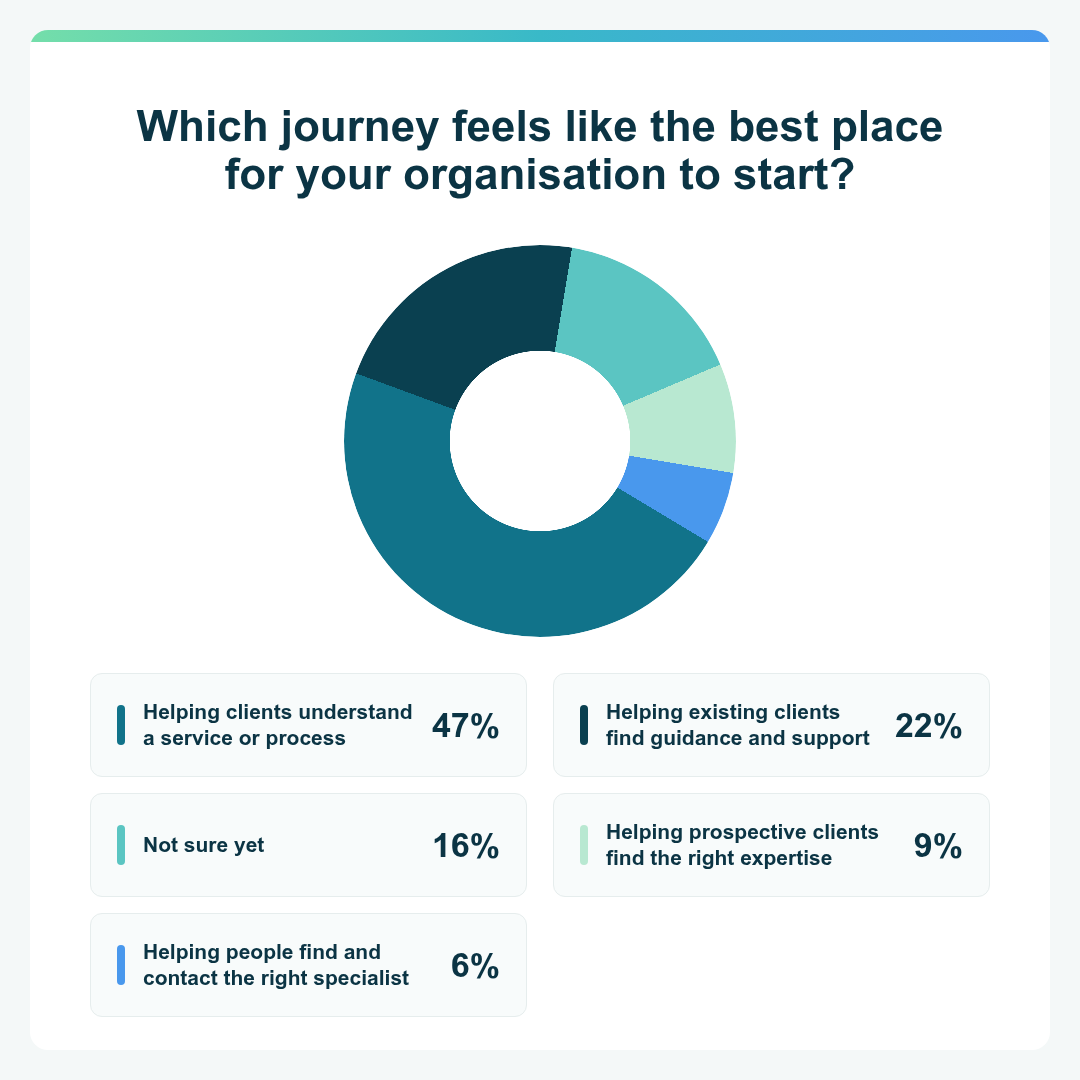
- 47%: Helping clients understand a service or process
- 22%: Helping existing clients find guidance and support
- 16%: Not sure yet
- 9%: Helping prospective clients find the right expertise
- 6%: Helping people find and contact the right specialist
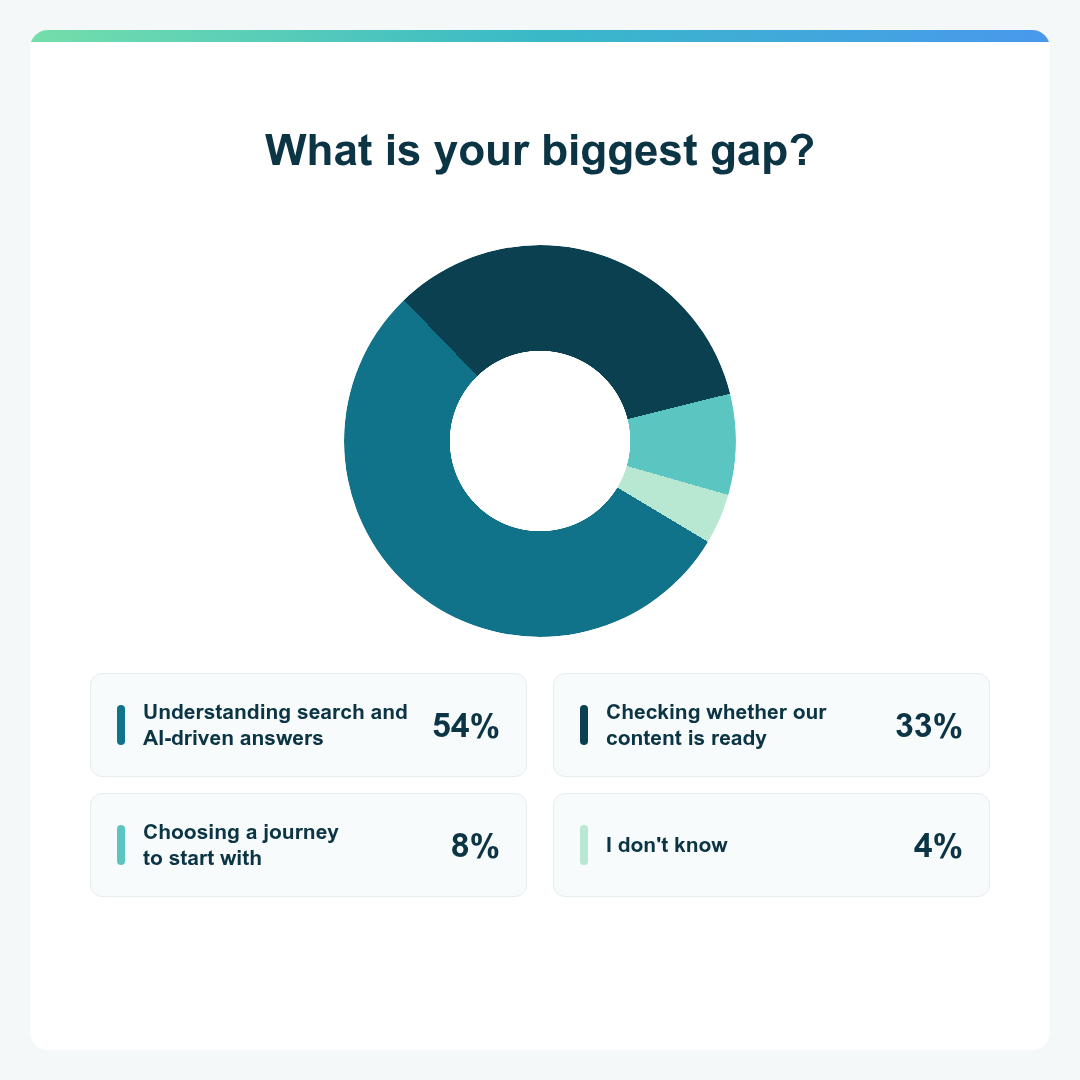
- 54%: Understanding search and AI-driven answers
- 33%: Checking whether our content is ready
- 8%: Choosing a journey to start with
- 4%: I don't know
Watch the government session
Transcript: Watch the government-focused webinar
Welcome and introductions
Toby Margetts
Hello, and welcome, everybody. We're just gonna give it, sort of fifteen, twenty seconds or so, to make sure everybody's in, and then we'll get going. In the meantime, there is a QR code on the screen as well. If anybody would like to take our two minute assessment to find out whether your website's ready for what comes next, exactly what comes next is what we're gonna be talking about today, but, yeah, feel free to give that a scan and go through that process.
Alrighty. Well, thank you all, very much for joining us today to chat about what AI driven digital experiences mean for government. It's a particularly interesting time, I think it's fair to say, for local governments with LGR, Local Government Reorganisation, underway in many parts of England.
Councils, I think, it's fair to say, are facing some pretty significant changes in terms of how they're structured, how services are delivered, and ultimately how residents interact with them.
I think that raises some really interesting questions, the main one probably being as councils come together and services change, how do we make sure that the digital experience becomes simpler for residents rather than more complicated?
I think because ultimately, residents and businesses don't really care which council department is responsible for a particular service or which system sits behind it, they really just wanna find accurate information, understand their options, and get things done.
So today, we're going to explore how AI driven digital experiences can help address some of those challenges, how we can move beyond simply just providing information towards experiences that actually understand what someone's trying to achieve, and ultimately help them take that next step.
I'm really pleased to say that I'm joined today by Jake White, who is one of our digital strategy directors, and also Tom Noble-Sabokbar, who is our public sector consultant. Please do submit any questions as we go. We've put aside about fifteen minutes or so at the end of the session today to do a bit of a Q and A, so, yeah, please do get your questions in.
Alrighty. I think when people kind of think AI on a website, they often picture a chatbot answering a question, maybe visions of Microsoft's Clippy back in the day. I might be aging myself a little bit there, but those kind of bots, think it's fair to say, have come a long way, particularly in recent years, but I think getting even a really good answer isn't always the same thing as making progress.
Someone might also actually need to explore relevant information, feel confident in it, and ultimately know what they need to do next.
I'm gonna invite my two experts to chime in here. The question I wanna kick off with today is, what's the difference between actually giving someone an AI generated answer versus creating an experience which actually helps them kind of move forward and take that next step?
From answers to action
It's funny, isn't it, how Clippy is always the barometer for the chat missing.
I miss him.
Jake White
Oh, no. There we go. Yeah. Look. I think it's really crucial to kind of first off say how important it is for professional public services to keep up with ongoing trends in the market as well. Citizens are users at the end of the day, and it's really important that the way that they are interacting across the board with the likes of Uber, Netflix, Deliveroo who enter ChatGPT, Gemini Perplexity. I think it's really important that we make sure that they're still getting that experience elsewhere because it's gonna become very jarring if they're using that all the time and then come a to a site and don't get that experience elsewhere.
And I think that experience is seen within chatbots as well. Right? Like, I was talking to a council. I won't name the council, but who are kind of quite cutting edge in terms of their adoption of AI.
And they have a chatbot on the site that I tested against kind of various other chatbots, and it does give pretty good answers, to be honest. Like, it's very good and very informative in terms of what it what it does. But speaking to that council, they were seeing uptake of that was incredibly low. And I think, personally, that is from kind of either people having a bad experience from a chatbot.
Like, I use them for, you know, my broadband provider, my mobile phone provider, and typically, they aren't particularly that good. And I think you get a one shot go at chatbots and if people use it or not. Whereas I think an experience...
When we talk about experience, a generative experience where they have conversational search through the search bar on a website or something similar, whether that's browsing or anything like that. A generative experience allows you to blend the... Blend what the user is used to seeing when they come to your site and actually providing that impactful information to them straight away. Obviously, you've worked so hard to cultivate that experience that you've built on the website, and users are used to using that to find the information they're looking for.
And with browsing and search, what we're seeing in the market, browsing and search are becoming one and the same. People are coming to the site expecting to find what they need straight away, not having to go and, we call it, perform their own research project. Right? But not having to delve really deeply into complex UI...
Complex structures and things like that also make no sense to them. Right? So the real key here is helping users find the information as quickly as they can in a format that works for them, but also allows you as the the kind of provider to give that information as quickly as possible and in the most relevant way as well, I think.
Tom Noble-Sabokbar
Yeah. I think those are those are really good points, Jake. I think that for me, the big difference is that an answer is really... Like, an answer on a website is just kind of the beginning. So if I ask a website a question and it gives me a paragraph with text, that's quite helpful, but I'm still kind of left figuring out what to do next.
I think an AI digital experience or generative experience can understand what I'm trying to achieve, bring together the relevant information and then help me take that next step. If you think about, like, in the public sector, that could be understanding, you know, if you're asking about bins, what other things are you going to be asking about? It might be weather warnings. There could be a whole range of other things that you want to signpost people to. So when you take that into consideration, I think for me it's about helping not just get people to the right information, but helping them progress as well.
Toby Margetts
That's a really interesting thing there. I know we've all kind of talked about it previously.
The Google share price tanking recently was on the front page of everywhere.
We know that AI answers in Gemini have led to a big decrease in clicks, and obviously clicks on ads is a core part, most core part of Google's business, and I guess in some ways it kind of shows how highly valued the pursuit of good answers is, the fact that Google are almost willing to temporarily cannibalize a big part of their business in pursuit of them, but then equally I think we look at that, don't we, and think, well, that's an interesting approach, but there is maybe a bit of a different approach there. It doesn't have to be one or the other, it doesn't have to be good answers versus clicks. It could potentially be both, and ultimately, that's providing great answers alongside really helping users to take that next step, which is exactly what we're gonna be talking more about today, So yeah, really looking forward to getting stuck in.
I think to pivot a little bit, clearly the goal, I think, isn't just a better answer, as I just said. It's actually helping people to get somewhere useful.
A bulky waste collection journey
I now want us to imagine a bit of a scenario, something that's probably pretty common amongst councils, but imagine a resident is looking to arrange, let's say, a bulky waste collection but doesn't actually know what the council will collect, whether there's a charge or how to book. I know you're laughing, Jake, because it's probably a conversation you have quite a lot. I'd love it if you guys could walk us through a little bit about what a kind of resident might encounter on a typical website today and then show us maybe what that kind of reimagined experience Yeah.
Would look.
Tom Noble-Sabokbar
I'm happy to jump in there to talk about my experience of talking to a lot of councils across The UK.
I think, you know, today, this sort of traditional council website that we are all familiar with is fairly static, and for good reason, right? It's a place where residents want to go and get things done quickly. But how people behave and how users behave has evolved a lot. So whilst before going to a home page and being signposted to click on things and scroll would have been the user behaviour maybe two, three years ago. That's now evolved into something completely different where they're starting their journey in large language models, then being faced with a completely different experience on the council website that isn't in line with what they're looking for. And so, Jake, I know you're you're gonna jump in to talk us through what that could look like in the future.
Jake White
Yeah. And I think, first and foremost, apologies to everyone from a local authority that we're talking to you about bins. Again, I feel like that you must get really bored of just talking about bins, but obviously, it's an incredibly important piece, especially as it's, I think, the most asked question on most local authorities' websites. But...
Yeah. To echo Tom's statement there, I actually went to my local dump or tip or whatever you wanna call it on Sunday. And I was kind of looking through, and I had certain things that I wanted to get rid of.
And I had to go through about four or five pages to even just book my slot to get onto the dump, but then let alone find out what I could... What I had, what I could dump there, what I had to take elsewhere. So like, it's... Do I need a skip for all my the y stuff? Do I need to take a sofa here, for example? Can I take that to the dump? So it needs to get collected. So that's the example that we're we're taking here.
And that found...
I found that quite difficult as opposed to if I went to just the likes of a ChatGPT or something like that to just answer that question based on the source where it gave me a summary, and I can I can ask that straight away? So what we're looking at here is kind of replicating that experience that a user gets off-site. So being able to say, okay. I can't...
You...
We can collect your sofa for £30, and then trying to get an understanding of what else I can put in there. That's a common question that people want to able to ask. They want to understand, okay, if I can give this, can I take this with it as well, or do I need to take that elsewhere? And being able to provide that in a really quick, easy way, as I say, replicates the experience they're receiving off-site, also comes from a trusted source on your website as well.
There's a lot of, I guess, scepticism from particular demographics within The UK and within our citizenship on how...
Whether they take their answer from an authoritative source or not within the website or whether they take that from the likes of Google or ChatGPT. So it's really, really important that we still get that information to that user as quickly as possible. Yes. They can find it off-site, but typically, people want to be able to get that information on-site as well, and being able to find that straight away is key.
So you can see here that we're we're providing that information and saying, yes. You can you can add certain things in.
Providing calls to action in there as well so the user can go and find that information if they want to. They're not just trusting the source, but it's really, really key to be able to provide those call to actions. So you can see that we're booking a collection straight in that single viewport or being able to kind of provide a contact number or also suggested questions. What we found with... And Toby, I know this is close to your heart as well.
But we found with kind of previous iterations and the same thing with a chatbot as we were talking about before, actually a failure to provide a follow-up question or a... An action off of that often leads to inaction from a user and often leads to them coming to do a more costly way of speaking to the council, be that over the phone or in person or anything like that. So we're really looking to kind of use that to drive that digital first journey and really make sure that the user's able to get all of the information as quickly as possible in a way that is, I guess, a really good experience, a rich experience for that user to find that there.
Toby Margetts
So there's a couple of really good things there, like, two things which I just wanna pick up pick up on quickly, because I find it really interesting. First one, kind of even mentioned it as well, Jake, was around, like, the naming convention people actually use when they're taking their rubbish to the to the tip, right, or to the dump, or I'm pretty sure the actual official title is the recycling center. Nobody ever uses that conventionally, right? And so plugging in the tip or the dump into a keyword search would often result in dead ends, right, and it would be an incredibly frustrating experience.
AI has gotten really good at understanding the intent around that, so that's kind of much less of a problem. But I think also something you just touched on at the end there as well, which is so, so important and a big learning for us in probably the early days of building experiences like this. You kind of think, in theory, splash a lovely search bar in front of somebody and say, ask anything you want, any question you've got, we'll take care of it, and however good and capable that search is, that's actually not a very good experience because often people land and they don't really know what their options are, they don't understand the kind of value proposition they're gonna get.
It's really important that we are prompting people, and I think in some of the slide we're here, we showed that in terms of actually people understanding what type of collections there are. People need those prompts, they need the routes in to begin that user journey. They can't just have a blank space to type something into, and that can be really personalized as well, right? We know that we have lots of different audiences that come to a site that want to do different things.
We've got almost certainly a raft of great data and funnel back that allows us to determine what those prompts should be. They should be different for different people. The follow ups they get should be different as well. The I love, and to me, that's the real fun of it, right, is designing that experience around that, helping guide them in and helping guide them out as well.
Jake White
And I think...
I know we're talking about bulk waste collection here, but for Sort of those high stress high stress situations, that's really important as well. Right? Like, there are services that local authorities provide that are incredibly important to people for a very specific need, and they may not know that they have to perform a certain action off the back of that. And it needs to be really simple for those users.
If they have, you know, someone who requires significant care suddenly or anything like that, they need to be able to provide that information and get access to that really, really quickly. If I had, you know, those sorts of requirements that came up suddenly, I wouldn't want to look through streams and streams of, you know, PDFs or paragraphs of information on web content. I wanna be able to just get that as quickly as possible. It's the same if people are just coming to a constituency or coming to a local area and being able to just say, okay.
I've just moved to insert place here. What do I need to do? And be able to list that out and find that really, really quickly. So I think although we are using this as a sort of bulky waste collection example, I think there are many, many places that we can use this that kind of reiterate the point that you made there, Tobes, in terms of how important it is just to get that information to a user as quickly as possible and prompt them up because they...
No one knows all of the services that council provides, and there are brilliant services that are out there that just don't get touched.
Yeah. Absolutely.
Sorry, Tom.
Tom Noble-Sabokbar
Yeah. So I was gonna say I think that the... There's a really interesting, term that is used for this, I think, called failure demand, which is in, sort of the concept of systems thinking. So it's the I was looking it up earlier, so I've got it loaded. The unnecessary follow-up work generated because the first attempt fell short. And I think that's what we're trying to help with these types of solutions, is kind of getting people to that place the first time around so that unnecessary costs or work aren't needed.
But also, like, first impressions are huge as well. Right?
If somebody uses it and they don't get it first time around, that's it.
Right? They'll they'll lose faith. They'll come back, and they'll say, I don't wanna interact with that again because I can't do what I what I want. Like, you've kind of almost got that one shot to get it right. Right? Or other... Otherwise, people lose faith.
Yeah. Totally.
Poll 1: Which journey is the best place to start?
Toby Margetts
Alrighty, just gonna move us on in the interest of time, but yeah, I think what's clear is that the experience that you guys have just walked through depends really, really strongly on information that people can trust, accurate information, and ultimately, obviously, pairing that with the appropriate next step, a next step that works for the user. We're gonna talk a little bit more about how we make that happen, but first, before we do that, and it wouldn't be a webinar without one, a little bit of audience participation, we are going to jump into our first of two polls today.
The question that we would love you to answer is which journey feels like the best place for your organisation to start? Helping residents understand and book a service, helping people find support or check eligibility, helping businesses understand permits and licenses, helping residents report an issue, or not sure yet?
Gentlemen, where's your money at? What's your money on?
So one more question.
Jake White
Yeah, no, I'm very much, I think, understanding of booking a service would be where I would go.
That's that's kind of mainly what I go to my local council for anyway. Don't know about you, Tom.
Tom Noble-Sabokbar
Yeah. I mean, when you think about the audiences for these websites, I wouldn't expect businesses to be the number one thing.
Maybe report an issue.
And as I said that, someone voted for it. So Was it that one?
Was that you? Yeah.
It was me. No. I feel like reporting an issue would be quite important. Yeah.
Like, where to go to report an issue. I mean, if there's a way, if that was, like, you know, a pipe leak on your street or something, that would be quite an important thing to report. And I guess you could, yeah, I guess you could kind of put that into book a service. But, yeah, that's where my head goes.
Jake White
I think it's really interesting as well with how this might change, you know, in the next eighteen months with everything coming into kind of unitaries in certain places. Like, at the moment, there is quite a delineation of, I guess, services that are provided from a city to a council to a district to a, you know, county authority. And I think it'd be really interesting if we were to do this again, you know, as I say, in eighteen months Yeah. If and when LGR does kick off again.
It'd be really, really interesting to just see how that changes. But...
Yeah. I... I'm going... I'm still going for book of service.
That's where that's where I'm going.
Toby Margetts
Agreed. Think this is broadly in keeping with what I expected to see. I kind of agree with Tom. I feel like maybe reporting an issue, I would have expected to be a little bit higher based on the conversations I have, but, yeah, what do I know?
Content accuracy and ownership
Toby Margetts
We're going to do a little bit of a pivot now. I've provided a bit of insight into what's next, but I think when we talk about these things and we get to this point, people often think, well, this experience sounds great, and I get it, but what if the content that supports everything we've just talked about isn't very good, basically? What if it's out of date? What if there's no real ownership around that content?
It's a really valid question to ask, and I think based on that, I'd love to throw out the following question to you, Jake, and Tom. And the question is, how can teams ensure that content and therefore, ultimately, the experience remains really good without, you know, a ton of work and a ton of overhead going on in the background?
Jake White
I think that's the main concern. Well, it is definitely not, I think. That is definitely the main concern. And also, I'm sure everyone who's joined this webinar has been slammed by suppliers, ads on social media, ads elsewhere on, you know, a certain tool or piece of piece of technology that can fix your content straight away and kinda go through that. And I think the answer is that there is some...
There is obviously some work that people need to do. Right? But we're... I think it's really important that whatever supplier you go with, it's really important that you're not having to go through those horrible content audits that everyone... That keeps everyone awake at night where you get a thousand cell spreadsheet that kind of allocates out different pieces, and you get the notification saying that you need to look at this. And, like, that will keep me up in a cold sweat if I was ever involved in that sort of thing. And I think it's really, really important that, yes, there needs to be kind of a strong structure in place around the content and make sure that everything has an owner and make sure that, you know, the content is right and it's up to date and everyone can rely on it as the trusted source. Because ultimately, that helps on-site and off-site as well.
But I think you need to have the tooling in place to really allow you to just fix that really, really quickly. Fix the simple thing first rather than have to go into those, as I say, those horrible content audits.
Toby Margetts
And nobody likes a content audit, do they?
Jake White
No. It's... Honestly, it's, yeah, I think it's one of the one of the real... That PDFs are my real bugbears around things that happen. But I think it... That structure is key, and there are obviously services out there that can help you create those structures. That's why certain roles exist, that is one of the key points that we need. But then you need to make sure that the technology supplements that and make sure that you can just keep on top of it, you just need to change the simple things.
That I think is really important, especially with, you know, rules changing. As we met... We've mentioned a few times around LGR, like, things are going to change, and they're going to change as quickly as they do within local government, right, which, does take some time, but you need to adapt to that and you need to be able to provide that and get ahead of the curve. So I think that's what's really important is making sure that, yes, you have the structure in place, but you have the supplementary technology in there as well to... Once you have that structure to just act really, really quickly on that.
Toby Margetts
So sorry, Tom, I was just going say before you jump in, it feels increasingly like that needs to kind of be automated to a degree, right? Your point around content auditing is really good. Partly I hear it a lot, particularly in HG, probably more so than ever, is by the time a content audit is finished, the content has all changed. It's almost like a waste of time because you go, oh, great. What we looked at is in this condition, but we can now completely disregard this entire content audit because 30% of the content that we audited is now different because that's the nature of HE websites, council websites, content updates, and content changes a lot. So staying on top of that's really hard without some kind of... Something to help you. Sorry, Tom, to to cut you off.
Tom Noble-Sabokbar
No. I you've covered it.
Was gonna say, I think if a resident is asking about a miss bin, for example, we don't just wanna give them a paragraph explaining the process.
We actually want to help them get to the right service and ideally complete that task. So I think, yeah, absolutely you need to fix that first part, which is the content itself, and that will always be where we need to start.
But, yeah, from our perspective, it's about making sure that once they're on your site, once they're in your owned and operated, that they feel that they can actually get these things done.
Totally.
Connecting content, AI and service handoffs
Toby Margetts
Yeah, love that. Clearly, I think what's kind of coming through loud and loud and clear here is that trusted, accurate information is important. Well, it's not just important. It's it's essential. Right?
Without it, this doesn't work.
So I guess the question then becomes, how do we then take the next step, or rather, how do we help users or residents or citizens take the next step where it's appropriate to do so, assuming we've got our content in really great shape.
If we continue to use the same example, I know it's not a very sexy example as you pointed out, Jake, but it is a really important example because we see it a lot. Bulky waste, what actually needs to connect so that a resident can move from a question to booking a collection or getting help without making the process really unnecessarily complicated?
Jake White
Yeah, I mean, we have some real key foundations that we think people should follow.
So there are three kind of main ones, which is obviously making sure that you have trusted content, making sure that you have experiences that are able to respond with intent. So as we mentioned before, like, something that's able to not just give them the answer, but prompt them prompt them beyond that. Give them the relevant services. Give them services that they may not even know that they need. Like, make sure that we're we're blending that experience in there.
And then have that service hand off. So whether that is a link in there to book off...
Sorry, to book a collection or to contact the council, whichever one the user prefers, we're providing that information. Hopefully, it's just to book the collection straight through the digital services. But really then being able to...
Fourth one there is key as well. Like, live doesn't mean done. Done doesn't mean done. We need to iterate.
We need to improve. And I think that's where kind of partnering with the right technology provider, as I mentioned kind of in the last the last bit, is incredibly important because technology is evolving at a rate that's been more rapidly than it's ever evolved before. Like, eighteen months ago, no one was really talking about AI. Now we're talking about Google sunsetting their traditional search method in favor of Gemini.
And we're looking at, I think, ChatGPT, for example, Toby, you'll keep me honest, has got something ridiculous like an 800% increase year on year in terms of the amount of people using it. It is here to stay. It's not a trend that's that's going away. We also need to adapt to that really quickly.
And I think that's where, as I said, that technology provider is really important. You need someone who's gonna allow the local authority or the business, whoever it is, to just worry about the front end and let the technology provider worry about the technology. Let them create things like MCP or, for those that don't know, model context protocols, which is essentially APIs for LLMs so agents can chat together and bring in that rich experience. So when you bring it in real time news, you're bringing in, I think Tom touched upon it, the weather.
You're bringing in train times, whatever that might be. We need to be able to have a technic...
Technology provider that you can trust that will then just go, we've got that. You just worry about the ideas. You just worry about the front end and what the user should get to. We'll worry about the rest.
And I think that's kind of really important because otherwise, if you...
We call it becoming an engineering company by mistake. But if you become...
If you try and run your own products in this space, you're gonna spend all of your time learning, you're gonna try and find the right partners to partner with that your one partner can find.
It's gonna be really important that you don't get lay weighed by all of that cool, really exciting stuff that you're seeing out in the news. And we've seen things like the PHP vulnerabilities that were there recently. Like, you're gonna have to have someone that can just react to those that you just know is gonna cover those, and that's really important. I know I've kinda moved away from the connecting experience, but I think that's the really key part.
Along with, obviously, the content that you need to have that structure in place, and you need to have the tooling there. And then you need to make sure that the experience is really...
Kind of utilizes that generative idea that's that's out there in the market to really try and drive that digital first engine.
So... Yeah. So that's where I think kind of certainly without making it overly complex, we need to connect these four things. We need to find and work with a provider that...
Whether that's Squiz, whether that's someone else, that you need to challenge that provider to make sure that they are covering you from that technology perspective, to make sure that underpins everything that you're doing from a front end and a content perspective.
Really...
Choosing a first journey
Toby Margetts
Some really interesting stuff there, and I kinda thought we could talk about this for a long, long time. I one do one eye one eye on the time, though, and probably gonna need to move us on shortly. But one thing which I just wanted to kinda come to, in terms of sort of connecting everything together, there's often a bit of fear, I think, amongst customers that kinda look at this and say, feels like a it feels like a lot. We've got a lot of different user journeys going on.
We'd have to do a lot of different things, put a lot of thought and effort into thinking about all those different journeys, and it's great if you've got a lovely big team and plenty of time and resources to be able to do that. The reality is most people don't have a lovely big team and don't have tons of resource, And so we do make it clear that's not fundamentally an issue. You don't have to do everything at once. We tend to recommend the opposite, right?
You actually should zone in, focus in on one journey that ideally is a sort of really impactful journey, something that's really gonna make a meaningful difference, and focus in on that. So I guess my question to you both around that is how does a team go about doing that? How do you pick that first journey? What should somebody thinking about this actually sort of do next?
Tom Noble-Sabokbar
Yeah. I think the most important thing is to start with the problem that you're trying to solve rather than starting with the technology.
Particularly in local government, councils are delivering, like, such a broad range of services that trying to transform everything at once can actually feel extremely overwhelming. So like you said, Toby, I'd look at where residents are experiencing maybe the most friction and what are they repeatedly contacting the council about? Like, what are they searching for but struggling to find? Where are people abandoning journeys or having to pick up the phone?
I think a great starting point might be something like reporting a missing bin collection, or understanding council tax or applying for a permit...
Parking permit. So some common things that you get called about a lot. And the kind of four things I would, think about are, you know, is it high value? Is it painful today?
Is it manageable and owned? Can we measure whether we've made it better? Because all projects like this need to be measurable. I'd say that you don't necessarily need a big transformation programme or a full new tech stack.
Start with one journey, get the right service team involved, make sure the content is accurate, and then test if you can make it simpler for residents. That would be my key takeaways.
Jake White
Yeah, I agree, and I think local authorities are in such a great position. Not many businesses have the breadth of data that local authorities have, right? You have all your call logs, you have Google Analytics. You have other analytics platforms that you may use. And I think that is the key point, is making sure that you can use that data to really align to those high value tasks, as you mentioned.
Toby Margetts
Love that. In terms of the three things to do next, I don't know if one of you particularly wants to run through these, but I feel like as a checklist, this is pretty solid. Choosing one journey, as we've talked about, that feels super important. Don't think you've got to do everything at once.
Think about something that is gonna be really impactful, that is gonna move the dial that is also measurable so that you can launch something and three months down the line, when your boss comes to you and says, hey, how's that thing going? You need something better than, oh, hey, we've got a vaguely cool user experience on the site. That's great, but it's not that useful in terms of measuring things. So yeah, getting hot on what that journey is, checking the expertise and handoff, so finding who the owners of the content are, making sure your content's in really good shape. That's also really crucial. And I've jumped ahead a little bit here that the testing and measurement side of it is super important for the reasons I've just outlined.
Jake, Tom, I don't know if there's anything you want to add to that at all before we move on. Yeah.
Tom Noble-Sabokbar
Yeah. I'd also say that start by looking at the data you already have, like your website search analytics, contact center inquiries, and feedback from residents, is that can actually tell you a lot. So look at that existing data that you've already got rather than starting a big research project. You probably already have all of this. It's just maybe in different places. So if you can collate that and then make decisions, on what journey to start with, think that would be a really smart way to go about it.
Poll 2: What is the biggest gap?
Toby Margetts
Love it. Yeah, great. As I said earlier, I've got one eye on the time, and I am keen to leave a little bit of time, for some q and a at the end, and we have got some questions rolling in, which is, great. Thank So you for anyone who's posted some questions.
Just before we jump into that, though, one more poll. I promise it's the last one for today, but I would love to get people's opinions on the following.
The question is, really simple, what is your biggest gap? So choosing a journey to start with, checking whether our content is ready, whether it's in good shape, understanding search and AI driven answers.
And, again, gonna put it to you too. Where's your where's your money on?
Think Sorry.
Go on.
No. No. You go. You'll be far more insightful than I will on this one.
Tom Noble-Sabokbar
For me, I think it's the choosing the journey to start with because councils don't... They're not private businesses, so they're not trying to generate money. And for that reason, it can be really hard to judge which one will be the most impactful.
Certainly from a business perspective and a revenue perspective. I guess some councils are doing fundraising, maybe. But that is quite hard to measure. I guess satisfaction with service, that could be measured. So you could look at that. But what do you think, Jake?
Jake White
I think with...
I think content is probably... Content is king, I think, is the way that I'd look at it. I think being able to really make sure that is top notch. And as I mentioned before, whether that's just a tool that will do all of that for you or kind of getting that structure in place, I think that's really the really the key the key for me.
Key takeaways
Toby Margetts
Lovely stuff. Alrighty. Almost there with a bit of q and a, and I'm keen to get to it because, yeah, I can see some really good ones in there. Just before we do that, I would love to just pass back very quickly to you both just do a very kinda quick recap of everything we've covered today. Appreciate there's been a lot of stuff.
But, yeah, I guess if you could sort of summarize it in a in a few lines, that would be that would be fun.
Tom Noble-Sabokbar
Happy to. Do you wanna go first, Jake?
Jake White
No, you go, Tom.
Tom Noble-Sabokbar
I've now interrupted you twice. I'm sorry, mate. So for me, the biggest takeaway is that residents don't think in terms of council departments or systems.
The analogy that I use and I like to use is that some public facing public sector websites are organized a little bit like Blockbuster Video and residents are still exposed to that. Have all the different sections, you're expecting them to find things.
You know, when you think about what people actually want from the council website, they just actually want to get something done. So I think that generative experiences give us the opportunity to make accessing accounts of information so much simpler and more joined up, more so than ever before.
So, yeah, that would be my takeaway.
Jake White
Yeah. I agree. I think people need to find trusted information. Right? Whether that is off-site, on-site, they want to be able to find that information regardless of what their trusted source is.
And I think... Or I know a generative experience is the way to help users get to kind of bringing those pieces together around what they know they want and what they know they... Or what they don't know they want.
But being able to provide that accurate information to a user that kind of hands them off to the right department at the right time, I think, is absolutely key at this point.
Audience Q&A: Finding unanswered questions
Toby Margetts
Brilliant. Well, thank you very much for that, gentlemen. That was great. We are going to just hop into a bit of Q and A now.
We've got about five or six minutes remaining, so enough time to get through, a few. My favorite question that's come in is actually nothing to do with, what we've been talking about, but it's someone in the chat, who is talking very favorably about my football shirt collection in the background. So, Joe, thank you very much for your comment around that. Much appreciated.
Got a few questions. I don't know whether to kind of aim it at one of you or both of you or just fire it out there and see who fancies it. The first question that we've got that's come in, which is a really great question, is how can we spot the questions our site is not answering very well?
Jake White
Go on, Tom.
Feel like that's in your remit.
Tom Noble-Sabokbar
Yeah. I appreciate the politeness, Jake, and I would just like to add that I don't think it's a great collection of triple shirts at all.
So, yeah, I guess, how can we spot the questions?
That's where, like I was saying earlier, the search analytics can be really valuable.
We can look at what residents are searching for, so you can look at which searches return their results, what people are repeatedly searching for, and where they're potentially abandoning their journey.
I'd say that gives us a really clear picture of the questions your website isn't answering. Again, looking at some of the call center questions that you're getting, if that's being tracked, which I imagine it will be, then you know very quickly what your website would be working harder to answer.
And I think then you can think about what...
Instead of trying to guess what needs improving, you're using actual citizen behavior to guide those decisions, would be my answer.
Toby Margetts
Yeah. I think solid.
Audience Q&A: Helping residents find the right service
Another question that we've had come in, again, really good one. Residents often call because they're not sure which service they need. We see that all the time. Someone's asked, where could an experience like this actually help with that?
Jake White
Yeah. I think, as I've mentioned a couple of times, it's around blending the right services with the ones that they know they're looking for as well. Right? Often, I think people...
Certainly from my own experience, I would call my local authority if, like, I know where to go if I'm looking to collect a bin or go to dump. Right? And I know where to go to report a missed bin collection. I don't know where to go if suddenly my mom requires quite significant care.
And I think that would be the point where I would call up. Right? So it's providing that information to the user as quickly as possible in a format that is digestible for them. And I think being able to reduce that cognitive load on a user is the key area where a generative experience could really help in that scenario.
And the fact that it's mimicking their off sites... Off-site way that they're engaging as well.
So certainly that and providing that information in a quick authoritative way that matches the experience they're looking for is where I believe that these generative experiences can.
Toby Margetts
It kind of speaks, doesn't it, to what we spoke about earlier in helping guide users into product, not just assuming that they know exactly what they need and how to get it when they come and they'll type in the really specific thing, but yeah, like in your example, Jake, if you were to land on the site and you'd see an option there that was around care and you'd go hey, and it had a really good value proposition, like yeah, by clicking here we're gonna give you some options around all the different things related to care, do you have a family member that needs it, whatever it might be, suddenly you're in a really lovely guided experience where you're like oh, there's a ton of stuff here that I didn't really know that I wanted but clearly I really do and you'll rabbit hole and you'll discover things that you didn't need which give you a much better chance of not having to pick up the phone, right, and speak to somebody because you've received any information sort of prior Yeah.
Jake White
Exactly. And councils do a real... Councils, yeah, do a really, really good job at segregating on the homepage, segregating services. But then after that real... Struggle's the wrong word, but I have to put quite a lot of effort in to find the piece of piece of content that I'm looking for. Whereas if, as you say, I can just get a summary of that, get an action point, know what I need to do next, provide me with prompted questions that I didn't even know that I needed to ask, that is to me the next step.
Really truly great experience that they're experiencing elsewhere as well.
Audience Q&A: Where should a small team start?
Toby Margetts
Nice one. We've got pretty much bang on sixty seconds remaining, so probably enough time for one question if you two are nice concise.
The question is, we have a very small team and lots of competing priorities. I feel like we hear that a lot from councils. The question is, very simply, where is the easiest place to start?
Tom Noble-Sabokbar
I'm happy to take that. And can I just say? Can I start by saying that I completely understand this problem? Because almost every council that I speak to, smaller councils certainly, are teams of one or two people.
And rather than adding more complexity to the team, I would say start with a couple of quick wins. And like we said earlier in the presentation, maybe just identify that one journey so that you can then take that to the rest of the team and say, hey, look, I've focused on this journey. It's improved the experience by x, and we're getting more value for our citizens.
So the idea is to really start small, demonstrate value quickly, and then build from there would be my advice for a small team.
Obviously, chat to Squiz. Chat to us if you want to get started. We can help you. We've done this lots of times before. We have lots of existing customers within local government that we have learnings from, and we'd be happy to share those with you.
Closing remarks
Toby Margetts
Amazing. We are absolutely bang on time, which is somewhat a miracle, I would say. Just to kind of round things out, thank you very much to everyone that joined the webinar today. Thank you, Jake.
Thank you, Tom, for your brainpower and all the good chats. There is a QR code on screen to do a little two minute assessment, which is really great, so I'd encourage you to do that. Also, as Tom mentioned, please do feel free to reach out to Jake or Tom or myself for any questions that you might think of after the webinar. But yeah, thanks to everybody for all of your interactions.
Sorry, Joe.
And thank you, Toby.
You're very welcome. It's been my pleasure. Yeah, thanks all, and we'll see you at the next one.
Thanks, everyone.
Video: Watch the government-focused webinar. Captions and transcript available on playback.
Poll results for government
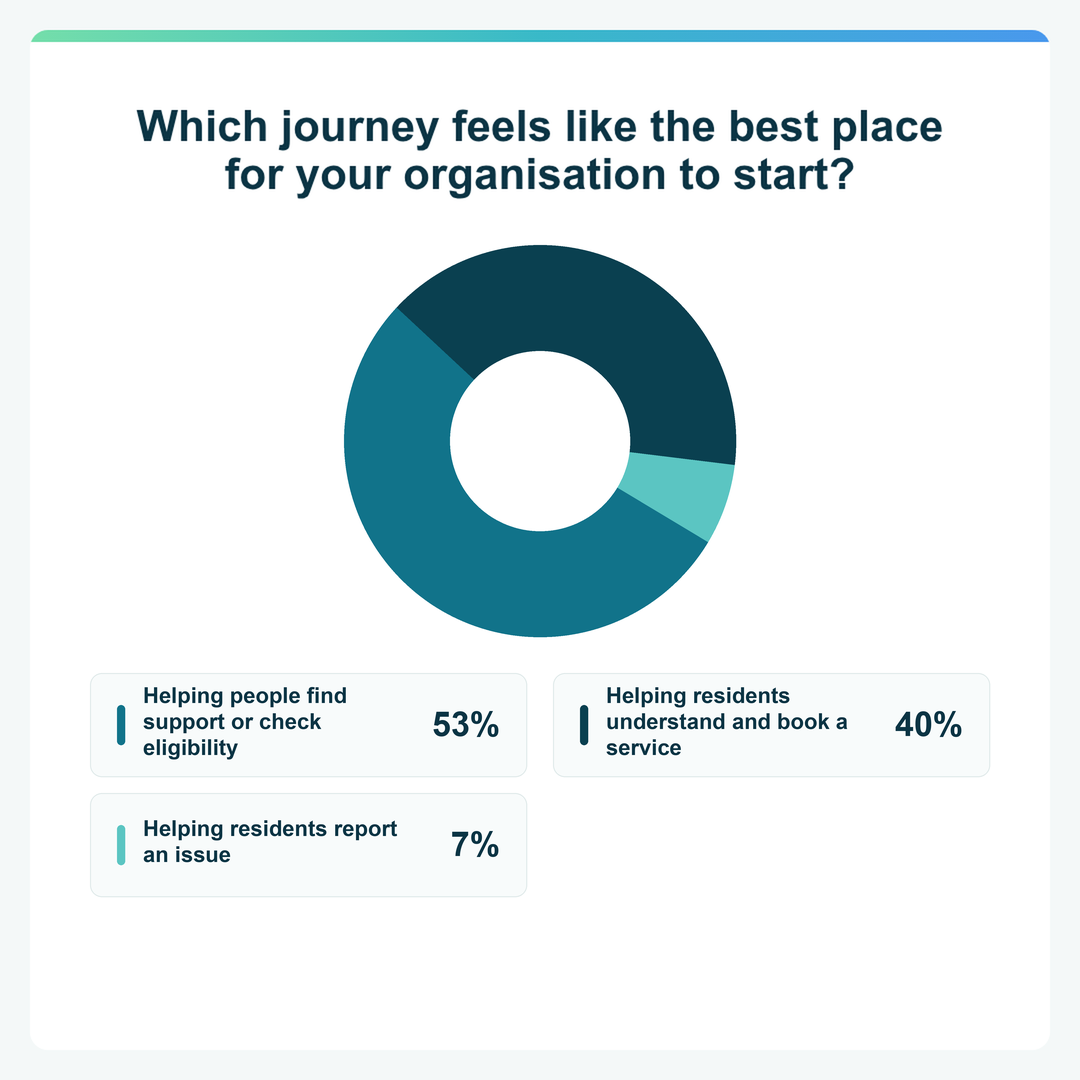
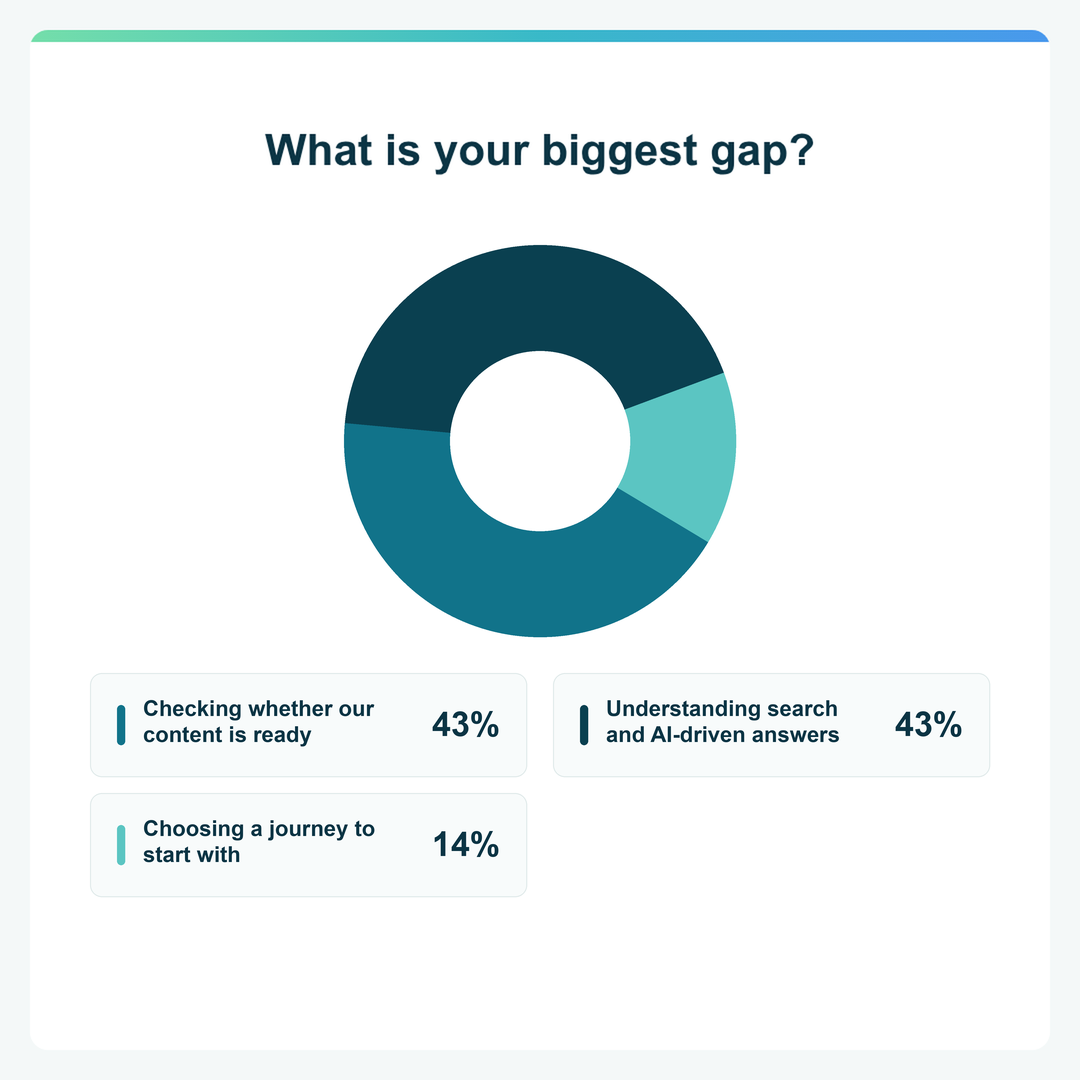
- 53%: Helping people find support or check eligibility
- 40%: Helping residents understand and book a service
- 7%: Helping residents report an issue
- 43%: Checking whether our content is ready
- 43%: Understanding search and AI-driven answers
- 14%: Choosing a journey to start with
Watch the higher education session
Transcript: Watch the higher ed-focused webinar
Welcome and introductions
Fran Zablocki [00:02]
Hello, everyone, and welcome to another Squiz webinar. I am your host, Fran Zablocki. I'm the digital strategy director here in the US. And today, we're gonna be talking about what AI-driven digital experiences mean for higher education. How are things evolving from where they were, where we had lots of information and lots of different places that answered questions that people had as they've been trying to figure out where they want to go to school and what they want to study and where we are headed in the future and what AI can help us to do there. And I have with me my two intrepid colleagues and, other brilliant strategists, Joel Goodman, who is the vice president for growth and Megan Andrews, head of customer in the US. So welcome, Joel and Megan. Glad to have you with me.
Joel and Megan [00:49]
Hello. Excited to be here. Always. Always.
Fran Zablocki [00:54]
So, yeah, this is gonna be a fairly open discussion about this topic. I'm really excited to dig into this because we have all been kinda living it the last few months and have some good stories to tell. But let's move into our first section of questions, and that is just framing how people have been thinking about how AI works and how we should be thinking about it moving forward in the context of public LLMs answering questions with simple text answers and kind of how that is going to evolve. So I'll open the floor, let's say to Joel first, but like, where are we headed from where we're familiar with at this point?
From answers to action
Joel Goodman [01:39]
Yeah. When you think about how search has progressed over the years, we've started with this, typical search bar in higher ed. You know, we typically would hide it behind an icon in the top right. Some of us have tried to make the search input a lot more front and center, but it's really the exception to the rule. And then people would maybe find it and then maybe type in a query, and then they'd get a long list of links. And, you know, for people like you and me, Fran, that have worked in higher ed and with the higher ed sector for as long as we have, we know the consternation, the complaints that both colleges and universities have about the quality of the results that come back. And, Squiz for a very long time has been at the forefront of fixing a lot of those problems with our traditional keyword search. But as more people are using AI, as more... Honestly, just as people continue to use Google and Google starts to change its product, we're finding that the types of the types of queries people are making are starting to morph from this, like, individual keyword style search to full questions. And when they ask a full question...
Honestly, even when they don't ask a full question, they're getting a big response back, a full paragraph or a couple of paragraphs or, you know, in some cases, three or four paragraphs and are expected to read all of that. And we've seen AI conversational search pop up on websites. We've been pushing the limits, here at Squiz with Funnelback, and conversational search. And I think what we're seeing on the next frontier is how do you turn these, question and answer style back and forth conversations into something that actually drives conversion. And for me, as someone with a UX background in particular and, you know, a conversion rate optimization background, I think it's pulling in some more visual elements. It's pulling in some of the nontraditional navigation paths that you might want, things like calls to action, things like, related content or, or video embeds or form embeds and things like that. That's where we're heading with, with Squiz and with our search products, and all of that tied back to our DXP. But I do know that we're seeing that in other places across the web.
You're starting to see versions of that happen in ChatGPT. You're seeing supporting content show up in Google search, and all of these different places.
Fran Zablocki [04:14]
That's great. Anything to add on that, Megan?
Megan Andrews [04:18]
I think Joel's right on the nose on that one. What's interesting is just how does this fit into the optimization framework? What shifts? So I'm curious, I think we're all gonna be testing and learning and that's an exciting part of changes like this. Just making sure that you're actually doing it right. So getting to the outcomes you want, but is it going be different from what we thought? So I think we're all learning that right now.
Joel Goodman [04:43]
Megan, there's one thing too, we're, I think on websites, right? Like traditionally we've seen people type in, like I was saying, the keywords or, you know, starting to ask these questions. But I think there's always been a little bit of a gap in terms of understanding what people are asking and what that does. And, I think one of the key things we're looking at here that I love your your input on or your thoughts on is this idea that we can kinda start to put in a flywheel or an information loop. We just saw the slide that was up, but we can, you know, ask questions, and then we start to understand what people want, and then we move that through to the process of getting them to explore a website and then and then take an action. I don't know. Maybe a couple of tangible things that, I don't know, even the two of you have been implementing because I'm... I've been watching a lot, but you got... You both have been, like, really implementing this stuff with our customers.
Megan Andrews [05:39]
I've had one quick note because I am fresh off of talking to some colleagues in Australia last night, and they were saying they'd implemented this type of conversational search with one of their customers. And they're looking back at the data and realizing the pattern already is the first question is a keyword or two. It's what we would expect you wanna put in a search bar, but the average is three different questions, follow-up questions after that and immediately it switches to natural language. They know they can type a sentence, they can express what they actually wanna express and that the inputs become much richer. So the way that our colleague was explaining it is that now suddenly they put their life story into the search bar. I really need help with this one acquisition we're doing. It was like a law firm customer who had done this. So they got a lot of information out of it. I think that is going to be a great way to inform back. So even on number five here is sort of learn from intent.
How does that come circle back to being better about understanding what everyone's asking, positioning this in the right place on their pages, understanding how to lead users into the questions they wanna ask first.
Fran Zablocki [06:49]
Yeah. And the way I've been thinking of it too is that, you know, those four steps or the fifth, you mentioned, where we're kind of looping back. We're... Have traditionally been over multiple sessions and or at least, like, multiple areas of the website, whether it's going through search or whether it's going down one path to a certain point, realizing you're either at a dead end or, you know, need to, like, redirect to another. And conversational search interfaces have condensed all that into kind of one single stream space, which is a really interesting thing from a lot of standpoints, whether it's just user behavior, how are people using it? Like, you mentioned, like, people may not even know it's conversational. And then once they do, oh, their entire behavior changes in terms of how they're interacting with it. But, also, it's just changing, like, how... You know, where are these located? How are these designed? How... You know, how all in one are they or, you know, what point are they handing off to something? What kind of things are they pulling in?
So it's a really exciting time to be thinking about this because I think it's gonna fundamentally change a lot of the ways these experiences happen for the audiences that we have, but also for those of us who kind of build these things, like how... You know, it's gonna really challenge us to think a little bit differently. So let's dive into...
A prospective computer science student’s journey
Fran Zablocki [08:02]
Let's take a use case. Right? A common use case and talk a little bit about an imaginary computer science student who is thinking about going to college, thinking about what programs they want to go to, but they have, like many do, anxieties around whether or not they can actually make it or cut it. So I'll hand this to Megan to walk us through, in their words, what are they what are they asking and what kinds of things would they get from a conversational response?
Megan Andrews [08:33]
Absolutely. I love this example because it's real. So if you can see the question here, am I cooked if my GPA is low, like for computer science? I was speaking with a customer back in May of this year and they were looking through some of their search queries. So this is just keyword search they're looking at on their site and someone had actually typed this. So, you know, some ambitious user out there is like, oh, I wonder if this is a conversational kind of like ChatGPT on the site already. So we were laughing about the example and we were laughing about how keyword search probably, it definitely did not understand what was being asked. Right? It's like looking up cooking lessons and things on campus. Right? Which is great for keyword. What we love and can leverage about AI is that it can interpret this type of thing. So in real time, this large language model can say, okay, I understand the lingo of Gen Alpha. The response actually, we've done this with live examples, this exact phrase, says, no, you're not automatically out. GPA requirements vary by program, that sort of thing. So this is comforting, right?
So there's almost like this, a better dynamic you can have with how you're searching and getting information. As a user, you're a like little bit more natural in your state and your questioning. And to speak to this example, think of this as a wireframe, this isn't how it would look on your actual website. You could stylize it, brand it, make it look like yours. But there's that response that's gonna be really helpful to the user. And then again, these dynamic components you can build around it. So it can get those users to different outcomes really quickly. Maybe there's something here, you'll get them talking to an admissions counselor right away, or you could even prompt or configure your agent to, if there's some intent in there that sounds a little bit more anxious, maybe that's a step they take more quickly, talk to someone about it. So I think there's a lot of opportunity here when you really consider the way large language models interpret questions to build all the content around it. And Joel, I think like, you've done so much over the years around conversion and pipeline.
I'm curious how you see this dynamic, these dynamic aspects playing out.
Joel Goodman [10:58]
Yeah. I think this is really funny because it's almost a translation layer. Right? It's like, the... Those of us old people might not be asking, asking questions in this way. You know? Like, in this case, our follow-up, might be a little bit, what about cost? But, like, a kid might ask, like, cost? You know? They just, you know, just drop drop a single word in. So there is this sort of, like, translation layer between our generational way of speaking or typing and the, you know, the the prospective students we have that are many levels down. But at the same time, it still handles our, you know, our way of talking as well. So you're not leaving grad students out. You're not leaving undergrad students out. You're not leaving, you know, high school students out or parents, you know, for that matter. I think with how this works, like, a lot of times, we... We've talked in previous webinars about this shift from fixed experiences to fluid experiences. And I think really what that comes down to is being able to anticipate what it is that someone wants to do next. It's very difficult to...
Maybe impossible to do that manually, at least on a very individualized level. But in, you know, in this case with with tools like, like conversational search, and Funnelback from Squiz, like, we're able to start leveraging AI to infer these different, paths. You know? Say, like you were saying, like, someone might have some anxiety detected on it, and so how do we then serve up a better path? I think, traditionally, when we think about conversion rate optimization, it's always been about reducing friction. It's saying, you know, we wanna make sure that we're not making people click through five or six different things to get to the action. We wanna simplify that down as much as possible. We wanna write content in a way that's giving them the most direct, access to the things they need to do. This actually cuts out a whole lot of that because, you know, the... Any of the any of the cognitive load that's on the person that's that's asking these questions is really just about their thought process. And they're probably... It's probably just a reframing of how they do their thought process.
Typically, if they were going through a fixed sort of journey on a website, their thought process is gonna have to dart in a bunch of different places. They already know what their goal is, but now they're having to find it. In this case, they can just start to ask, and they can kind of explore the various areas of your site through these questions, through their queries, through kind of poking and prodding at the content that you actually have. And then on the UX side, it's our responsibility as people managing these websites to start to surface those proper actions for them and reduce the number of steps again for them to get to that point that they're looking for.
Fran Zablocki [13:39]
I really like that idea of a translation layer because as someone who has tried to work with, you know, controlled vocabularies or taxonomies or just try... We're just trying to guess, like, what words will people use to describe these things? And the and the fact of the matter is people use all kinds of different words to describe the same things and there's no real like one size fits all with that but like the systems that we've had in the past have always been we've kind of been forced to try to structure them kind of linearly in like in the most basic sense, know, we had strict keyword search back in the day where it was like, you didn't enter the exact word, you're just gonna get a zero search result, which didn't feel really feel good. And we obviously have had like more sophistication with, you know, what we call, like, fuzzy, you know, fuzzy entry or fuzzy response before AI took over to say, okay. Well, there's at least some... We're gonna guess at what your... What the word you're using are... Is or there's, a synonym and that can be useful.
But this really feels like an evolution that is helping all sides and with ease of access because, yeah, it can take something like a single word and infer from just that word, like, that there's a more complex question underneath, or it can take jargon or lingo that isn't necessarily exactly the way you describe it internally. And how many times have we all said, oh, we need us to stop talking about ourselves in the way that we, you know, we do internally. We need to we need to talk about ourselves in the way that prospective students are doing so. Well, this really, like, helps to bridge that gap very naturally. And the other benefit that it has is that you're getting to see in real time... Well, maybe not real time, but at least in terms of an output to having a system like this, what people are asking and how they're asking it so that you can then follow-up and change your content to to further match it. So you're kinda getting all sides. Okay. Great. I like that. I like that.
Like, addressing anxieties early in the decision making funnel is such an important thing, and being able to be familiar to people and address them in their own language just feels like a really good way to connect. So it's exciting to see. I think we have a poll that we're going to share next. Yes.
Poll 1: Which journey is the best place to start?
Joel Goodman [16:01]
So we just showed you one journey that would be, you know, applying to a particular program. But from your standpoint, those of us... Those of you watching, what journey feels like the best place for your organization to start? Or, like, what... Which journey would you be most excited to tackle first? Fran, how do you go about, you know, when you're working with our customers that are implementing this, how do you go about sussing out that initial journey or those initial sort of, like, priority paths?
Fran Zablocki [16:31]
Sure. I mean, I think most schools are going to say that enrollment and, you know, applying to programs is the first and foremost, but it really depends on what part of the university you're a part of. Right? So if you're talking to folks in financial aid, that's gonna be their focus. If you're talking to people who support student life and services, that... That's gonna be their focus. And if you're talking to the overall overall marketing team, they're gonna wanna be able to address all these things at once. And I think... Yeah. I mean, what we're finding is, like, you never know what... I mean, you can put... Well, we have a good example with Oklahoma State University. We put the... We put conversational search with generative experiences in their undergraduate admissions space, but people are still asking questions about all kinds of different things from that space. Right? So you never quite know. So I think, you know, the place to start is probably what you see here, which is helping people explore and apply, and that is the main goal.
But, all of these are, like, related to one another and end up kinda getting pulled in as well.
Joel Goodman [17:42]
That's a unanimous choice, which is really fascinating. Not surprising, but it... Worth pointing out everyone was aligned around that. Yeah. Enrollment is very key and every... Top of mind for everybody for sure. Okay.
Content accuracy and governance
Fran Zablocki [18:00]
Well, thanks all for filling that out. So... Alright. So we have gone through a use case and talked a little bit and imagined a little bit how this could work well, what kind of roadblocks might be in the way of this? Like, what kinds of things can cause friction in getting to that realization? You know, is it out of date content? Is it conflicting and ambiguous content? What are, you know, what kind of things are tripping people up or kind of giving them pause before they are able to launch this? Joel has ideas. Joel has ideas. I left it open. Joel, go ahead.
Joel Goodman [18:39]
Yeah. I mean, what we're what we're really... What we're seeing a lot through, you know, these implementations is that the major roadblock is actually not that huge. In most cases, to get really good answers back, you really just need to fix conflicting information. And this comes down to how large language models in AI actually read and interpret content. If you have conflicting information in two or three or four different places, it just doesn't know which one is correct and which one's right. And so typically, how that manifests itself externally on ChatGPT is that it just can't trust your content, so it's gonna go someplace where it feels like it can trust it. That's why you see a lot of, like, replies coming up, you know, talking about your institution from Reddit threads instead of from your own website. Those are the sorts of things that you have control over that you can fix and makes the search experience on your own site even better because because all of these AI search tools, they they... The models interpret the content the same way.
The display and the way that it goes back, or a way that it integrates into your UX is the key thing that's different. And then I think on top of that, like, it's... The rest of it's just good UX practice. Right? You don't want your content to be ambiguous when someone is just browsing your pages, so make it clearer. It's the same stuff that we've been saying for years and years and years as content strategists and as web strategists. We're just seeing that AI is amplifying all of those things even more. And so start with fixing the things that are conflicting and then, and then work on, your out of date and ambiguous content because those are the things that are going to confuse people and going to confuse the models. Yeah. Anything to add there, Megan?
Megan Andrews [20:27]
I think that's it. I've always called content the foundational brick and everything builds from there. So, yeah. And it's, you know, finding the right tools. It, manual audits are so painful and we don't have to do them anymore. So there's hope with all these great new tools.
Fran Zablocki [20:45]
Yeah. So if, you were in charge, Megan, of kind of creating and implementing one of these journeys from the standpoint of being, you know, campus, like if it was your charge to get this new technology spun up, what would that look like? Like who would you want to involve and, you know, from a governance standpoint, you know, who do you think is important to be part of that conversation and that effort?
Megan Andrews [21:14]
Oh, this is a great question, Fran. This is something I think about all the time because the way I've talked about this is this is such a firm handshake between web and marketing teams. There is so much fun stuff to be done in the simplest way of saying it. And I think it's, yes, there's like really important outcomes you wanna get to, right? You need to know your strategic objectives, be aligned, understand your enrollment numbers or where are we focusing our efforts right now? Is it in prospective undergraduates? Is it in continuing or adult education? Those things are important. So finding the right stakeholders who know your strategic objectives, but then it's this really cool exercise of, I mean, our technology is anyone who's a non technical person can implement these things and understand them and configure them. So that's the great part. But I love the idea of bridging between, technical and web and marketing to get the best outcomes. You know, the ways you can configure this now and to our... What we've spoken about a little bit, there is so much opportunity across content, but also design.
You know, maybe you've got an agency partner who can have some really slick ideas for how this, you know, is presented on your site and can help you iterate and test on that. So I think it's a combination of the right folks who can get the tool in place, help you wrap your heads around the right content that you're gonna be focused on and then also measure. So whether that's your analytics or, you know, Google Analytics or web specialist who's looking at all those things, set up some tags on these different things and understand how are users behaving with it. So that would be a dream. Give me a little bit of time and the right group of people, and I would love to have this live on a university site. So, yeah, Joel, I think that you've probably worked with enough universities over the last fifteen years that you've seen teams come around, rally around different projects. Do you agree with some of what I'm saying or have a different perspective?
Joel Goodman [23:23]
Yeah. I mean, I... Ideas that have finally been implemented through this are things that I've been talking about for years and years and years, or at least in different maybe related ways. I think that, you know, I've never been happy with the typical search experience. I think that, you know, once we have access to large language models at scale and for reasonable price, there was a lot of... There are a lot of things that have opened up because of that. I think, in higher ed specifically, we've all talked about personalization for a decade plus, and very few institutions actually can speak to that. They... Very few know what they mean by that. Very few, very few know how to implement something. And I think this is a really interesting first step. And I think specifically when combined with the sorts of tools that we build into our DXP, like personal... Like, the actual personalization, tools that go into the editor, and allow us to personalize some of the, content directly within, within our generative experiences and, you know, our customer data platform and integrations with CRMs and SISs and all those things.
Once you have all that data flowing, it opens up this really, for me, exciting possibility of having, like, an entirely personalized homepage, but in a way that feels natural and invisible and not in a way that's yelling out saying, like, you know, hey, Megan. Welcome to the website. You know? Like, no one really wants that. Like, that... It can get creepy at that point. Right? But what we do really want, to enable is as we learn about people, as they're asking questions, as they're searching, as they're clicking through and visiting pages, start to start to subtly change out some of those content to guide that journey. I think using, you know, using our, using Funnelback search with the... With conversational search and generative experiences is a is a first step towards doing that. And, eventually, that enables us to do it across the entire website in all kinds of different interaction modes because not everyone uses search, and not everyone wants... You know, some people have different modes of exploring and are at different stages in the process of finding things. But it does take ambition. Right?
Like you were saying, Megan, like, finding that right group of people. I've been fortunate enough, you know, you... Prior to joining Squiz to have worked with some institutions that are ambitious like that. One of them is now a customer, which is awesome. But there there are institutions that want to go that direction, but it does take a little bit of understanding that you need the tech to enable it, and then you need to have the right content foundations in place to be able to really make those experiences something that's sticky and useful to the work that you're doing as an institution.
Personalization, data and privacy
Fran Zablocki [26:14]
Yeah. You mentioned... Touched on this a little bit, both of you, but the data integration piece and the idea of personalization and then, you know, the counterpart to that, which is privacy and making sure that, you know, we, you know, we're being compliant with personal information. I... I'm I'm curious what you what you all think of that because I mean, we've... We know that where this is headed is that we wanna be able to integrate more systems into the output for these rich experiences. Right? Like, right, you know, you can scrape... You can crawl the content on the website through HTML and have a great output, but wouldn't it be even better, you know, if we could get you signed up with an admissions counselor right there from the experience and by pulling in some information from, let's let's say, like, a faculty and staff directory or something like that. Right? So just curious from your standpoint, you know, how does having this type of search overlap with the idea of privacy and consent and also, you know, what kind of opportunities are we given by this that we didn't have with older style personalization engines?
Joel, I'll start with you.
Joel Goodman [27:31]
So I think from a technical perspective, it really is crucial that you have the right technical partner that has those security precautions in place that's taking the privacy side of it seriously. Not every web platform out there does that. Squiz takes security very, very, very seriously. And on the privacy side of it, I mean, part of it, there there are laws that exist. Like, you know, if I kinda think of it as if you're gathering this... If you're gathering parts of this data anyways in a CRM or something else, then, like, what are you doing with it? Are you just sitting on it? That's probably less secure than using it for something that's going to help someone get to your system and then getting rid of it or moving it somewhere else. Right? For us, like, we... You know, we're not looking to store personally identifiable information in... Inside our platform. That's why we have these integrations. Like, you're on, you know, Slate or HubSpot or Salesforce, you know, whatever it is for a CRM. Like, they've got their own security measures in place. We're flowing that data through.
We can keep all of that anonymized within our CDP to an extent and then sync it back and go back and forth through it. But I do think, like, knowing knowing whether the technology partners that you're working with have those security precautions in place is the is the really, really important thing. But I think this also hints at, you know, a struggle that most institutions have had over the years with, like, stealth applications or stealth traffic across their websites. Right? What do you do with those people? That's that's why I said earlier that these sorts of search experiences give you sort of a... It's like a starter personalization because it's not necessarily at first taking on that personal information at all. It's just like, here's an entity on the website. They are doing these things. Now we can we can use the input that they're giving to us to serve things up.
And then as you have those relationships, those data data contracts, I guess, with, with users down the line, they've, you know, they've opted in, they've consented, they're letting you use cookies, then you can start to really do cool things that are hyper personalized to that one individual person.
Choosing a first journey and measuring progress
Fran Zablocki [29:42]
Yeah. Like that. Okay. So, Megan, where do we start with all of this? I mean, this... We've covered a lot of different broad ranging topics, on how to get this set up and what this could look like. So without overwhelming everybody with too much on their to do list, what's the first step?
Megan Andrews [30:02]
I actually think it's very straightforward. That's the good news. You know, I talk about these these two first areas, you know, what's really important and what's really painful. Those are the two places you might wanna start. Is there a part of the site you know is so valuable? And typically, we're gonna look at admissions in that case, making sure those prospective students get exactly what they need. That's what we're finding with most customers we're working with. You start with admissions. However, there could be other things that are particularly painful or friction full on your site and you know that and they've been an issue. That can be another place. Maybe you're consistently receiving calls about a certain type of request or need across campus. Man, they're always calling about fixing dorm rooms in a certain way and you're putting a lot of resources into that. If that's really painful, you could also start somewhere like that and say, hey, there's gotta be a better way to surface good information and answers than having everyone call in to these advisors or this team. So those are the obvious ones, right?
And that pretty much people know where those are. A lot of organizations already have a great hunch, if not really good data supporting these things. And then it's just understanding, okay, what are the right tools we need to have in place and put a framework around it. What's your project? What does it look like? What are the outcomes that you wanna hope for, the hypothesis you have going in and start measuring. Go live, start measuring, test, iterate and learn what you need to learn. So I think it's pretty straightforward. It's just taking that first step, getting the right heads around the problem together or the opportunity together and then hitting go.
Fran Zablocki [31:44]
Yeah. Love that. Alright. So, you know, start small, get the right people in the room, take one small piece at a time. Yep. Yeah. What about just some practical next steps on what people can do? I mean, you touched on this for a second, Megan, but I'm kinda curious, Joel, in your experience, what are the things that really act as a catalyst to get this type of effort jump started?
Joel Goodman [32:11]
Yeah. I think I think really it takes, like I said, a little bit of ambition at first, you know, to really think through it. And then once you know that you wanna push into these sorts of things, just picking that one journey. Like, what's that first thing that we talked about in that first poll? You know, maybe that first journey is your your getting to application sort of thing. You know? And then what are the parts within that? But it could it could also be like, you know, we really need to... We we get lots of calls. As you were saying, we get lots of calls about financial aid and cost management extremely complicated issue in the US and takes a lot of work to really, really define well and to answer those questions. And, you know, a net price calculator on its own probably isn't the thing that's gonna answer the question for everyone. So, you know, you pick that one journey that you think is going to really improve the experience for that prospect or that, that parent, and then and then start, you know, working on it. You know? Find who the owners of that thing are.
Could be that it's, you know, admissions and admissions, is also working with financial aid. You need to talk with them about it. Figure out, make sure that, you know, you're... You know what those actions are. I... What I used to do in, like, more traditional CRO roles is I would go in and say to the admissions office, like, what are the things that you're getting calls about all the time? You know? And I'd find institutions that are like, yeah. And then we try to send them to the website, and we can't find the link, and we can't do this and that. You know? Like, there are questions that your frontline reps actually get all the time, and those are really, really, like, low hanging fruit sort of places to start. Right? If you know they're always getting a question about, you know, about where to find a certain document, well, then there's probably a problem on the website. And so now you can start to say, okay. Well, that's really important. We need to surface this up as, you know, one of those paths, one of those journeys, one of those pieces in the journey. Right? And then test it. Are you getting responses?
Are people clicking on it? Are they following up with additional questions in your in your search? And if so, then, then you fix it. You can move on to the next one. Right? Not really. You have to keep monitoring. Like, all this changes all the time. People change the questions, but it does mean that you can start to release some focus on that and move on to the next journey. And it really doesn't take that much. It's just a... It... It's a normal kind of iterative cycle of picking the important thing, finding the people that can help you answer the question, you know, to help you make the journey really good, and then put it in place and test it. And if it doesn't work, refine it, start to work back around, and just get it to a place place where it's actually performing really well.
Fran Zablocki [34:53]
Yeah. That's great. I mean, I think to sum all of that up is, like, just begin. Right? Like, just just take the first step. Try try the first trial. So the...
Poll 2: What is the biggest gap?
Fran Zablocki [35:01]
That's great from both of you. Thank you. Alright. So we've got one more poll to pull up. Where is your biggest gap? Like, what feels like the thing that is a little bit intimidating to get started with? Like, what's on... What's top of mind for you in your probably should have listed out here getting started. I think, yeah, I think, yeah, getting started regardless of which flavor of getting started it is is oftentimes the toughest thing. Yeah. Checking whether our content is ready. That is such a... I feel like I've talked about that probably two or three times a day over the last couple weeks of just, like, are we ready for AI search? And are we showing up in AI search? And how do we know, like, what... You know, if we've been doing a good job? And I think from our standpoint, you know, we have a product, Content Intelligence, that helps to answer exactly that question. Right? It literally says, for all of these different pages and topics, how AI ready are you? And if you're not AI ready right out of the gate, like, what types of things can you address to get there?
And it really helps you understand how these LLMs think about content and and scan content and helps you to identify some really specific nuanced differences and contradictions or ambiguities that are on your site that will help humans to find what they need just as much as AI search, but can be be a really good first step. And it does it at scale and kinda takes a little bit of the onus off of you in terms of your workload to do so. So Content Intelligence is a really good tool for that. Yeah. Checking whether out whether content is ready seems to be the lead. Not surprised there. That's been kind of the the topic of conversation for me as well. Alright. So we wanna give... We're a little... Yeah.
Key takeaways and audience Q&A
Fran Zablocki [37:00]
We got a little bit of time left. We wanna give some time for questions. Let's just quickly summarize some key takeaways and next steps for folks. I also wanna make sure to mention the website readiness quiz. There's a two minute assessment that we have that you can go ahead and run through to give yourself an early sense of what... Kinda where you stand and kinda get an idea for what Squiz and Content Intelligence, like I mentioned, can do for you. So please use that QR code to do so. But in the meantime, before you take that, we'll take your questions. So anybody want to submit a question first? I think we've got a couple questions already in the queue. We can take a look at. We've got got one. Yeah. The first one is students... Oh, wonderful. There we go. Students tell us they find different deadlines on different pages. What should we fix before using AI search?
Audience Q&A: Conflicting deadlines
Megan Andrews [38:09]
Oh, you gotta fix the information. You gotta figure out what's conflicting or not. Yeah. This is a classic issue. Right? So many different dates and deadlines and pages, and it's not the same content team managing all those. So the orientation date here is different from orientation date on this. That's an issue. So the best way to do that, mean, Content Intelligence has become my favorite tool because it flags that for you. You don't have to go crawl around your site manually. So I highly recommend just run the scan and see where you stand. You... It'll surface everything for you, and then you can start tackling those. So that's it.
Joel Goodman [38:49]
If I could clarify on that one too, like, you use AI to figure that out. We could... Like, to figure out where those things are. Like, you actually need some sort of technology, especially if you have hundreds of thousands of pages to go through. You need a tool to do that. It's a... It's... You're gonna have way more, way more potential for error and missing something if you try to do it manually, and it's going to take up so much time. Those are the things that AI are really good at, like pattern matching, finding those sorts of discrepancies. That's kind of probably where the tool should be used more more than some of the use cases we see for AI these days. So I, like, definitely use that for finding those sorts of things.
Audience Q&A: Working with existing tools
Fran Zablocki [39:32]
Yeah. That's great. A couple more questions in the queue here. Can we start with the tools that we already have? What tools do you have? Yeah. What do you got in your bag?
Megan Andrews [39:47]
Spreadsheets and spreadsheets and, and time. You can, but it's hard. It's painstaking. Fran's done a lot of those in spreadsheets. I have. I have. Yeah.
Fran Zablocki [39:59]
It's anyone who's managed a large website and that could be hundreds or thousands or tens of thousands of pages knows that it can can get... Feel really overwhelming really quickly when you try to take it all in at once. And so the tools we've been using to date, sure, like a lot of spreadsheets, a lot of probably site scanners, right, that are just kind of giving you top level information on SEO, like maybe saying, okay, like, how do you... You know, how many meta descriptions do you have? Are they repeating each themselves? You know, do you have all your alt tags and stuff? Like, those have been those have been helpful. And of course, you have your own your own time and energy just kind of like using your two eyeballs to look at things and review them and improve things. But as we've mentioned in past, you know, conversations like that's really hard to scale. We're all really busy. We've got a lot on our plates. And so there's only there's just only so much time that you can spend doing these things manually. So, yeah, I would say you have you have things at your disposal, and you'll be... You could do all the...
You know, you could do the review manually to a point, but in order to get across your entire web ecosystem, you're gonna need some kind of tool like Content Intelligence.
Audience Q&A: Connecting people to forms and staff
Fran Zablocki [41:07]
Alright. Next question's an interesting one. Can we point people to a form or a person instead of trying to answer everything within conversational search, I'm assuming that means so. Fran, I would toss this one to you.
Fran Zablocki [41:22]
Oh, back to me. Okay. I think you can point people to a form or a person, but the... What I would do is turn this around and say, what we wanna be able to do with conversational search is that this isn't... This is not an either or situation, but within the conversational search response would be a way of getting in touch with somebody directly, maybe, like literally starting a phone call potentially, but maybe just, you know, shooting an email off to somebody or even pulling in a form to the experience itself and I don't think we showed that in like the wireframes earlier but that is something that is really of interest where you know if somebody is asking questions so let's take our computer science example and they're asking you know how much does it cost and is, you know, are my grades good enough? Those are pieces of information that get input, you know, can be input into a submission to a form submission to the admissions team. And the form could very well, you know, even start to fill in some of the information based on what's been talked about, you know, to give somebody a little bit of a head start.
And the form could, if it's tied in, like we were talking about with other data systems, if it's tied in with, you know, Slate or a reservation system, someone could submit that information directly from the conversational search... The con... The conversation itself and not have to be taken off to a third place. Now that said, you know, I think that's where we're headed eventually, but we're... You know, like, a slightly simpler version of this would be to be able to tie in responses to prompts and queries with really key calls to action off to those sites. Right? So maybe that... Maybe the reservation system lives elsewhere, but you set up some logic within conversational search that says, look, if someone if someone mentions that they want to talk to a human or I want to, like, make make an appointment or something along those lines that type of information gets pulled into the response so it's really really easy for them to go to that for the next step and I think that's kind of the key to this whole conversation is we're all used to having text based responses as our default. What we are... Where we're headed is what's next.
Like, how can we take people to that next step and that conversion point? Because the purpose of a website isn't to get people to spend time on a website. It's to get them to talk to a human either on the phone or through email or get them to visit in person and see real humans. So, you know, how can we integrate that and pull that next step or next couple steps into the experience? So that's where I get really excited thinking about like, how far can we push this type of technology and how far can we get somebody down that decision making funnel before they even have to kind of exit the website? Like how much can we serve up in a single session?
Closing remarks
Joel Goodman [44:21]
Alright. I knew you'd have strong opinions, Fran. I like that.
Fran Zablocki [44:24]
I can always be relied upon for strong opinions. So no no worries there. Alright. I think that is all the questions that we had. So Yeah. I think we are good to go. I really appreciate everybody's time and interest today. And for those colleagues or folks who maybe couldn't attend with you, we will, as always, be posting this like, recording of this session up on the Squiz webinar thought leadership section of our website. And you can obviously also get these via email, you know, if you've shared that with us too. So go take the two minute quiz, see see where it lands you, and, yeah, let us know if you'd like to chat about any of this more one on one at some point. We'd love to talk. Alright. Thanks all. Have a good day. Thanks. Yeah. Bye.
Video: Watch the higher ed-focused webinar. Captions and transcript available on playback.
Poll results for higher education
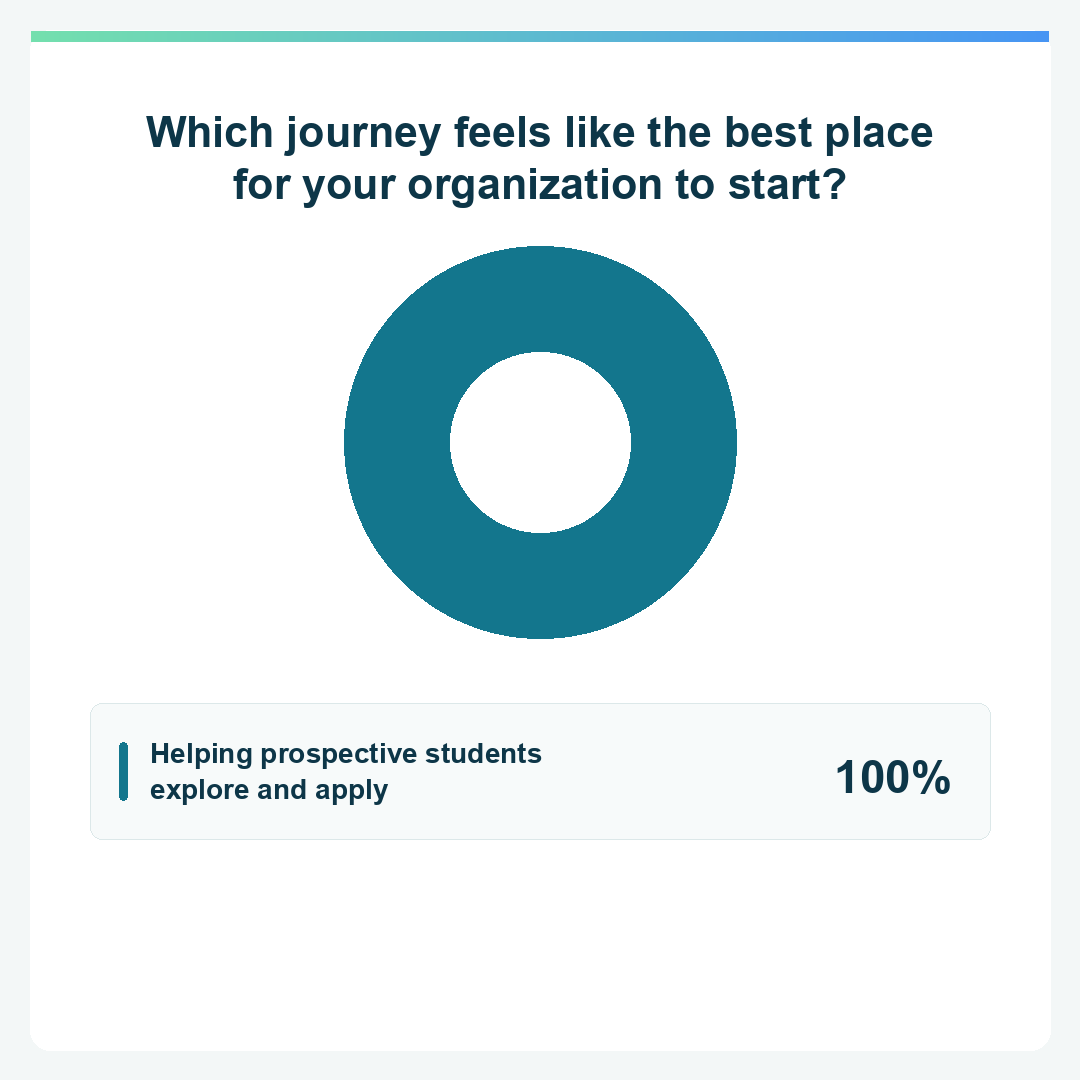
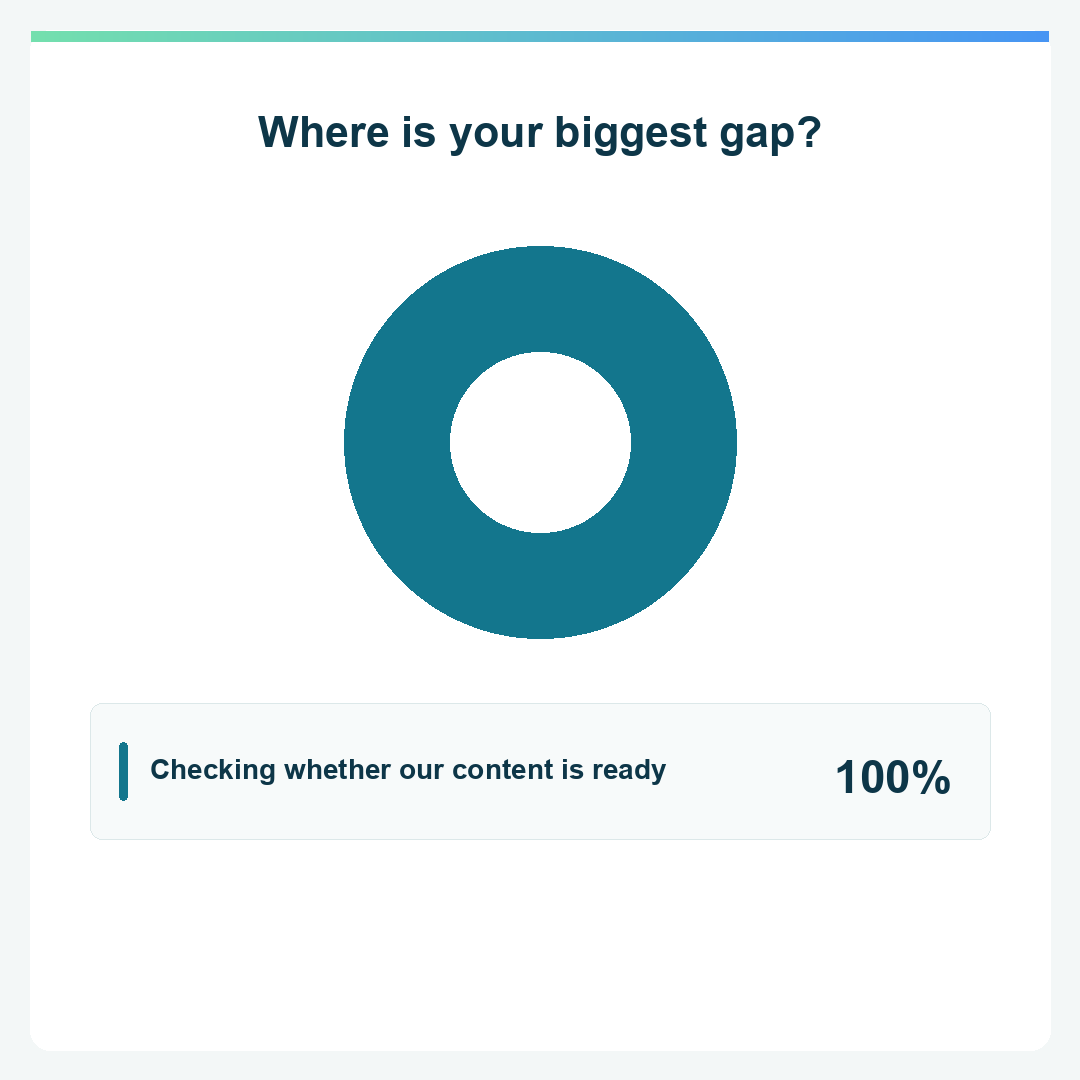
- 100%: Helping prospective students explore and apply
- 100%: Checking whether our content is ready
Webinar Q&A
Professional services
Start with the client’s situation, rather than expecting them to know your practice areas. An AI-driven experience can bring relevant services, sector expertise and team contacts together around their question.
For example, someone considering a technology acquisition might need information about transactions and intellectual property. Keep that information current and agree who receives and triages enquiries across practices; the experience should support, not replace, that human process.
Yes. Start with a service area that has useful, current information and a clear owner. Check for gaps or conflicting claims, then test whether the pages answer common client questions.
You don’t need to update every profile first but before recommending a named specialist, check their role, profile and contact details. Otherwise, direct people to an appropriate team or general enquiry route.
Offer a route to an initial conversation and ask only what you need to respond, such as a contact method and broad area of interest. Tell visitors not to share confidential details in a public interface.
Agree data handling with your privacy, legal and risk teams. If more detail is needed, use an approved, secure channel or a conversation with the right team. Make clear that general information is not tailored professional advice.
Yes. An AI-driven experience can bring relevant service information, sector insights and approved examples of your work together around a visitor’s question, with links to the sources.
Offer a useful next step, such as reading an insight or exploring a practice, while keeping a contact option available when they’re ready. Make sure examples and claims are approved for public use.
Choose one valuable client need that is difficult to meet today. Use enquiry themes, search data and business development feedback to find it.
Identify the content owner, check the contact route and agree one or two measures. Then test a manageable improvement, such as a clearer service page or enquiry link. You don’t need to start with an AI tool; expand when you have evidence the change helps.
Yes. Use existing analytics, search data and enquiry processes to identify a problem. A clearer page or a verified link to the right team may be enough to start.
If conversational search would help, Squiz Conversational Search can be deployed alongside existing search without replacing your website. Confirm the implementation, content scope and integrations needed for your environment.
Review questions from on-site search, enquiries and client-facing teams. Test whether people can find an accurate, complete answer and a useful next step.
Squiz Content Intelligence can help identify gaps and conflicting information. If you use conversational search, review questions and answers where your setup and privacy permissions allow. Improve the source content, then test again.
Check the sources, not just how convincing the answer sounds. Use approved, current content with a named owner, resolve conflicts and make sources available for review.
Test representative and high-risk questions with subject-matter owners, comparing answers against the source. Provide human help when information is missing or uncertain. These safeguards reduce risk, but cannot guarantee every AI-generated answer is correct.
Yes. A link to a service page, enquiry form or team contact can be the right next step, especially when someone needs individual advice or the content doesn’t answer their question.
Check that the link works and someone owns the follow-up. An existing form may be enough; completing an action inside the experience requires suitable integration and permissions. Keep accessible alternatives and human help available.
Agree a measure and record a baseline before making the change. For example, can representative visitors find the right service and contact route, and do enquiries reach the intended team?
Repeat the task after the change and compare results. Where practical, track completed enquiries and successful handoffs, alongside accuracy and accessibility. A click or conversation alone doesn’t prove someone completed their task.
It can work that way. A visitor asks a question and the experience uses approved content to provide an answer and relevant next steps.
In Squiz’s approach, Content Intelligence prepares a question-and-answer foundation from monitored website content, which Conversational Search uses to generate responses. Your team can curate supporting content and links without manually maintaining a separate FAQ. Additional personalisation or actions depend on the configuration, permissions and connected services.
You can’t guarantee an external search or AI service will mention you or send someone to your site. Publish clear, current, accessible information and check how important audience questions are answered externally.
On-site improvement complements that work. When someone does arrive, an experience based on your approved content can help them explore their options and reach a useful next step.
We expect conversational interfaces to play a larger role, but it’s too early to say every website will include them by default.
Start with whether conversational search helps your audience complete an important task. Keep the supporting content trustworthy, and provide accessible navigation and human support alongside any new interface.
Well-structured, accurate content is essential and may be the best first investment if it’s the biggest gap in a priority journey.
On-site conversational search serves a complementary purpose: it helps visitors ask follow-up questions, explore approved information and find a next step. Where permitted, it can also reveal questions people ask on your site. Choose based on the problem and evidence, rather than treating the two as competing priorities.
Yes. In one published example, a university added conversational answers to its existing search. Another case study focuses on admissions and financial aid.
For professional services, the webinar recording shows a fictional law firm helping a prospective client explore acquisition expertise and reach a consultation. It was a demonstration, not a live client implementation.
Government
It can let residents describe their situation in their own words, then bring together relevant service information and suggest useful next steps, without expecting them to know which department is responsible.
For example, someone looking for care support could be shown relevant guidance, follow-up questions and a route to the right team. Keep the information current and provide accessible alternatives and human help, especially when someone’s circumstances need individual attention.
Yes. Start with one important service journey where people are struggling, such as understanding how to arrange a collection. Use search data, enquiries and service feedback to choose a need that matters and can be measured.
Check that the supporting information is accurate, accessible and owned, and that the booking or contact route works. Set a baseline, test a focused improvement and use what you learn before expanding. You don’t need to replace the whole website or start with a new AI tool.
Choose one valuable resident need that is difficult to meet today. Use search data, contact centre enquiries and service feedback to identify a manageable journey.
Agree who owns the information and the next step, then make a small improvement and measure whether it helps. A clearer service page or booking link may be enough to start; use the results to decide what to do next.
Review on-site search terms, contact centre enquiries and resident feedback. Look for repeated searches, searches that return no useful results and places where people abandon a task. Test whether people can find an accurate, complete answer and a useful next step.
Squiz Content Intelligence can help identify gaps and conflicting information. If you use conversational search, review questions and answers where your setup and privacy permissions allow. Improve the source content, then test again.
Higher education
First, identify the conflicting dates and ask the responsible admissions or policy team to confirm the authoritative deadline. If no one is sure, escalate it for a decision rather than asking AI to choose. Update the source and related pages, and assign an owner to keep them current.
Squiz Content Intelligence can help identify conflicting information. People still need to verify the correct answer and test it before it’s used in an AI-driven experience.
Make key information easy to find again: use clear program pages, useful links to admissions and financial aid, and straightforward next steps. Conversational search can also help students ask follow-up questions in their own words when they return.
If you want to tailor an experience across visits, check what your existing tools support and agree how data, consent and privacy will be handled. Don’t assume a conversation or personal preferences are automatically saved.
Provide clear general information from approved sources, but avoid presenting it as a decision about that student’s admission, eligibility or financial aid. Explain when the answer depends on individual circumstances and offer a route to the appropriate team.
Ask only for information needed to help, and use an approved, secure channel for sensitive details. Test these questions with the relevant staff and review the experience’s boundaries before launch.
Test common student tasks and check whether the suggested contact or form leads to the team equipped to help. Agree who receives each type of enquiry and how it should be passed on if it arrives in the wrong place.
Record a baseline, then compare the proportion of enquiries reaching the right team, misrouted enquiries and successful handoffs after a change. Feedback from students and admissions staff can help explain the results.
Choose one valuable or frustrating student journey, such as finding application requirements or financial aid information. Use search data and questions received by frontline teams to decide where to start.
Check the supporting content and contact route, agree an owner and one or two measures, then test a small improvement. You don’t need to fix the whole website or launch an AI tool first.
Yes. Existing analytics, site search, enquiry records and staff feedback can show where students struggle. You might begin by clarifying a page or fixing a link to the right team.
Manual review can work for a focused area, although it becomes harder to sustain across a large site. If you need more help, Squiz Content Intelligence can help identify content gaps and conflicts; confirm the scope and setup that suit your institution.
Review on-site searches, enquiries to admissions and financial aid, and student feedback. Look for repeated questions, searches with no useful results and points where students abandon a task. Test whether someone can find a clear answer and a useful next step.
Squiz Content Intelligence can help identify gaps and conflicting information. Where your setup and privacy permissions allow, review conversational questions and answers too, then improve the source content and test again.
Check the source, not just how convincing the answer sounds. Use approved, current information with a named owner; resolve conflicting dates, requirements and policies, and make sources available for review.
Test common and high-risk questions with the relevant teams, comparing answers against the source. Offer human help when an answer is missing or uncertain. These safeguards reduce risk but cannot guarantee every AI-generated answer is correct.
Yes. A link to an application form, admissions counselor or financial aid team can be the most useful next step, especially when a question needs individual attention.
Check that the route works and someone owns the follow-up. A link may be enough to start; completing a form or booking within the experience requires suitable integration and permissions. Keep accessible alternatives available.
Agree a measure and record a baseline before making the change. For example, can students find accurate application requirements and reach the right team or complete the intended form?
Repeat the task after the change and compare results. Where practical, track completed tasks, successful handoffs and repeat enquiries alongside accuracy and accessibility. A click or conversation alone doesn’t show that a student achieved their goal.