





✨ NEW Content Intelligence is here! Make your content unmissable to AI search
Prioritized content fixes shown overlaid on a webpage with Squiz Content Intelligence

Where does your firm rank for AI search visibility?

In Squiz's analysis of the top 100 US law firms by revenue, we found that AI visibility is uncorrelated with revenue rank. Any firm has the opportunity to pull ahead by applying Content Health principles to its web content.

Five signals AI looks for

One

Consistency

Same terminology and structure across every page. Contradictions force the model to hedge or skip you.

Two

Specificity

Named industries, jurisdictions, outcomes, clients. Generic statements rarely get cited - they’re skipped for your competitors.

Three

Completeness

Who, what, where, when, why – all on one page. Incomplete stories lead to competitor citations.

Four

Consolidation

One authoritative page per topic. Scattered duplicates create conflicting passages.

Five

Freshness

Dated, updated, and current. Stale content loses trust to newer sources. Remove old content and ensure knowledge articles and PDFs are dated.

What does the data tell us?

The gap is wider than you think

The difference between the top and bottom performers is stark - a 55-point gap in AI search visibility. What’s more surprising is that it doesn’t follow revenue rankings. Smaller firms are outperforming bigger names simply by showing up better in AI-driven search. This isn’t about size or reputation - it’s about how effectively your digital presence is structured, surfaced, and kept current.
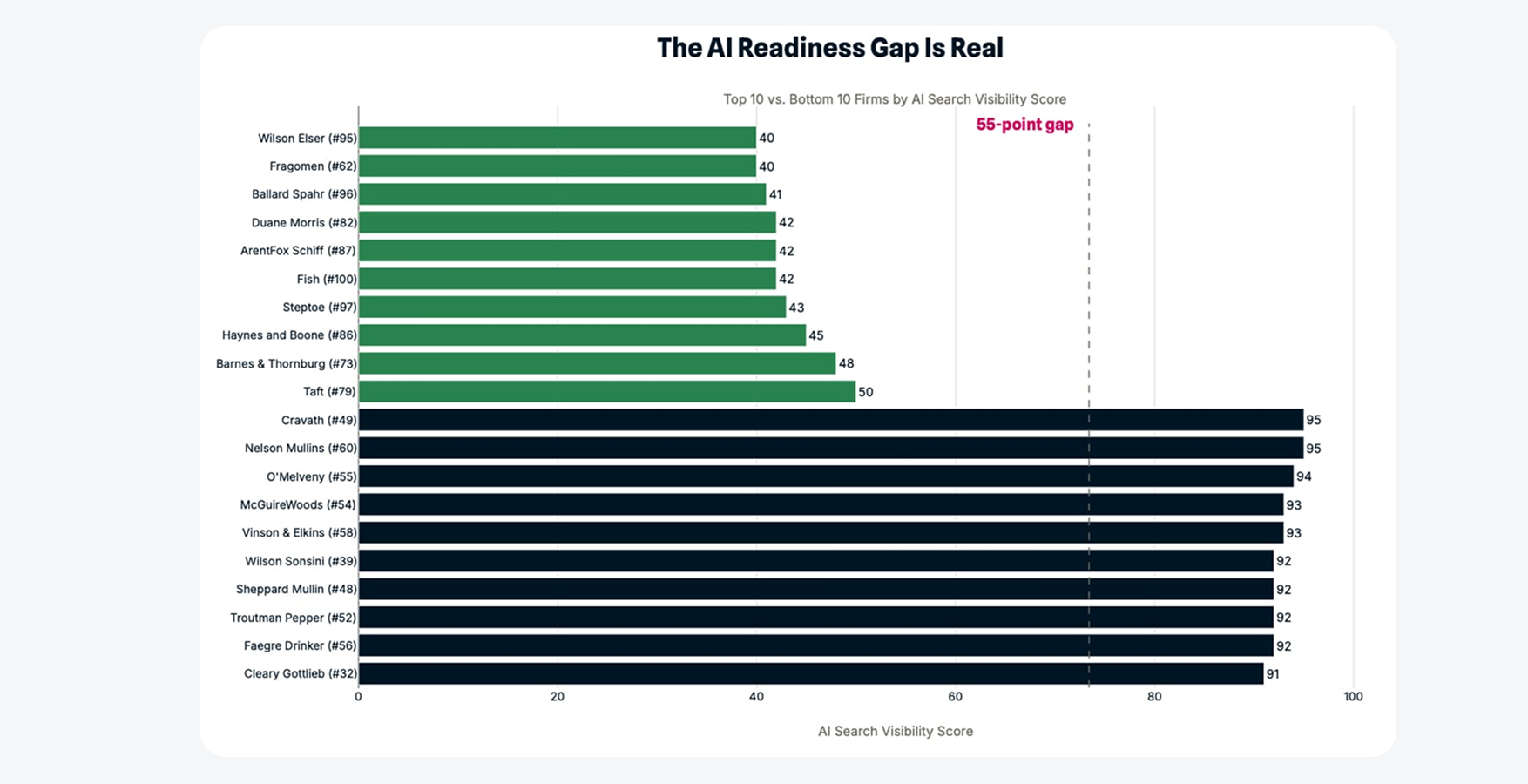
Title on chart: The AI Readiness Gap Is Real — Top 10 vs. Bottom 10 Firms by AI Search Visibility Score  Short alt text: Horizontal bar chart comparing the top 10 and bottom 10 AmLaw 100 firms by AI Search Visibility Score, showing a 55-point gap.  Long description: Horizontal bar chart ranking the top 10 and bottom 10 AmLaw 100 firms by AI Search Visibility Score (0–100).  The top 10 firms — led by Cravath (95) and Nelson Mullins (95), followed by O'Melveny (94), McGuireWoods (93), Vinson & Elkins (93), Wilson Sonsini (92), Sheppard Mullin (92), Troutman Pepper (92), Faegre Drinker (92), and Cleary Gottlieb (91) — are shown in dark navy bars extending past 90.  The bottom 10 firms — Wilson Elser (40), Fragomen (40), Ballard Spahr (41), Duane Morris (42), ArentFox Schiff (42), Fish (42), Steptoe (43), Haynes and Boone (45), Barnes & Thornburg (48), and Taft (50) — appear in green bars clustered between 40 and 50.  A dashed vertical line and callout label highlight the 55-point gap between the two groups.  Meaning / takeaway: AI search visibility is not evenly distributed across the AmLaw 100. The best-performing firms score more than double the lowest-performing firms.  This gap is not correlated with AmLaw revenue rank — Nelson Mullins (#60 by revenue) outperforms the entire bottom 10, many of whom rank higher by revenue.  The key takeaway: a firm’s position on this axis is a meaningful competitive factor. Firms on the lower end risk being effectively invisible in AI-driven search.

Performance drops in predictable ways

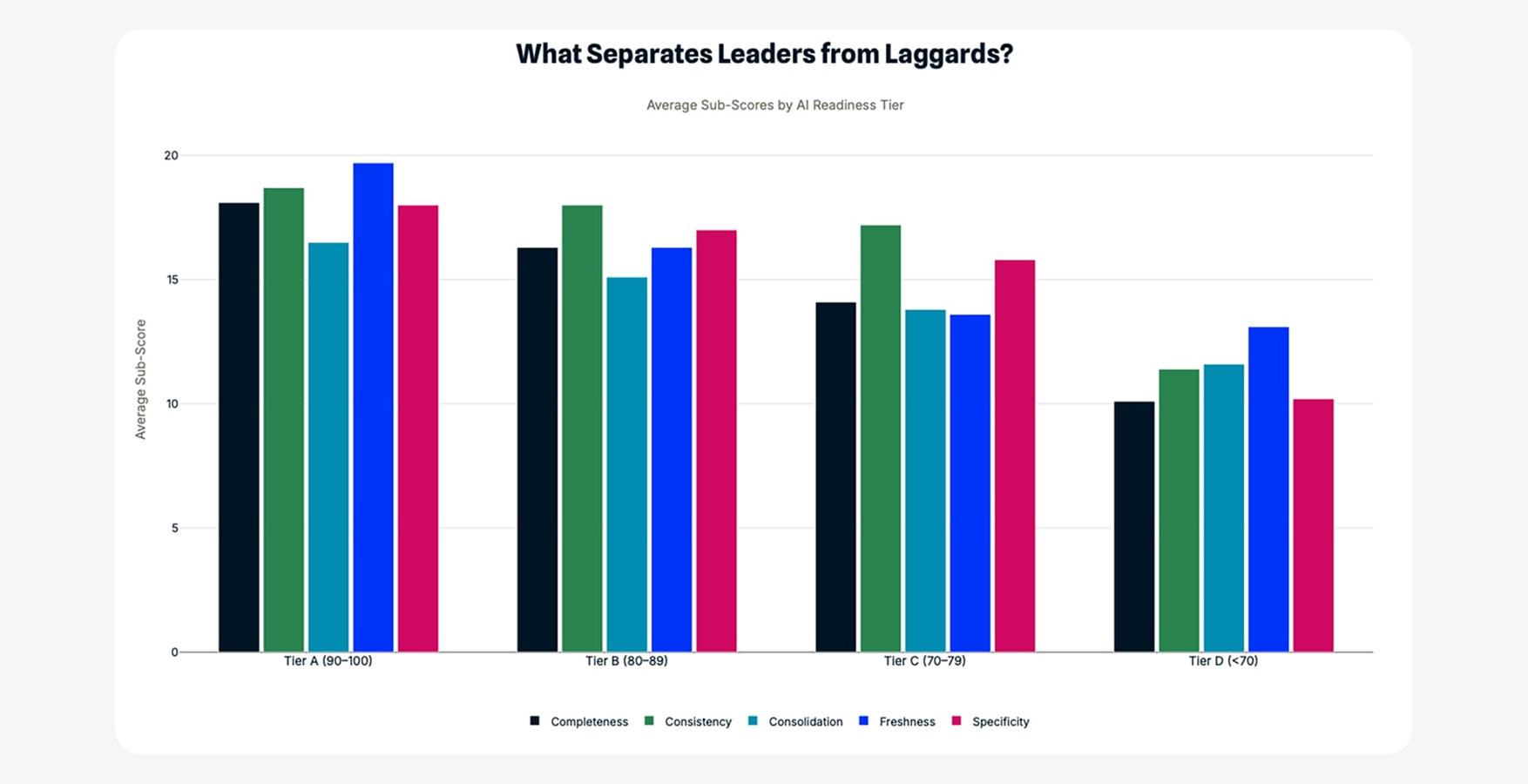
As firms move from high to low performance, the decline isn’t even. Consistency tends to hold, but freshness, completeness, and consolidation drop off quickly. That tells a clear story - most firms aren’t failing everywhere, just in the areas that matter most for AI visibility. Focus on keeping content current, complete, and well-connected, and you’ll see the biggest gains.

Title on chart: What Separates Leaders from Laggards? — Average Sub-Scores by AI Readiness Tier  Short alt text: Grouped bar chart of average Completeness, Consistency, Consolidation, Freshness, and Specificity sub-scores across four AI readiness tiers.  Long description: Grouped vertical bar chart showing average scores across five dimensions: Completeness, Consistency, Consolidation, Freshness, and Specificity.  These are broken out across four AI readiness tiers:  Tier A (90–100) Tier B (80–89) Tier C (70–79) Tier D (below 70)  Tier A firms cluster around 18–20 across all dimensions, with Freshness the highest (~19.7). Tier B firms sit around 15–18. Tier C firms show a mixed profile — Consistency remains relatively strong (~17), while Completeness, Consolidation, and Freshness drop toward ~14. Tier D firms fall to roughly 10–13 across all areas, with Specificity the weakest.  The most noticeable declines across tiers are in Freshness and Consistency.  Meaning / takeaway: The five sub-scores don’t decline evenly as performance drops.  Consistency is typically the last to degrade — even weaker firms often maintain consistent brand/NAP data. By contrast, Completeness, Freshness, and Consolidation drop sharply in lower tiers.  Practical implication: For firms outside Tier A, the highest-impact improvements usually come from:  Freshness (publishing cadence and recency) Consolidation (how consistently the firm is represented across channels)  These are the biggest differentiators between leaders and laggards.

Balance is what drives visibility

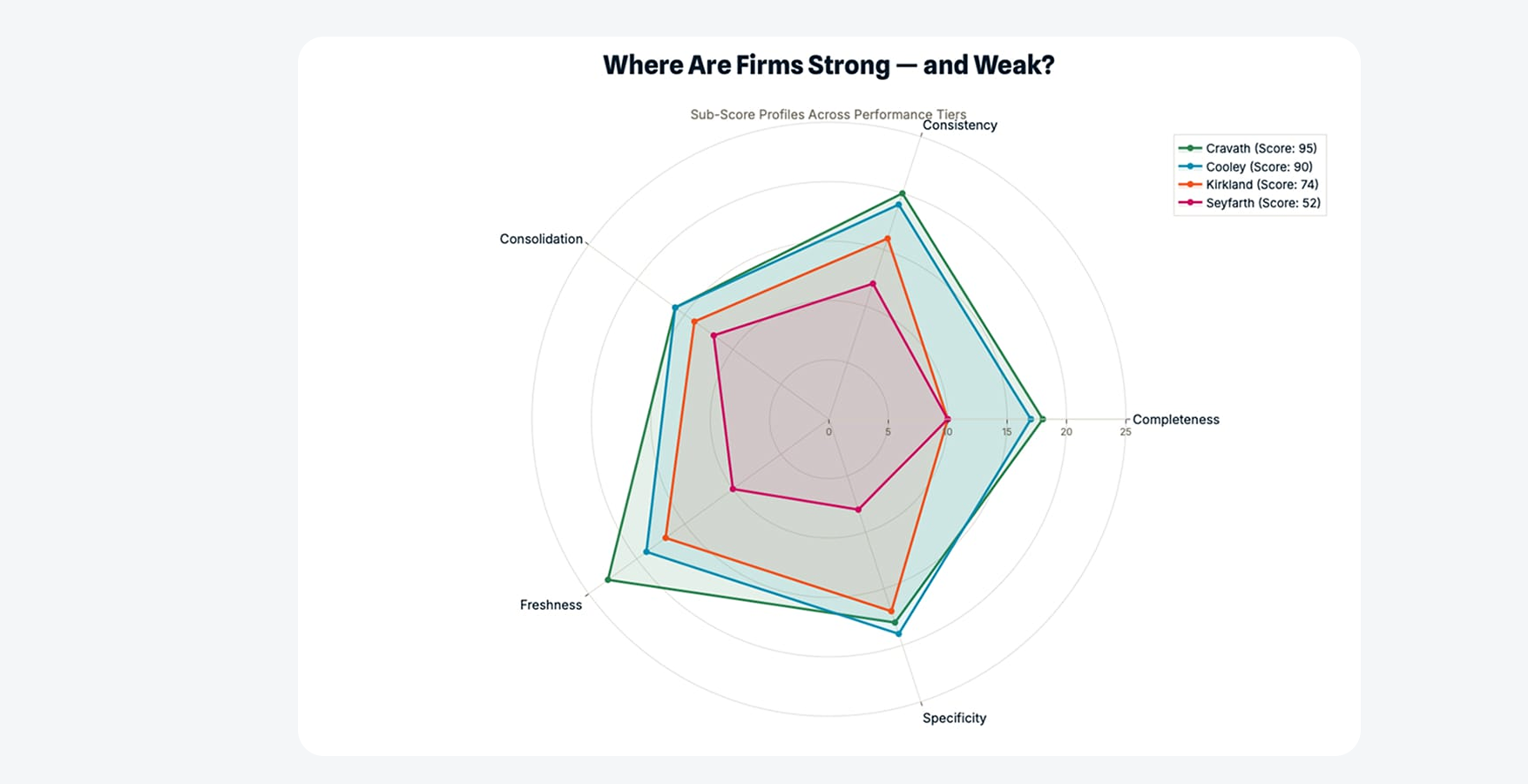
High-performing firms don’t rely on a single strength - they perform well across all five dimensions. That balance is what gives them consistent visibility in AI search. Others tend to show uneven profiles, where one or two weaker areas pull down overall performance. The opportunity is clear: identify the gaps and strengthen them to improve your overall visibility.

Title on chart: Where Are Firms Strong — and Weak? — Sub-Score Profiles Across Performance Tiers  Short alt text: Radar chart comparing sub-score profiles of four firms: Cravath (95), Cooley (90), Kirkland (74), and Seyfarth (52).  Long description: Five-axis radar (spider) chart comparing four firms across the five AI Visibility dimensions:  Consistency Completeness Specificity Freshness Consolidation  Cravath (95, dark green) forms the largest and most balanced shape, scoring roughly 18–22 across all axes, especially strong in Freshness and Completeness.  Cooley (90, blue) is similarly balanced, slightly behind Cravath.  Kirkland (74, orange) shows a smaller, uneven shape — strong in Specificity and Consistency, but weaker in Freshness and Consolidation.  Seyfarth (52, pink) forms the smallest shape, with scores around 8–12 across all dimensions.  Meaning / takeaway: Top-performing firms don’t dominate in just one area — they perform consistently well across all five.  Cravath and Cooley succeed because they are both strong and balanced. Kirkland illustrates a common mid-tier issue: solid fundamentals, but clear weaknesses dragging down overall performance. Seyfarth represents the typical laggard: no single catastrophic issue, but underperformance across the board.  Key question this chart prompts: “Which profile looks most like our firm — and which dimension is holding us back the most?”

Request your AI Visibility Report

Receive the full 100-firm rankings and a competitive snapshot of your website's AI search visibility. 

Top 30 firms

Feature comparison table
Feature Firm Name Score Top 100 Rank
1

Cravath 

95 

49 

2

Nelson Mullins 

95 

60 

3

O'Melveny 

94 

55 

4

McGuireWoods 

93 

54 

5

Vinson & Elkins 

93 

58 

6

Wilson Sonsini 

92 

39 

7

Sheppard Mullin 

92

48 

8

Troutman Pepper 

92 

52 

9

Faegre Drinker

92 

56 

10

Covington

91 

31

11

Cleary Gottlieb 

91 

32 

12

Foley & Lardner

91 

45 

13

Arnold & Porter

91 

51 

14

Fried Frank

91 

53 

15

Cooley

90 

24 

16

Alston & Bird

90 

43 

17

Baker & Hostetler

90 

57 

18

Polsinelli

90 

59 

19

Perkins Coie

89 

47 

20

King & Spalding

88 

21 

21

K&L Gates

88 

44 

23

Orrick

87 

35 

22

Wachtell

88 

55

24

Winston & Strawn

87 

46 

25

Gibson Dunn

86 

26

White & Case

86 

27

Paul Hastings

86 

22 

28

Wilmer

86 

34 

29

Proskauer

86 

41 

30

Ropes & Gray 

85 

Video: Close the gap with Squiz Content Intelligence. Captions and transcript available on playback.

Close the gap with Squiz Content Intelligence

Squiz Content Intelligence reveals your content gaps and recommends what to fix first.