





Is your content ready to be found by AI?
In this webinar
Search has changed. AI-powered tools are now the first stop for many users looking for answers – and if your content isn't structured, signalled, and optimised for how AI retrieves and surfaces information, it simply won't be found. In this session, we dive deep into what it means to be found in an AI-powered world.
Read more about this topic: Is your content ready to be found by AI?
Video: Watch the webinar. Captions and transcript available on playback.
Watch the webinar
Press play to watch the webinar on demand.
Transcript: Watch the webinar
Poll results
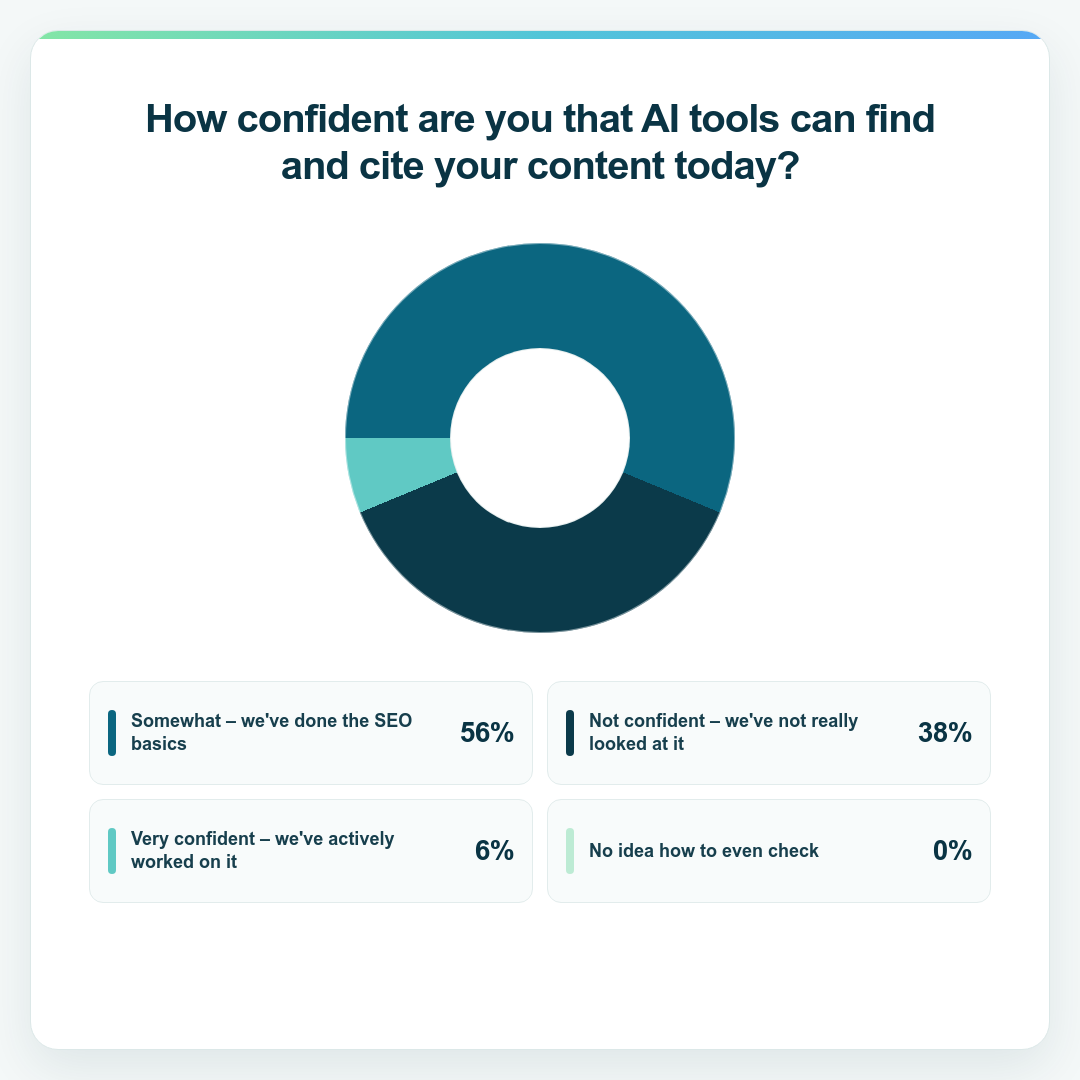
- Somewhat – we've done the SEO basics – 56%
- Not confident – we've not really looked at it – 38%
- Very confident – we've actively worked on it – 6%
- No idea how to even check – 0%
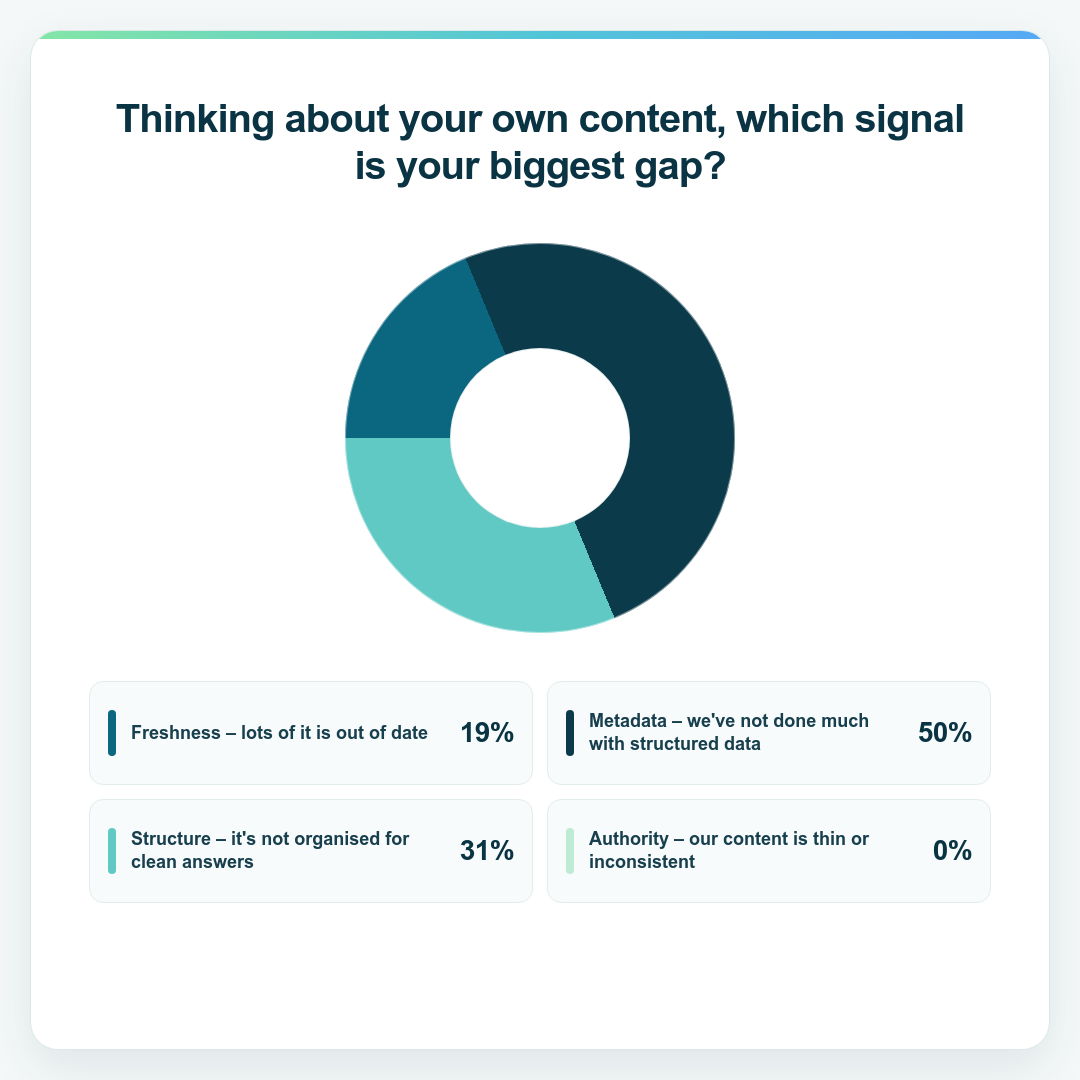
- Freshness – lots of it is out of date – 19%
- Metadata – we've not done much with structured data – 50%
- Structure – it's not organised for clean answers – 31%
- Authority – our content is thin or inconsistent – 0%
AI visibility report
Is your content invisible in AI search platforms?
Get a free AI visibility report of your content. See where you stand today and get clear recommendations on next steps.
Webinar Q&A
List the questions people ask about your organisation, then test them regularly in the AI tools your audience uses. Record whether you are mentioned or cited, which page is used and whether the answer is accurate and current.
A spreadsheet is enough to establish a baseline. For larger sites, Squiz Content Intelligence can test content at scale and show what needs fixing. Use analytics as supporting evidence, as many AI answers do not generate a click.
Traditional SEO remains important for discoverability, but it cannot address unclear, poorly structured or outdated content on its own. Being found and cited by AI requires an additional focus on structure, metadata, authority and freshness, so AI can extract clear answers, understand the information and trust the source. You can audit and improve your content manually, or use Squiz Content Intelligence to do it at scale and prioritize the fixes that will have the greatest impact.
Yes. SEO remains important because AI search features still need to find, access and assess web content. Google has confirmed that its AI search features use its existing search index and ranking systems.
The main difference is the experience. Traditional search ranks links, while AI search may combine information from several sources into one answer. Content therefore needs to be easy to find, clear, complete and trustworthy.
Yes, if it makes content repetitive, unnatural or split across several similar pages. AI systems can understand related words and phrases, so you do not need to repeat every keyword variation.
Use consistent names for services, policies and products. Focus on answering the question clearly rather than meeting a keyword target.
- Give each page one clear main topic.
- Put the answer or summary near the top.
- Use clear, specific headings. Questions can work well when they feel natural.
- Use consistent terminology.
- Use proper HTML headings, lists and tables.
- Keep important information as readable text, not only in images or downloads.
- Add descriptive page titles, summaries, links and image descriptions.
- Keep information accurate and remove conflicting versions.
- Balance AI visibility with a good experience for people.
Common problems include blocked or inaccessible pages, vague headings, important information buried deep in the page, missing context, duplicate or contradictory content, old figures and broken links.
Formats can also create problems. Scanned PDFs, text embedded in images and content loaded only after someone interacts with the page may be harder for some systems to process reliably.
AI systems do not publish one universal trust score. They may consider whether a source is relevant to the question, clearly identified, consistent with other credible sources, current and recognised as having first-hand knowledge of the topic.
Clear authorship can help establish context. Useful signals include an accurate byline, an author profile, relevant credentials, information about the organisation and structured author data in the page’s code. These signals support trust, but none guarantees selection.
For a question about a university’s own deadline, the university website is normally the strongest source because it owns the information. However, that advantage can be lost if its pages are inaccessible, unclear, contradictory or out of date. The safest approach is to publish one clear, current and authoritative page for each important topic.
Not necessarily. A long page can work well if it covers one main topic, uses clear headings and gives direct answers in sections that make sense on their own.
Length becomes a problem when the page covers unrelated topics or buries important information. If sections meet different user needs, split them into focused pages and connect them through a clear overview page.
Questions can make effective headings when they reflect what people genuinely want to know. They create a clear link between the question and its answer, which helps readers scan the page and makes the content easier for search and AI systems to interpret.
Do not force every heading into a question. Use a short descriptive heading when it is clearer, and avoid pages made up of dozens of repetitive questions. Choose the format that helps people understand and navigate the page first.
Clear headings do not make every organisation sound the same. Use the content beneath them to express your voice through original expertise, evidence, useful examples and specific details.
Questions followed by direct answers can work well for both people and AI. That does not mean every website needs a large FAQ page.
Place relevant questions within the main page where possible. Use a separate FAQ page only when the questions are closely related or genuinely apply across several topics. Avoid mixing unrelated questions or repeating information that already has a clearer home.
Schema markup is information added to a page’s code to describe its content, such as an article, event, organisation or update date. Search engines use it to understand pages and support certain search features.
Its direct effect on citations in every AI tool is not proven or consistent. Treat schema as a supporting layer, not a shortcut. Start with accurate content, clear structure and accessible page code, then add schema that matches what people can see on the page.
It depends on how they are built. Content included in the page’s HTML when it first loads is the safest option, even if it is visually collapsed.
Google can render JavaScript, but other search and AI crawlers may have limited or inconsistent JavaScript support. If important content is loaded only after someone clicks, some systems may miss it. Keep critical information in the initial page content.
PDFs are not automatically invisible. Google can index text-based PDFs, and some AI tools can process them. However, scanned, image-heavy or poorly structured PDFs can be harder to interpret and less accessible than a well-built web page.
Start with files that support important tasks, receive high traffic or change often. Put the essential information on an accessible web page and keep the PDF as an optional download. Where possible, rebuild important PDF forms as web forms.
It depends on how the flipbook publishes its content. If the text is available as crawlable web content, it may be found. If it is presented mainly through images, a PDF or interactive JavaScript, discovery is less reliable.
Provide the important information as accessible text on your website. Treat the flipbook as an optional visual format rather than the only source.
Video pages can appear in search, but AI tools cannot always interpret the full spoken content reliably from the video alone.
Publish an accurate transcript as web text, ideally on the same page, with a short summary and clear title. Captions remain important for accessibility, while the transcript gives search and AI systems a dependable text version.
Keep information as current as its subject requires. Fees, deadlines, eligibility rules and policies need more frequent reviews than stable background content.
Use both a visible update date and, where appropriate, a dateModified value in the page’s structured data. The visible date helps people judge whether the information is current, while the structured value makes the date easier for search systems to interpret. It does not need to appear at the top of the page – a clear, consistent position near the beginning or end can work.
Search systems may also use sitemaps, page headers and crawl history. These signals describe when content changed, but changing a date alone does not prove quality or guarantee better visibility. Review the information before updating the date.
Refresh the existing page if it already serves the same purpose. This keeps its URL, inbound links, search history and established authority. It also reduces duplication and gives people and AI one current source rather than several competing versions.
Create a new page when it serves a genuinely different need or the old page cannot support the new content. If it replaces the old page, retire the old version and redirect its URL so existing links still lead to the current information.
Historical news can remain online if it is clearly dated and labelled as archived. It becomes a problem when an old announcement looks like current guidance or contradicts an up-to-date service page.
Retire, redirect or clearly archive expired information about fees, rebates, deadlines and eligibility. Keep current facts on the main service page and give time-sensitive content a review or expiry date.
Keep one trusted source for each fee, with a clear owner and review process. Show the fee on related task pages where people need it, but avoid manually maintaining several separate versions.
If your website supports reusable content, manage the fee once and display it wherever needed. Otherwise, give a short summary and link clearly to the main fees page for full details and exceptions.
Use an automated audit that groups content by topic, not only one that looks for identical wording. Overlapping pages may use different language while answering the same question.
Squiz Content Intelligence can organise related pages by topic, test the questions the content should answer and identify issues such as conflicting, scattered, vague or outdated information. Teams can then choose one main page for each important topic, consolidate the strongest information there and retire or redirect redundant pages.
Start with pages that are central to the organisation, receive the most traffic or support the most important user tasks.
Then:
- Fix site-wide template issues so headings, accessibility and standard page information are correct across many pages at once.
- Improve the highest-value pages first.
- Use an automated audit to identify the biggest gaps and create a prioritised list of work.
- Review and improve content regularly rather than treating it as a one-off project.
There is no reliable evidence that every AI system gives Reddit a fixed preference. Reddit may appear often because its pages can rank highly, contain direct questions and answers, and provide detailed first-hand discussion.
Like any open platform, it can be manipulated and should not be treated as reliable evidence by itself. The strongest long-term approach is to publish clear, specific and authoritative information on your own site and support it with credible independent references.