





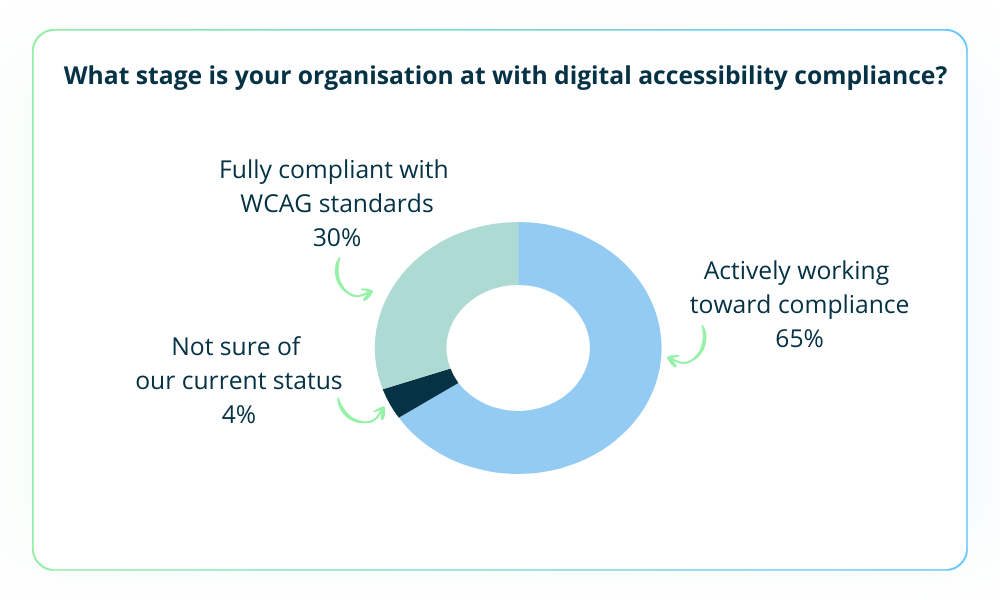
Poll 2: What stage is your organization at with digital accessibility compliance?
Fully compliant with WCAG standards – 30%
Actively working toward compliance – 65%
Aware of requirements, but no formal plan – 0%
Not sure of our current status – 4%
After years of AI experimentation, 2026 marks the transition of AI from emerging technology to operational reality. But while 66% of organisations now report significant AI productivity gains, success isn't universal. In this 45-minute webinar, we dive into four interconnected trends reshaping digital experience.
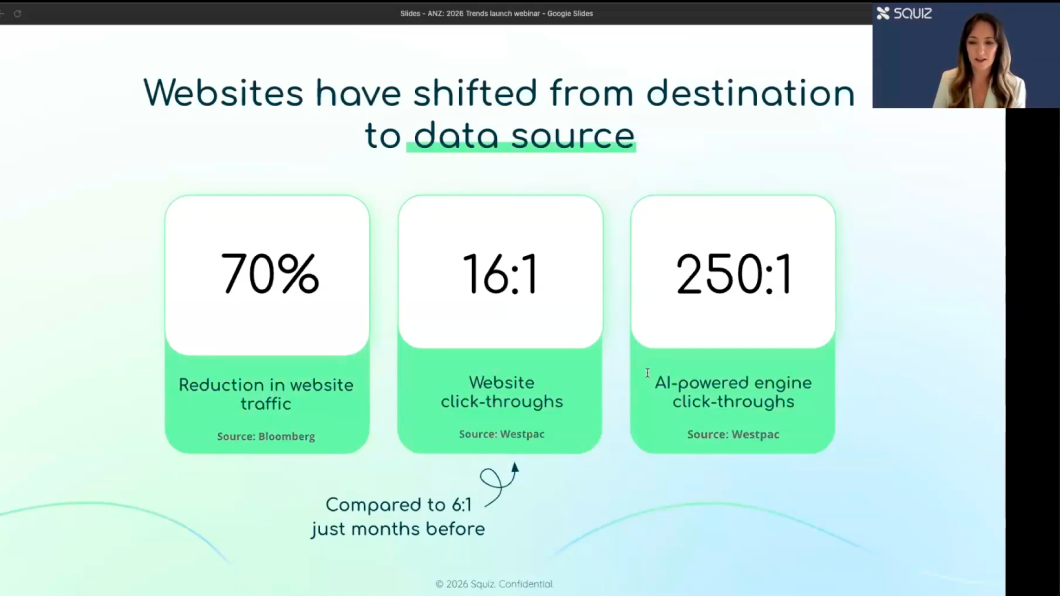
Video: How digital experience, content, and accessibility are evolving. Captions and transcript available on playback.
This webinar explores how AI is reshaping digital experiences in 2026, focusing on content discoverability, accessibility, productivity, and security, and why strong digital foundations are critical for success.
Dig deeper into practical frameworks, implementation checklists, and insights from digital leaders navigating the AI reckoning.
Fully compliant with WCAG standards – 30%
Actively working toward compliance – 65%
Aware of requirements, but no formal plan – 0%
Not sure of our current status – 4%
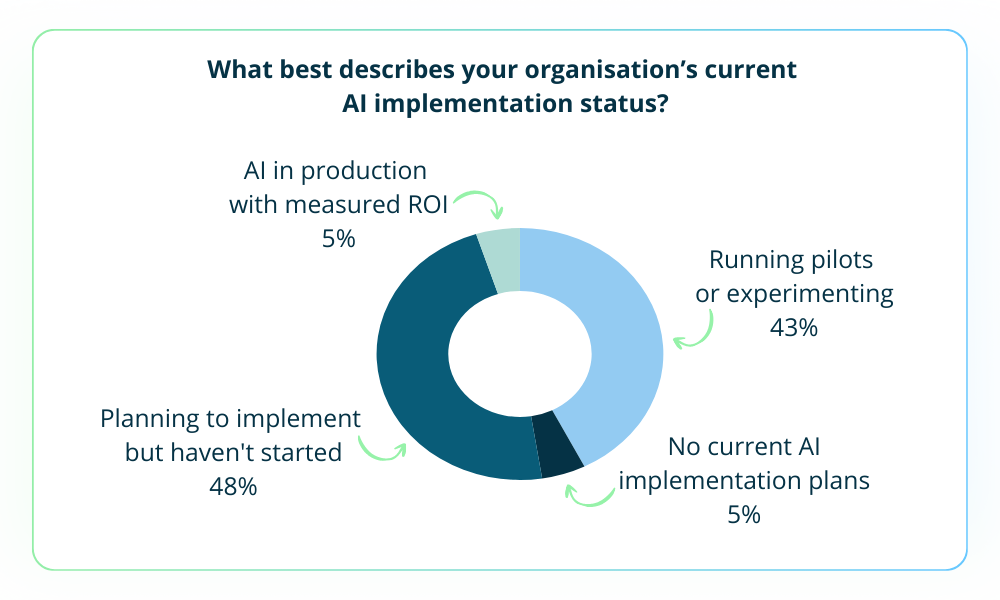
AI in production with measured ROI – 5%
Running pilots or experimenting – 43%
Planning to implement, but haven't started – 48%
No current AI implementation plans – 5%
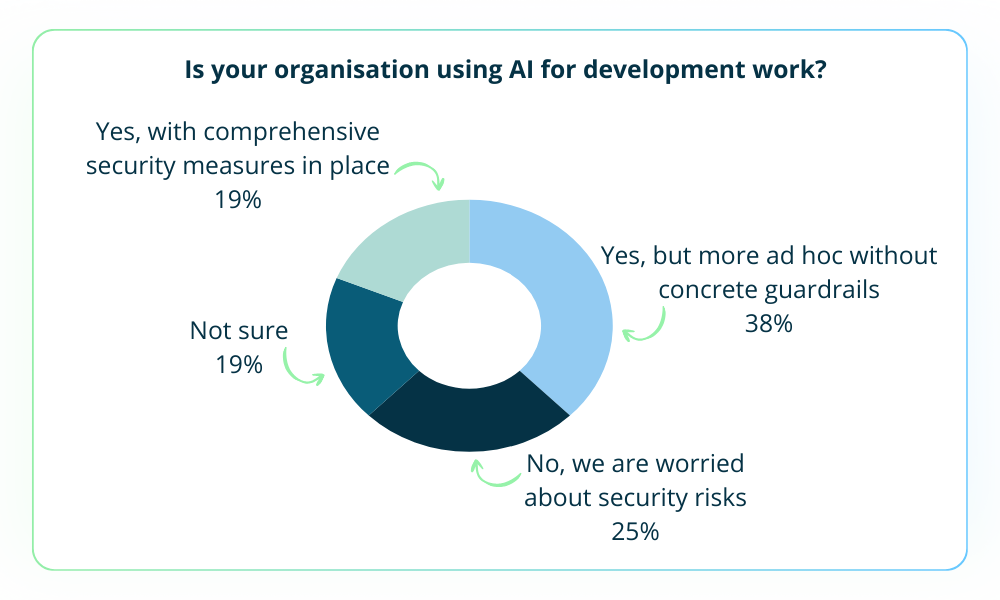
Yes, with comprehensive security measures in place – 19%
Yes, but more ad hoc without concrete guardrails – 38%
No, we are worried about security risks – 25%
Not sure – 19%
Full question:
"I'm reading, hearing, seeing a lot that following established website and web content best practice for conventional SEO, accessibility, and writing 'good' content for humans will get us in good shape for AI and GEO. But I'm also reading about some things we're not currently doing - e.g. schema markups. Do you have any view on the benefits of investing time in adding schema markups?"
Answer:
Schema markup is worth investing in – just make sure your content foundations come first.
Schema markup sits in your page code, invisible to human visitors, and acts as labels for conversation-based search – telling them whether a page is an FAQ, a service page, a how-to guide, and so on. While conversation-based search can infer this from well-written content, schema reduces ambiguity and reinforces those signals.
That said, schema amplifies content that's already clear, accurate, and well-structured. It won't rescue content that's outdated, buried in PDFs, or written in language no citizen would search for. Get those foundations right first – then schema markup becomes a valuable layer to add.
If your content is already written in plain English, organised around what users need, and published as web pages rather than documents, you're well-positioned to benefit from schema markup.
Full question:
"We are in the midst of implementing Conversational Search and I am confident our content is in a good place (after a recent content governance project). To assist us further and to make sure our content is cited, is there clear guidance / information on using schema markup to further improve the ability for LLMs to source and cite our content?"
Answer:
That’s fantastic – if your content foundations are already in a strong place, schema markup is a useful next step.
If you’re looking to prioritise implementation, a few types are sensible places to start:
Using established standards like Schema.org, and validating with tools such as Google’s Rich Results Test, can help ensure your implementation is consistent and working as expected.
Full question:
"So there is a DIRECT link between good SEO and good AI / GEO. Because having your content appear in the top 5-10 conventional Google search results gets it into the RAG set that then feeds the Google AI summary?"
Answer:
There's a real relationship, though it's not quite a direct pipeline.
For Google's AI summaries, the system retrieves content from across the web and uses it as source material for its generated answers. As a rule of thumb, ranking in the top results gives your content the best chance of being included – but the process is more dynamic than a strict cutoff. Relevance to the specific question matters too, so a lower-ranked page can still make the cut if it's a better match for what's being asked.
That said, getting into the pool doesn't guarantee you'll be cited. AI search platforms look for content that clearly and directly answers the question being asked, from sources that are credible and up to date. A lower-ranked page that answers a question concisely can outperform a higher-ranked page that buries the answer.
Good SEO gets your content found. Good content – clear, current, and from a trusted source – gets it cited.
The goal is the same - create clear, accurate, well-structured content - but AI introduces a second audience with specific technical requirements that your pages need to account for. A few things to focus on:
No - SEO remains relevant, and the two are more complementary than they are in competition.
Many of the principles that underpin good SEO - clear, well-structured content, logical page hierarchy, relevance to what people are searching for - are the same foundations that GEO builds on. The difference is that GEO goes a step further: rather than optimising for keyword relevance and rankings, it focuses specifically on whether your content directly answers questions and can be accurately cited by AI search platforms.
The practical implication is that if your SEO fundamentals are in good shape, you are already closer to GEO-ready than you might think. The additional work is about ensuring your content is complete, consistent, clearly structured, and explicitly answers the questions your audience is asking.
Not in any fully established sense - though paid placements within AI-generated search results are beginning to emerge on some platforms. It's still early, and the options are limited compared to traditional paid search.
While these paid channels are still taking shape, our recommendation is to focus on what you can control: your content foundation. Building content that is accurate, well-structured, and directly answers the questions your audience is asking is what drives organic visibility, improving your chances of being discovered and cited across AI platforms. That's the core of what GEO addresses.
Authoritativeness is a complex signal, but a few content-related factors are particularly important for how AI systems assess and cite your site.
A good starting point is to focus on:
Completeness. Identify the questions people are likely to ask about your organisation or topic area, make sure your content answers them, and use tools to test for gaps. Gaps in coverage are opportunities for a competitor to be cited instead.
Depth. AI engines favour content that goes into meaningful detail on a topic over content that skims across many. A page that thoroughly answers one question is more likely to be cited than a page that partially answers five.
Accuracy and currency. Keep content up-to-date and factually reliable. The more consistent and current your content is on a given topic, the stronger the trust signal it sends.
Consistency across your site. If multiple pages reinforce the same information coherently, AI is more likely to treat your site as a credible, authoritative source on that topic - rather than a site with conflicting or fragmented content.
Publishing content directly on your web page is generally the better approach. HTML gives you full control over structure - headings, schema markup, semantic tags - all of which help AI systems parse your content accurately and cite it correctly.
PDFs hosted online can be indexed and read by AI tools, but they offer far less structural control, which makes it harder for AI to understand context and extract the right information.
Where you have the choice, publishing directly on your site in a well-structured format is the stronger option for AI discoverability, and for users too.
Traffic alone is no longer a reliable signal for retirement decisions. As discovery shifts to AI search platforms, a page may be actively informing research and referrals without registering many direct visits.
A more useful approach is to audit the quality and relevance of the content itself:
Rather than retiring pages based on traffic drop alone, consider whether the content can be updated and improved. In an AI-driven search environment, well-structured content that directly answers questions is an asset - even if fewer people are arriving at it directly.
This is a legitimate concern, but re-architecting your entire site is unlikely to be necessary.
It's true that many AI crawlers and LLM agents cannot execute JavaScript, which means content that only appears after JavaScript runs - as is common with client-side rendered applications - may not be readable to them. If an AI tool visits your page and sees an empty shell rather than actual content, it can't cite what isn't there.
However, the most practical fix is not a full re-architecture. Most modern frameworks, including React, Vue, and Angular, support server-side rendering (SSR) or static site generation (SSG) as a configuration option. These approaches pre-render your content so it's available in the page source, without requiring a rebuild from scratch.
If a full technical change isn't feasible, a simpler option is to ensure your most important content is either server-rendered or published as standard HTML pages, even if the rest of your site remains client-side.
Will AI solve this problem itself?
Probably over time, but not fast enough to ignore it now. Browser-based AI agents like Claude in Chrome are already capable of rendering JavaScript, so they can read client-side content. As this kind of agentic browsing becomes more common, the gap will narrow. But the major crawlers used by Perplexity, ChatGPT, and Google's AI systems today are largely HTTP-based and optimised for speed and scale - they're unlikely to execute JavaScript across millions of pages any time soon.
Some GEO tracking tools are starting to emerge, though the category is still early days and it's not yet clear how reliably most of them measure what they claim to. Tools like Profound, Scrunch.ai, and Otterly are among those worth watching as the space matures.
For now, the most practical approach is to split measurement across two things you likely already have or can access.
Web analytics remain the right tool for understanding AI-referred traffic - but it's worth knowing that not all AI platforms send traffic the same way. Perplexity, ChatGPT, and Claude are designed to show sources and encourage users to click through, so referral visits from these platforms will show up in Google Analytics as traffic from perplexity.ai, chatgpt.com, or claude.ai. Google AI Overviews behaves differently - users often get their answer without leaving Google, so your content may be cited frequently without generating a single visit. This means web analytics alone will undercount your true GEO visibility.
Content auditing tools fill the gap for the GEO-specific side - helping you understand how well your content performs in AI search and where to improve. Squiz Content Intelligence does exactly this: it crawls your entire site and groups content by topic. From there, it uses AI to test how well your content answers the questions your audience is likely to ask about each topic, identifies issues and gaps, and surfaces prioritised recommendations with AI-generated fixes on what to address first. You can learn more about this tool here.
You can't control where people encounter your content - but you can control the source it comes from. AI systems don't create information, they aggregate and present it. Your website is the primary source of truth they draw from, which means the quality, accuracy, and clarity of what's on your site directly determines how you're represented elsewhere.
A few things matter most:
If you're not filling that space with accurate, well-structured content, something else will fill it for you.
AI systems don't give you the exact same output every time, which creates a different kind of security challenge compared to traditional software. There are a few layers to how you address this.
First, control what the AI has access to. If sensitive information never enters the AI's context, it can't leak it. You need clear data boundaries - what content is the AI allowed to draw from, what's off limits, and how is that enforced? Scope matters too - a conversational search tool answering questions about your public website is a very different risk profile from an internal AI with access to customer data.
Second, layer your defences against prompt injection. That's where someone tries to manipulate an AI system into ignoring its instructions or revealing information it shouldn't. The defence has to be layered - input validation, system-level instructions that are harder to override, output filtering, and monitoring to flag unusual patterns. No single layer is perfect, but together they create a robust defence. Anthropic (the company behind Claude) recently published research showing they've reduced successful prompt injection attacks to around 1% through reinforcement learning and classifier-based scanning - though they're transparent this remains an active area of research.
Third, test, red-team, and monitor continuously. AI security isn't set-and-forget. Regular red-teaming and ongoing monitoring are essential. OWASP ranks prompt injection as the #1 risk in their Top 10 for LLM Applications.
The short answer: you can absolutely use AI with sensitive information, but you need to be intentional about the architecture, the access controls, and the testing.
This tension is common, especially in larger organisations - universities, government agencies, and enterprises where marketing and IT have historically operated in separate lanes. A few things help:
Start with relationships, not policies. A lot of the friction comes from assumptions made at a distance. Getting people in the room together - marketing and IT, leadership and security - shifts the conversation from "fast vs. slow" to "how do we move at the right pace."
Both sides need to give a little. If you're pushing for speed, take the security and governance concerns seriously - they're usually legitimate, and ignoring them creates bigger problems down the line. If you're on the IT side, it's worth asking whether your current approach is genuinely protecting the organisation, or whether it's pushing teams to work around you rather than with you.
Start with a focused pilot. Pick a use case that's lower risk but high enough value to show results. A focused pilot gives leadership something tangible to point to, while giving IT the chance to understand what governance and oversight need to look like before committing to scale. What you learn from that first pilot shapes how you move forward - faster and more safely than if you'd tried to do everything at once.
The goal is secure velocity. Organisations getting this right aren't choosing between speed and safety - they're building guardrails that let them move fast sustainably. That means automated workflows, approval gates at key checkpoints, and senior oversight built into the process - not added as a bottleneck at the end.
Ultimately, IT and security teams want the same thing leadership does - to get it right, not just get it done. Approaching it that way makes finding common ground a lot easier.
Squiz takes a multi-layered approach to AI security, covering both the platform level and the AI-specific architecture.
Platform security foundations: Squiz holds ISO 27001 certification, SOC 2 accreditation, CSA STAR Level 1 certification, and TX-RAMP certification for US government data. Infrastructure is hosted on AWS with CIS benchmarks, role-based access controls, encryption at rest and in transit via TLS, Web Application Firewalls (WAF) via Cloudflare, and DDoS protection. Independent penetration testing is commissioned annually, with automated daily network scans for anomalous configurations. Code is scanned through GitLab CI/CD pipelines to catch vulnerabilities before deployment, and SentinelOne provides real-time threat detection and response across the environment.
AI-specific security architecture: For Conversational Search - Squiz's AI-powered search product - security is built into the core architecture through several layers. The system uses a Retrieval-Augmented Generation (RAG) framework, which means the AI can only draw from content that has been explicitly approved by the organisation. There is no access to external data or the open internet - responses are grounded exclusively in your verified content, with inclusion and exclusion controls down to individual URL level.
Critically, Squiz employs a dual-agent verification architecture. A generative agent produces the response, and then an independent guardian agent inspects that response before it's delivered to the user. The guardian agent validates that the question is legitimate (defending against prompt injection), verifies the answer is strictly grounded in approved content, and checks for any issues with accuracy or relevance. If problems are detected, the system defaults to a safe response rather than delivering potentially incorrect information.
Data boundaries and control: Organisations retain full control over what content powers AI responses. No customer data is used to train AI models. Content processing and storage takes place within the customer's deployed region (UK, North America, or Australia). Access to customer data and infrastructure is restricted to authorised personnel only, with all access logged and tracked for auditability.
Ongoing security practices: Squiz operates a continual assurance approach with monthly checks on control effectiveness, maintains a dedicated security incident response process, and publishes security posture information through the Squiz Trust Centre (https://trust.squiz.net).
The number is less daunting than it looks. A single image missing alt text can trigger violations across many pages, so 8,000 issues is rarely 8,000 distinct problems - it's more likely a handful of recurring patterns replicated at scale. The priority is not to fix every item in sequence, but to address the highest-impact issues first.
A few principles:
If the number is genuinely that high, it's also worth asking whether your CMS or platform is contributing to the problem at a structural level. Fixing platform-level issues at the source will clear far more ground than manual page-by-page remediation.
The right tools can make this significantly more manageable - by surfacing which issues to prioritise, where the quick wins are, and how to work through the list efficiently.
Getting to production is less about the AI being ready, and more about whether your organisation has the right foundations in place to support it.
Think of it like onboarding a new employee. No matter how capable they are, they'll struggle without the right support structures around them. The same applies to AI. Before moving from pilot to production, consider whether you have the following in place:
Organisations that are seeing real returns from AI are consistently those that invested in this foundation first.
Here's a summary of what we have available now and what's coming across our AI-related capabilities.
Available now
Conversational Search is already in general availability. It brings AI-powered search to your own website, drawing answers directly from your own content - so your users get instant, accurate responses to natural language questions based on content you control, rather than a generic list of links. You can learn more about it here.
Coming soon
Squiz Content Intelligence is a content health solution that scans your entire website and gives you a clear picture of its health - showing exactly what's broken, what to fix first, and how to fix it. Launching as part of Content Intelligence are two auditors:
Learn more about Content Intelligence here.
Further out
We're expanding Content Intelligence with additional auditing capabilities - covering areas like broken links, spellcheck, brand compliance, and SEO - alongside an AI "fix it for me" feature that automatically implements fixes rather than just flagging them.
We’re also working on AI-assisted page building - two capabilities that fundamentally change how pages get built:
This is a snapshot of where we're headed - there's plenty more in the pipeline as our roadmap continues to evolve.