





Is your firm’s content ready to be found by AI?
How AI is changing the way clients discover expertise - and how to check whether your thought leadership is ready.
Meridian West and Squiz discuss how AI is changing the way clients discover expertise, why valuable professional services content can be missed, and how firms can assess whether their priority content is ready to be found.
Watch the webinar
Transcript: Watch the webinar
Welcome and introductions
Alastair Beddow [00:02]
Hi, everybody. I'm Alastair Beddow. Welcome to the first in a series of three Meridian West and Squiz webinars. We're delighted to have you all joining us today to unpack what is a really interesting question, and certainly one that I'm getting asked quite a lot: “Is your firm's content ready to be found by AI?”
Things are changing really rapidly in this space. To help me provide answers to that question and many more, I'm delighted to be joined by Ethan Murphy from Meridian West. Hi, Ethan.
Ethan Murphy [00:33]
Hiya.
Alastair Beddow [00:35]
And also Will Noble and Joel Goodman from Squiz. How are you guys doing?
Will / Joel [00:41]
Doing great. Good, Alastair. Thanks for having us all.
Alastair Beddow [00:44]
Great. Well, great to be working with you on this series of three webinars. In the first webinar today, what we'll be taking a look at is thought leadership. Does it still have a place in today's business buying cycle? Then we'll have a look at how AI is changing the way content is being discovered. Then we'll think about what that means for you all on this webinar today. How can you assess your current readiness? And then we'll take a look at what's coming ahead in webinars two and three.
Let's do some introductions. Will, do you want to remind people who Squiz are?
Will Noble [01:26]
Yeah, sure. Hi, everyone. Squiz is a digital experience company for regulated industries. Firms use us to build websites, portals and apps. Services include helping firms become discoverable. We can help visitors find information when they do arrive on your web estate, and we can also transform back-office processes so non-technical teams can deploy content and new experiences.
Alastair Beddow [01:52]
Fantastic. And a little bit about Meridian West for those who don't know: we've been working across the professional services landscape for the last 25 years. A big part of what we do is helping firms create fantastic content and thought leadership that elevates their brand and helps win new business. My colleague Ethan is going to be talking about some of the research we've been doing in that space.
As we go through, if anybody has questions for myself or my three colleagues on the panel here, do type them into the appropriate box, and we'll try to cover those either as we go through or at the end of our chat. Don't be afraid to ask some difficult questions. We're ready and prepared for those.
Why thought leadership still matters
Alastair Beddow [02:36]
Let's dive in. The first area we wanted to have a think about was why thought leadership matters, and does it still matter? How is this influencing people when it comes to buying professional services?
I've got some thoughts on that, but I know, Ethan, you've been spearheading our ATLAS campaign, which takes a look at the role of thought leadership in the professional services buying journey and what firms are doing. Maybe do you want to start by telling us a little bit about what this is, and then we'll hear some of what you've found from the research?
Ethan Murphy [03:14]
Yeah, sure. Thanks, Alastair. In answering the question, we'll draw on our experience working on thought leadership projects. But a big part of what we've been doing over the last year or so is the ATLAS campaign, which is a piece of research on best practices around creating thought leadership content.
We listened to marketers, creators of thought leadership, writers—everyone involved in the creation process—through a series of different channels, including surveys. We also did a series of in-depth interviews with experts in that field and a series of roundtables focused on different topics that arose. It all ended with this report we did earlier in the year, which is accessible through the QR code on the screen if you want to go and read that.
This is really around understanding firms' approach to thought leadership and what they were using it to try to do in terms of moving the dial on different business metrics as well. We've seen the importance of success in the projects we've worked on, but this is our understanding of the wider market as a whole. It helps show what we see on a day-to-day basis as well: thought leadership is still having quite a big impact.
Alastair Beddow [04:30]
Let's maybe have a look at what we've found through ATLAS because, as you say, thought leadership is still very central to the way a lot of firms go to market, demonstrating their expertise. You found some really interesting things around what role it's playing today and the way firms are using it.
Ethan Murphy [04:50]
Exactly that. As you mentioned, what we're seeing thought leadership used for, when done well, is really being powerful in building credibility, supporting client and new relationships, but also, from a real commercial perspective, creating those direct opportunities.
Our ATLAS research shows this. One of the questions we asked was around the different objectives of campaigns, and over 70% of respondents said that establishing expertise in specific areas, educating clients on emerging issues, deepening existing relationships and directly cross-selling were highly important objectives they were trying to achieve when conducting thought leadership.
That's really interesting because it looks at the returns on both a short- and long-term scale. In the short term, really being able to provide clients and the market with answers to emerging issues and challenges, keeping you front of mind and opening dialogue for really topical conversations.
But then also the long-term impact, which maybe doesn't necessarily open a direct conversation, but keeps you in mind: the impact on brand and reputation. Overlapping with a lot of the insights we hear from client listening as well, clients are demanding more from those relationships with professional services. They want to hear insights. They want to be kept in the loop with different changes and regulations, etc.
Thought leadership is a really strong way of sustaining what you've already got with clients, as well as reaching out to a newer market. There's a few other stats in the research as well, but these three do show that.
Alastair Beddow [06:34]
I'm really interested in what you're saying about the commercial drivers, short term and long term. Are there any examples you've seen or worked on that maybe illustrate that for our audience today?
Thought leadership in practice: Reward Gateway
Ethan Murphy [06:47]
There's loads of examples we've worked on that show that. One of the best ones is a campaign we worked on with Reward Gateway. It's called the Economic Value Study.
For those of you who don't know, Reward Gateway are a provider of employee experience platforms and benefits. They create these solutions, and the aim at the start of that project was to do a study that looked at the link between offering employee benefits and business growth—more so just to make a bit of a business case for their services.
But what started as a more targeted campaign actually turned into something really fundamental. It evolved not only the way Reward Gateway shaped their internal service offering for their clients, but also allowed them to become one of the leading voices in the sphere of employee engagement and how that works internally.
They did a big report launch at a summit with loads of people, got thousands of downloads and impressions on social media, and generated millions in revenue. But also they've now become a voice, and they're using that campaign year on year to update and explore the area. They've got loads of extra pieces they're researching as well.
It's a really good example of how a strong piece of content allowed a firm to do a lot of different things, both from a brand and a commercial perspective.
How AI is changing content discovery
Alastair Beddow [08:06]
Great, and lots more examples in that ATLAS report you mentioned as well, Ethan. You've made a really strong case to open our discussion today about why this matters.
What's interesting, certainly from my perspective, is that the nature of the conversation in the last few years has really changed from, “How do we produce high-quality content in and of itself?” and the sense that it would automatically be found by the audience. But now we're in a slightly different landscape where we know AI search in particular is changing the game.
This is where we need to start asking other questions, which is: how is that changing the way content and thought leadership is found by the audience? Will and Joel, you've got some interesting perspectives. I'd love to hear what you're seeing in the way AI search is changing how thought leadership is being made visible.
Will Noble [09:03]
Thanks, Alastair. Great summary. I suppose the first thing to note is this is still a very nascent industry. It's barely been two years that we've been talking about this channel, and the engines do change how they cite sources without telling anyone, which keeps us on our toes.
A couple of reflections. Possibly the largest readership of content now is the bots. Bots are now over the internet as much as humans are, and this will grow 100 times, 1,000 times over the next few years. We need to react to that, and what we can do is something I'll talk about in a second.
Also, what is changing is that AI has changed the attribution model we've all become familiar with, which is search, click, convert. They're designed to synthesise content in their own words, pair it with external sources, and quite potentially might not pass you that attribution or mention. That can be a great jump in user experience, but slightly lousy if you're a marketer trying to attribute good ROI from this work.
But what is coming into play is that AI search is really a branding channel. I don't think ChatGPT is going to be the new Google. We've probably seen clicks from AI remain around the same level over the last year. Of course, the big change is the layout change in Google and how we disseminate information. That is very, very big.
From a branding perspective, establishing expertise—as you saw in that research, Ethan—it's really important to be mentioned in AI search. If your content is overlooked, then it's almost like you don't exist. You don't have the same luxury as in a normal search engine.
From our research, content can be overlooked if it's inaccessible, unclear or contradictory. If you contradict yourself, you can often be overlooked. But it can also be overlooked if your thought leadership or content looks exactly the same as 300 other firms that published exactly the same thing that same week. Resonance now counts more than it ever has done.
Poll 1: How confident are you in your AI visibility?
Alastair Beddow [11:22]
That's really interesting. We'll dive into a little bit more of the mechanics on that in a moment. But before we do, we'd love to hear from you all on the webinar today how you're finding things. We've got a poll question which is going to come up now, and we'd love to hear your thoughts.
How confident are you that your priority thought leadership is visible and usable in AI search? Will was talking about how the landscape is changing. How confident are you that it is being found in this new landscape?
We'll give people a moment to share some of their thoughts on that, and then we'll take a look. Will, as we're waiting for some of those results, what are you getting a sense of from the people you're talking to? Are people prepared for this challenge?
Will Noble [12:14]
I would say it's mixed. Everyone in the industry is having that question from their managing partners: “I ran this query for our practice area, and it didn't come up. Why is this?” How do you answer that question when everything's on shifting sands?
It'd be interesting to know if you're very confident in something at this early stage. We're still very much at, “We know this is a new channel we need to work towards, but how we actually do it, that's the question mark.”
Alastair Beddow [12:51]
We're seeing some of that through the poll results. Most people there, two-thirds, are saying somewhat confident. That suggests to me exactly what you're saying: they're asking the questions, they're starting to think about this, people are asking questions of them, but there's more we can do.
Sixteen percent are not very confident at all, and in fact nobody's put very confident. Clearly you're all here because there's more to do in this space. Let's think now in a little bit more detail about some of the reasons why there is not full confidence at the moment, some of the gaps you're seeing, Joel, in terms of content visibility.
Common gaps in AI content visibility
Joel Goodman [13:45]
From a technical perspective, here at Squiz we've taken the approach of looking at how AI and large language models actually interpret content. I'll keep this not super technical for everyone, but here are the basics to look at.
We often see important content locked away in a PDF, and PDFs are not generally accessible. They're difficult for the AI agents and bots to really read through and pull things out of. They might look nice. They might be a good download or presentation. But unless the work is put into making that content readable and parsable by pulling it out, putting it on a web page and putting it in a format where AI bots can read it, it's often making it difficult for that content to even see the light of day, let alone be cited by AI search and put into those search results.
Similarly, when we look at how content is written, often in professional services there's a certain way of writing. We also work in other industries like higher education, which have a very different way of writing, but also equally vague and confusing to a normal person.
The effort we put into being clever with our titles can oftentimes not match the way people are actually asking questions online. How are they phrasing them? It goes back to the typical user experience practices we've done for years: thinking about who our audiences are, thinking about who our prospective customers are, and writing in their words so we're reducing that mental load.
Similar for AI: if it doesn't understand the way you're talking about something because it's not obvious, it's generally going to skip over it and find a better piece of content, or a piece of content it feels it can trust because it understands what it's saying.
We also often see duplicate content across websites, or pieces of information and facts that are contradicting. When an AI bot shows up on your site and it's trying to figure out what the truth is, if you have two different pieces of information that conflict with each other, it either makes something up—we've all seen AI hallucinate, and that's a common cause if it can't understand which piece of content or fact is the correct one to say—or, more than likely, you've probably seen everyone worried about answers coming from places like Reddit, other forums or competitor websites. That's the default at this point. If those AI bots can't trust your content because they can't figure out what's correct, they're going to find something they feel they can use as correct.
The same thing goes for stale figures, pricing that's out of date or facts that are out of date. Those give a signal to the AI bots that we can't trust this content because it may not be current. They can't find a reason for it to be current.
Then a really easy one: there was a time when AI crawlers were first coming up, and a lot of businesses decided to put up AI bot blocking because they didn't want their content taken by AI and used in things—copyright law, all those sorts of things.
The downside to that is that when an actual AI model does its training every so often—we don't know the actual dates—it's not including your content in its training data. Then when it goes out to search, it's probably being blocked by those robots.txt crawler blockers. You're not even giving it a chance to pull your content into those answers as you go along.
The journey from crawl to citation
Joel Goodman [17:29]
On top of that, we can look at this simple model of the journey your content actually has to survive to make it even into a citation. This is a very simplified version of it. It gets really technical under the hood.
Essentially, what happens first is it's got to survive the crawl: the actual bot going out and looking for your content. Then it's got to be parsed. It has to be read and processed by that model.
A lot of times, that's where accessibility comes into play. If your website and content aren't accessible to people using assistive devices, screen readers and things like that, the same technology is used by these AI bots. If a person can't use a screen reader to understand your content, an AI bot isn't going to be able to understand your content either.
If you get past that phase, it then has to understand what the content is about. How well did you write it? How clear is it? How obvious is it? Are you giving a good question-and-answer header and body pair? Those sorts of things.
If it can understand it, then it needs to figure out if it can trust it. How can it trust it? Is there conflicting information? That's a signal against being able to trust you.
It's usually going out and doing a whole bunch of searches around it. Going back to what we were talking about with the reach of thought leadership, are other people posting about it? Are other people talking about it? That PR play that happens with your thought leadership being passed around plays into the trust factor. You can think back to old SEO practices of having backlinks. This is the new version of that. It's a kind of word of mouth that happens among AI because it's reading all these different things in different places.
Once it feels it can trust you, it has the ability to cite you. But there are so many layers. It's doing 50 or 60 or 70 other searches underneath. All those things have to come back. It really is a long process.
We've internally been calling this the gauntlet your content has to survive in order just to get a place in the citation, and each one of these steps is critical. If you miss one of them, you're probably just going to be dropped.
Audience Q&A: What does resonance mean?
Alastair Beddow [19:38]
We've had an interesting question come in from Rachel. Thanks, Rachel, for the question. Will, you mentioned the term resonance before, and the question essentially is if we can say a little bit more about that.
Joel, when we talk about resonance, is that a composite of the different things you were just talking us through in terms of the gaps, making sure the language is going to resonate across those stages of the journey you talked about?
Joel Goodman [20:07]
I talk about it in terms of PR, and this is where PR starts to become a little bit more important. It's about brand reach, and resonance is all part of that. They play off each other. You can't just depend on an AI citation for reach.
The typical modes of SEO still matter. Having a network that's sharing your content on LinkedIn, sharing your content in other places, reposting it and linking back to it—all of that plays into this resonance thing. The more resonance you have around the different web surfaces you interact with, the more likely it's going to be that you'll end up in these search citations as well.
The content side of it is the baseline. If your content isn't readable, then you're not going to show up there anyway. But adding those other points of visibility are the things that really add up to a likelihood of being shared.
The commercial impact on buying decisions
Alastair Beddow [21:02]
Great. Thanks, Joel. That segues us really nicely into the next question we wanted to explore. Ethan, you started talking about why firms are investing in content. We've then heard from Will and Joel about how the journey to find that content is changing in the age of AI search.
But this raises a question: why does this matter? What's the commercial impact here if AI is skipping over content? We've got some interesting perspectives from the buyer side. How is this influencing the way people are making decisions about the firms they want to work with? What have you found from the work we've done here?
Ethan Murphy [21:44]
When we talked through the ATLAS research, that was research from the creator's perspective. We talked about them recognising successes and the importance of doing content in terms of reaching their clients.
There's a lot of stats online. Here's a few really powerful ones about how research can influence buyers on the consumer side of content. The first stat from the Momentum research: 99% of senior executives and buyers consider content crucial when reviewing potential partners. You have stats from the Edelman and LinkedIn research showing the influence of good thought leadership on the likelihood people would engage with you, but also invite you to bid.
There's a lot of research online showing the influence on people looking for services. They'll go to websites, they'll look at your content. That's a really clear indication of your expertise and quality.
Where the interesting question stems, and where thought leadership really differentiates, is that there are people who know what they're looking for, they know what services they're after, and they're searching online to review advisors. But especially for thought leadership content, it's often a trigger that will address an unknown need or a service people don't entirely know they need. They know their challenge, they know their issue, and they're going to search about that. Thought leadership or that type of content will push those buyers towards, “This is a solution that really works for you.”
That goes back to how people will use search engines and chatbots. They might not put in as frequently, “What are the suppliers who do X, Y, Z?” They might put in, “I'm having challenges with this,” or, “My current issue is this. I want to expand here. What do I do?” That's where you've got to really make sure your thought leadership comes up, but also answers the questions and leads naturally into how you can support people.
There's one quote on the right from a senior marketing manager at a leading advisory firm who I interviewed. They mentioned that if they're not producing good content, people won't think about them. They won't see their content. They won't want to buy from them. There's clearly a really strong influence on buying decisions, and firms recognise that by producing good thought leadership.
But then the question comes to: good thought leadership is only as good as its reach, right? Part of the topic today is that the way people are searching for content is changing. How do you make sure your content is [unclear in captions]?
Alastair Beddow [24:16]
You make some really valid points there. If we think about the buyer journey, a lot of this is happening and firms don't even know people are asking these questions. This is way before a client or potential client may have contacted your firm.
Hopefully we've made quite a strong, compelling case that investing in this content helps firms be found when there are those trigger points you mentioned.
That throws up a final question we wanted to take a look at today: what do you do about this? We've heard from people on the webinar that nobody's really confident they're getting this right today. What are some of the steps, Will, from your experience, that firms can actually take to help make sure content is being found and used by AI platforms?
Practical steps for AI discoverability
Will Noble [25:07]
For sure. That was a really interesting comment. It reminds me that maybe the idea of thought leadership is similar to buying a billboard or a TV ad, because we're making an influence, but attribution is somewhat challenging.
There are some practical tips we'll get to, but my first one is maybe don't chase GEO or AEO tactics in isolation. AI visibility and organic performance move together. A company called SEO Works ran an analysis of thousands of companies and found that websites gaining AI referrals were also websites whose organic performance was improving.
Good SEO practices and brand building can't be skipped to just win the race in AI. Everything's got to work together. Here at Squiz, we're all about the owned content, and your website remains the trusted foundation between direct human traffic and AI-mediated experiences. Writing original content that stands out in the market, as we mentioned before, will get picked up more. Storytelling is the superpower.
If we move to the next slide, there are some practical takeaways to have a look at. From a technical standpoint, make sure the actual content itself is clearly laid out with good page hierarchy. Any web agency or marketing team worth their salt will be able to make sure you've got the right semantic HTML and H1 tags. Don't put that thought leadership into a PDF if you want to maximise its reach in AI.
Joel mentioned earlier making sure your content is free of any contradictions. Here at Squiz, we've built tooling: our Content Intelligence technology finds contradictions across all your different websites and web pages. If you contradict yourself, that contributes to hallucinations and removes your cited link.
Authority is a reason to trust and cite you. If you're claiming you're number one in litigation practice, you might want to have some evidence to back up that claim, because we can all say we've got the best pizza joint in town. An AI model will look at your own content, your own site and source, but also look elsewhere, at things like the rankings, to make sure [unclear in captions].
And is content fresh? At Squiz, we ran some research across 170 different firms. The firms cited more often updated their content at a higher frequency than others. This was also found by Ahrefs, an organisation that found that 70% of all citations in ChatGPT came from content published this year.
If you've got a piece of campaign content or thought leadership content you think is still relevant, but it's from 18 months ago, it's worth revisiting, making some adjustments and getting it out there again, because it won't get picked up.
Poll 2: When do you consider AI discoverability?
Alastair Beddow [28:05]
Interesting. So recency really does matter as well. Great. Let's squeeze in, if we can, one more poll question because we're coming towards the end of our time today.
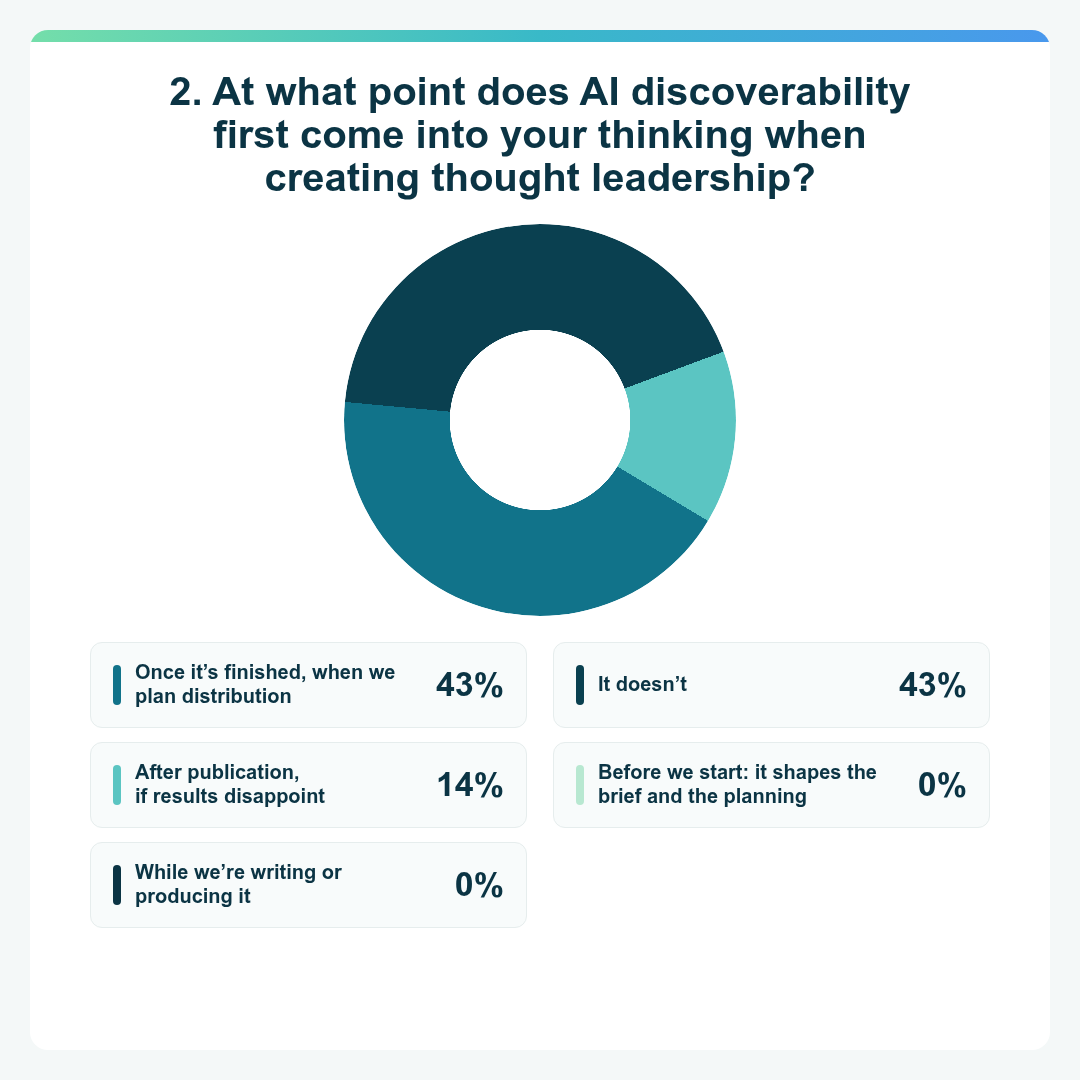
When we were chatting in preparation for this, one of the questions we all wanted to ask everyone in the webinar was: is AI discoverability something that comes into your thinking? Is it something you're planning, talking about or actively considering when you're creating thought leadership at the moment?
We've got some options there. Is it something you're basically looking at before you start? Is it during production, after production or not at all? Again, we'll give a few seconds to see some responses coming in on that.
Will Noble [28:52]
This is an interesting one because there's been a lot of advice thrown around over the last two years where it's now questionable whether it made a difference or not. We're all trying to find the silver bullet. I'm sure Joel can appreciate that. It'll be interesting to see if people have cottoned on.
Alastair Beddow [29:12]
It's interesting. In terms of results, most of it is either just before publication, post-publication or it's not even happening at all. In terms of proactively thinking about this issue, it's clear that it still remains a bit of a blind spot, which tells us why we didn't see anybody super confident around this when we asked the previous question.
Upcoming webinars and closing remarks
Alastair Beddow [29:37]
We're rapidly coming towards the end. That's been part one, so we've just really scratched the surface around what's happening here. Parts two and three will be diving into much more of the practical considerations, so we'd love you to join us.
Part two is on November 17, and then part three is on the ninth [month not stated in captions]. Do scan those QR codes, but anyone who's joined us live today will get follow-up links as well.
All that remains for me to say, because we've run out of time, is a massive thank you to Ethan, Will and Joel. We look forward to seeing you on November 17, when we'll be looking at this in a little bit more detail. Thanks, everyone, for joining today.
Video: Watch the webinar. Captions and transcript available on playback.
Poll Results
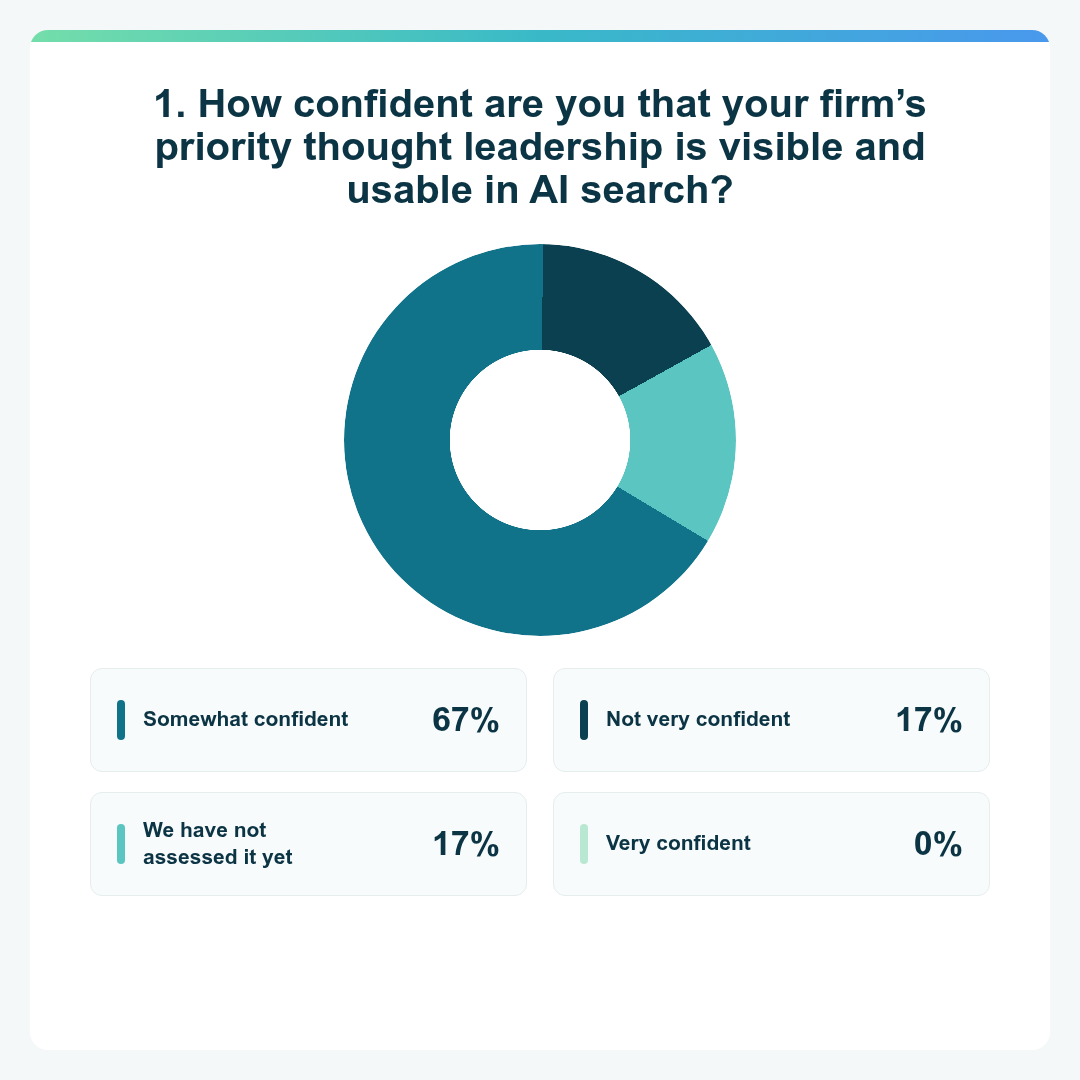
- Very confident – 0%
- Somewhat confident – 67%
- Not very confident – 17%
- We have not assessed it yet – 17%
- Before we start: it shapes the brief and the planning – 0%
- While we’re writing or producing it – 0%
- Once it’s finished, when we plan distribution – 43%
- After publication, if results disappoint – 14%
- It doesn’t – 43%
Watch the Europe webinar
Transcript: Watch the webinar (UK)
Welcome and introductions
Joel Goodman
Good afternoon, and welcome to our webinar today.
We are excited to speak with you about, what what happens after GEO, all of this pressure that we're sitting here having? My name is Joel Goodman. I'm VP of growth strategy here at Squiz. With me are Toby Margetts and Jamie Liechty.
And we are just keenly aware of how much pressure digital teams are under to make their websites and their content show up in AI search. And, it seems to have dominated a lot of the discourse around marketing offices. And, throughout the Internet and anywhere you go on LinkedIn, you're hearing this pressure.
And today, we just kinda wanna look at, you know, the the realities of getting your content to show up in AI search, but also the gaps that, that really don't get talked about within the the discourse that we're seeing across the Internet. So we're gonna look at where AI can add genuine value to the work that you're doing as marketers, and, you know, what has to be true before it can actually achieve that sort of value, and then how you can take those first steps to become, or to make it actually manageable for your team to to sustain going forward long term.
So let's let's dive in because we have a lot to talk about today.
GEO and the shift to intent-driven experiences
Joel Goodman
So as I said, most of this pressure is landing on digital teams. You're being told to show up in answer engines and figure out how many times you're being cited in AI search and, seeing your traffic drop probably on your website due to research and and exploration happening in other places.
But I think it's kinda worth separating the things that you can influence from the things that you can actually control in this new landscape. So today, let's start there.
I don't know. Toby, Jamie, who wants to take it first? But let's, dive into, all of the all the discourse that we're talking about. Why is generative engine optimization and showing up in AI search really only part of the picture, and what are some of the gaps that, we're noticing as we work with these tools every day?
Jamie Liechty
Yeah. I'll I'll jump in there. So first of all, thanks, Joel, for having us. Always fun to have a conversation.
I also want to say marketing teams, we see you, we hear you, we understand your pain points, as Joel already mentioned. We talk to marketing teams all day, every day. I come from the partner lens, I'm VP partnerships here at Squiz, so I work with a lot of partners digital agencies who work with marketing teams, and the pressures are real and we see it all the time. And again, we understand the pressures you're under.
So it's a fun conversation to talk about and also a little daunting at the same time. But to answer your question, Joel, I think really when I think about GEO and AEO and AI and all the things, I think it really comes down to, from a marketing team's perspective, what can you control versus what is out of your control? And I think a lot of pressures from probably management that you're seeing that marketing teams are getting is, hey. We need to do something with AI and and figure this out.
And it's kind of this blanket statement, and then, like, what does that actually mean?
And I think sitting in a marketer's shoes, I would think, okay. What can I actually control versus what is under my control? You can't control how people are going to search, for you, whether they come to your site, whether they go to LLMs, you can't control that. What you can control is how you feed those LLMs via your content. So as long as there's solid content and there's a story behind that content and it makes sense and it's fluid and it's your brand voice and all the things that you wanna make sure that is prevalent, then it's really feeding what are the right answers to the questions that people are searching. So I think that's what I always think about is like that foundational principle of, you can't control the uncontrollables as an old mentor of mine used to say, you can really just control what you can. And I think content is again that principle, so.
Toby Margetts
Yeah, think it's a really good point. You've kind of both touched on it, this idea of control versus influence and what you can do and what you can't do. I think one of the really interesting things as well is if you think about how websites have kind of broadly worked over the last twenty, thirty years or so, We've essentially had, I think, pretty fixed experiences. We've created pages, navigation structures, and thought very deeply about user journeys, and then just expected people to figure out what they need, but I think AI is changing that pretty fundamentally, particularly amongst maybe younger demographics, and I think people are getting really used to the idea of just asking what they want in their own words and getting something relevant back, And I think they're gonna expect that same level of of experience when we're actually dealing with general websites.
Right? That's gonna become, I think, a really normalized experience people expect to have. So, yeah, I I think it's not really kind of about putting a chatbot on a website, and instead of chatbot can be a bit of a dirty word, it's really about, I think, using AI to improve that underlying content that you have and to connect people with the right info and services to actually help them get things done. So I think for me, GEO is a really kind of important part of the conversation, but I don't think we need to get too caught up in the acronyms that you mentioned it, Jamie, like, hey, yo, GEO, like an absolute ton of acronyms, and I think we can kind of distill it down to a question, which is, are we actually helping people find accurate information and understand the options that they have and how they can take that next step?
Jamie Liechty
Yeah, I totally agree, and I think also the conversation and kind of what you pointed out, Toby, in terms of like this personalized, I'm visiting this site, so I want the information that I'm seeing on that site fed to me specifically for my needs at and that right time, at that right moment and all of that versus just, yeah, this broad stroke website of here's what we do, here's who we are kind of thing. Having that conversational experience on your site, I think we're seeing a trend that it's it's definitely moving, of course, in that direction. And I know, Joel, you've... You and I have talked about this a lot where, if you're not conversational on your site and if it's not personalized and and fed to that specific user, you'll likely lose them because they're not gonna find the information they want or they're not gonna find it fast enough.
Toby Margetts
That's super exciting as well, right? That brings in a whole ability to deliver what feel like incredibly personalized experiences, I think.
If we can match up, a, here's a great answer to your question where we've clearly really understood the intent of what you're asking, along with some really simple, straightforward next steps around how to progress and how to go and do the thing that you're here to do, that then is like... That feels like magic. Right? That's the next kind of, era of, of user experience, I think.
Jamie Liechty
Yeah. And then I think it comes to the point of what questions are actually being asked, and do I have the right content to feed those questions, to actually answer those questions. And I think that's that's really hard. That's really hard for marketers to pie in the sky, like, how many questions is someone going to ask about my site or my content on my site? Like, that is really, really hard and guessing at those questions. So if there's a way to identify what those are or themes of the questions, then you can again write that content and that foundational principle of the right information on your site for for the user journey, really.
Poll 1: What is driving AI adoption?
Joel Goodman
Let's launch a poll real quick since we're here at the beginning and kinda level set with the rest of, the people joining us today. We're wondering what's driving AI on your digital road map right now. What is it that you're hearing from leadership within your organization? What are the things that are on your mind as you work through how to integrate AI into your workflows, but also just how to address your content showing up on AI search and other places.
As we get into this, I think...
I I just wanna reiterate where there are things that you can control. That's the content on your website, and then there are those things that you can influence via your content. But it's similar to kind of the the old days of building a brand on, like, a social media platform. You can't really control those algorithms very well.
You can't really, you can't really game AI systems. And so in this case, like, we're looking at, where should you put your efforts? And I think the the difference is that if you're looking at doing purely, like, citation tracking, you're not getting a full picture of the questions people are actually asking of your content, and you're not getting a full picture of of the volume, I think, really, because a lot of that is down to specific context for that individual person and and the, you know, their AI chat and the history that they're...
They've already done with other websites and other research projects. You can't control that stuff. And so it's a little bit more, of a risk to spin your wheels trying to make something happen there than really digging into the content across your site and making sure that it's ready for these, these kind of variable, malleable experiences. You know, making sure your content can answer those questions no matter who is asking it, what is asking it, where it's being asked, and that's the thing that you can actually control here.
So looking at our poll results here, yeah, this is not surprising. Right? We we are all seeing we're...
I mean, maybe it's a little surprising. I would have expected maybe more than 50% where, we're we're we're seeing pressure on how to show up in answer engines, but, it's...
It seems that we've got a good percentage of people that are working through the process of refining that and trying to show up in those answer engines in different ways going forward. Toby or Jamie, any any comments on the on the data we've seen here?
Toby Margetts
One thing I'm really glad the one at the bottom is pretty low, because that feels like not a good reason to be going ahead and doing cool things with AI, right? Even though in the background there is, I think, this mandate amongst all organizations like, hey, we should be doing something. We don't necessarily know what it is, which I guess gets to the crux of what we're talking a lot about today. But I think what's interesting is, yeah, the idea around pressure to show up in AI answer engines, it's like, is that actually necessarily even the right question?
So if you turn around and say, Hey, why do we need to show up in answer engines? Why do we need to be the one that is top of the list when somebody says, Hey, what's the best university for x? The answer to that, I guess, is kind of obvious. You want to be up there.
I think what's more crucial and what we're gonna touch on, more and more is people, I think, increasingly will expect to see and have those experiences on the individual organization's website, and that may even be deemed a little bit more more trustworthy. People do trust things like ChatGPT and Gemini, but we know they're fallible, they're open to hallucinations, they don't necessarily have the level of guardrail and control that may be sufficient when you're getting really into the nitty gritty of needing very factual and accurate answers.
There's a lot going on, and people I think are under a lot of pressure to do things well and to do things right, and it's really, it's an obvious thing, right, to go, hey. I wanna go to ChatGPT, type in something, and I wanna see my name at the at the top. If I'm not, I'm not happy. That may not necessarily be the right question to ask, and I think it's gonna be interesting as we go through today to to, explain a little bit more about about why, I think.
Speaker unclear
Oh, sorry, [unclear in transcript].
Jamie Liechty
Just say one thing real quick, Joel. I do want to touch on one thing you said, Toby, is the trust and the trust signals. I mean, I think that's so huge, obviously, you want your brand to be trusted in all areas on digital, whether that's your own site or whether that is an LLM. But I think that's a big piece is so many users are trusting exactly what they see from their question and then the answer that they see. And is it accurate? And that's kind of... It's kind of scary, right, for a marketer to know or to think of is that accurate? So I think any way you can help shape that answer is definitely the steps to take.
Three foundations for reliable AI experiences
Joel Goodman
So what are the foundations that we've been seeing inside Squiz as we've been working with, our tools internally, but also just the the general research that we do across the industry, that we think an AI initiative kinda depends on? Like, what are what are those kinda key things that, those of us that have joined us today should be looking at with their own organizations and and putting their focus on?
Toby Margetts
Yeah. Good question. I think I think I would say there are probably three things, the first being probably the most obvious one, which is content.
Ultimately, AI is only ever gonna be as useful as the information that it's working with. It's not magic, right? It needs good content to perform well. If your content's out of date, if it's inconsistent, if it's structured badly, if it's spread across multiple different systems, putting a really great intelligent interface over the top isn't gonna suddenly fix all of those problems, so yeah, absolutely getting your content in a good place and making sure it's accurate is really fundamental to this. I would say the second thing is probably the experience itself. It's not just about someone asking a question and getting an answer back. We've kind of touched on this already, but it's actually about understanding what that person is really trying to achieve and bringing together the information and the options and the next steps that are actually gonna be really relevant to them in terms of the journey that they're on.
So I guess rather than someone having to search through five different pages, piece together all of that information themselves, and then work out what to do next, we curate and do all of that hard work for them.
Then I'd say third of the three things is the underlying tech and governance, so making sure that actually your content, data, and services can all work together with the right permissions and having the right controls in place.
I guess ultimately, it depends on what someone wants to do, but if they're there to check their eligibility for something, they wanna book an event, download a prospectus, start an application, whatever it is, the experience needs to actually be able to connect all of those different things, and a lot of what people want to do touches on lots of different systems.
But what I would say, I think, is broadly the mistake maybe some organizations make is treating those three things as separate projects. You need to look at them, I think, holistically. The real value, I think, comes when you bring those three things together, so trusted content and experience that responds to what someone actually needs, and ultimately, the technology that helps them do something about it, I would say.
Jamie Liechty
Yeah. I think... Well well said, Toby. I feel like I don't have much to add because I think you nailed that. But I... Yeah. I think, again, it comes down to that what is trusted, What's the intent behind the search? And how are you monitoring that on your site?
Toby Margetts
I love them, Jamie. I love... You mentioned earlier around the trust. A question I often ask people is how often do you, when you go and use an LLM, how often do you go and look at the sources or the citations of the answer you get? And it's really rare, but nobody looks at it. Even though it's sort of fundamentally think it should be important, and it is important where the answer is coming from, And we found that as well in things that we're building, we always will put forward the sources and will say, hey, this is where it came from, but nobody really checks it, and it is kind of amazing how trust has sort of almost been built into this system, something that you think people would be very, very wary of. Tend to be pretty trusting of it, which is really interesting.
Jamie Liechty
Yeah, and especially if you're sitting side by side, Toby, if you and I are sitting side by side and we search the exact same thing on our separate devices, we're likely gonna get some differences and some nuances in those answers. And so it's interesting that you see the answer and you read it as face value and that it's true. And to your point, I don't think a lot of people are looking at the sites and going back to the sites and confirming the truth to it. I think they just take it as face value.
Assessing readiness: Trusted content
Joel Goodman
Yeah. Totally agree. So let's let's break down these three foundations a little bit and kinda look at some of the questions that our, our our our, I don't know, our guests here today and the people joining us here today might think about as they're as they're thinking through, how to put these things in place.
Who wants to take trusted content?
Jamie Liechty
Yeah. Sure. I'll I'll take that one.
So I think I'm just gonna read this, and then we can talk about it. So is your content accurate, current, and clearly owned? Really good because if it's not accurate, obviously, it's not good content. It's not trusted.
It's not viable. It doesn't make sense to the to the user. Or maybe it does, but it's wrong. And so that's that's definitely a risk.
I think when you look at...
Or when you think about, again, searching on LLMs, like, that is a brand moment, and those are brand moments you can have. And, again, if you're not feeding it that right, you know, accurate content, you're you're gonna lose that moment. So I think that that makes a lot of sense to me. The second point is, is your content structured and accessible for people in AI?
This is something we've been talking about for quite some time now here at Squiz is, are you talking... Is your content feeding humans or the AI or both? And I think that's where marketing teams have a really challenging job is how do you feed both in the same content and how do you help the AI and the LLMs find your content and feed it into their answers, from an AI perspective, but also how do you write it in the way that a human wants to actually read it and consume the content. So I think that's really challenging. And so I think if if there's a way that you can make it accessible, which is how the AIs, in the LLMs feed and and read that is fantastic, but also you need to have that human touch. So I think that trusted piece again is a little tough, I think, for marketers. And so again, we feel your pain marketers, because it's hard to make sure that it is both human and AI, recognized.
Assessing readiness: Intent-driven experiences
Joel Goodman
And and, Toby, you've been doing a lot of direct work with intent driven experiences, a lot of experimentation, a lot of work with, our newest, our newest features within, Squiz Funnelback Search.
What are what are you seeing really drives the best, the best experiences through through that sort of intent interaction, that that might happen? Like, how do we define this to someone that doesn't understand what intent driven means at this point in time?
Toby Margetts
Yeah, it's a really good question. It's, I think, rethinking how we thought about those kind of user journeys or traditional user journeys, which, as I kind of mentioned a bit earlier, for twenty, thirty years, that's been pretty fixed, and it's like yeah, we create a bunch of static pages and we try and link those together and send them off to the appropriate page at the right time, which for twenty, thirty years, as I say, we've just accepted as the way forward, and people broadly across the web have come up with some really great and interesting ways of doing that, but I think this has just really changed the game, because AI is so good at being able to understand intent and being able to understand multi intent questions as well.
So even with the best content and will in the world, if somebody comes and asks a question that includes a bunch of different facets and says, hey, I'm interested in studying this particular course, but I don't want to come and live on campus, but I do wanna do this. And it's like a keyword search and lots of different pages, that's really hard to pull all of that content and aggregate it all into one thing.
AI is great at doing that. AI is so good at really understanding what the intent of that question is, then pulling all of the information from the sources that are required, which often will exist for understandable reasons in lots of different places, and then presenting it to the user alongside calls to action and things that drive the next step.
Yeah, that's just a really hard thing to do without AI, and as we've been saying, people are very quickly, I think, getting used to those experiences being really good, and it will become, I think, a bit frustrating when you have to go to a website and you go, I've got to do all the hard work, I've got to go to six, seven different pages, find the information, and figure out what to do with it. I almost feel like that will feel old fashioned really quickly if not already.
Joel Goodman
So it is sort of getting ahead of the curve and and kind of... I don't know. I think I think a lot of marketing, teams felt a little bit on the back foot when AI kinda took over. It seemed to happen really, really quickly even though it had been growing, you know, and all of these demands kind of came up.
Maybe they weren't so fast, but they feel extremely urgent. Urgency always makes it feel like it was it was sudden and quick. So this is a way to start thinking about how does, your content adapt to that individual person on your website or wherever they're searching for and interacting with your brand, versus, kinda forcing them into a single journey or the the traditional kind of navigation information architecture structures that we've put in place for the last, what, fifteen, twenty years. And I think all of that comes from having a governed foundation.
A governed foundation without added complexity
Joel Goodman
Ironically or maybe not so ironically, I think all of all of this, your your content being, trusted, and your content being flexible enough, comes from being able to have this this governance foundation underneath the content across your content estate, your your... All of the websites that you possibly have. But even more importantly, as as we're doing this for marketers, right, this whole webinar, you gotta make sure whatever you put into place to manage that governance doesn't add additional complexity to your team, doesn't add, you know, additional time commitments, and we're all we're all overworked. Right? We all have plenty of plenty of stuff on our on our plates that we have to deal with.
Adding one more thing that is as complex as having our content adapt and mold itself to the person that's on the other side of the computer is something that we have to find ways to do without dragging down the rest of the work that we do.
Readiness assessment and the changing role of digital teams
Joel Goodman
Alright.
Let's move on from this. I just wanna say this is kind of...
We we have a readiness, checklist. It's it's kind of a two minute assessment. There's a QR code and a link that'll go into the chat, but, this is just half of it. If you wanna kinda get a sense of where your, your organization or your institution is at in this process, it's a really good quick way to kinda just do a self a self check of where your processes are and where your content is sitting at this point.
But from here, like, we really wanna dive into what the role of our digital teams are and how that's changing with this new approach to content. So we've, we've talked about what needs to be in place. We've spent a little bit of time on what this does to your day job and hopefully not too much, too much extra work.
And now we wanna dig into how if, these experiences are being, created and and assembled and put together around intent. What what does change? Like, how does that thinking change for the person that's managing this this content, and how should they start to think about writing content, creating pages, building out their their future web experiences?
Toby Margetts
Jamie, do wanna go?
Jamie Liechty
Go for it.
Speaker unclear
Go for Okay.
I'll I'll...
Toby Margetts
Yeah. Sure. I'll I'll jump in. I'm sure you'll probably have something better, than I have to add around this, but I think it's a really interesting part of the conversation, because it's not...
This isn't just about introducing new technology, right? It is, like you mentioned, Joel, it's about kind of fundamentally changing how teams work and how they think about work, and I think if you think about how most teams, most marketing teams, content teams operate today, a huge amount of time gets sunk into maintaining individual pages, designing those user journeys that we talked about, updating content, and actually trying to anticipate all of the different things that somebody might want to do and having static experiences that can meet those needs. I don't think that stuff just goes away entirely, but I do think the balance starts to shift, and I think rather than having to design every possible user journey in advance, teams can spend more of their time defining actually what a good experience looks like, and again, it goes back to what we were saying a bit earlier, what are we actually trying to help people achieve, what information can we trust, what rules and guardrails need to be in place, all of those questions, and then I think we can use AI to start doing more of the work to bring those things together based on what the individual is actually really trying to achieve, and that feels like quite a liberating thing to me, so content people and marketing people I think don't want to be down in the nitty gritty of that kind of stuff.
They know their users really well, they know what they're trying to achieve, they haven't yet had the tools to be able to make that stuff really easy, but AI is making the ability to understand their intent really good, so I think then it becomes really exciting to think about the possibilities of what you can provide to them at the time in which they need that information to help them take the next step and to help them have the experience that you want to to give them.
Yeah. Don't know, Jamie, if you've got anything to add to that.
Jamie Liechty
Yeah. Yeah. I think I I think...
Yeah. Basically...
Or not basically, but I think what you're saying is definitely, like, what are the goals and what's the call to action? Like, what's the purpose of this content and and where is it going to go from there? So I think you...
Utilizing your website, of course, and the personalized journeys on your site, whether it's LLL or on your site is where do we want to take this experience and what does that mean for that specific user at that specific time? So I think that's really exciting because you can really pinpoint like what that is and have multiple different user journeys and whatever that may look like for whatever you wanna do on your specific site. But I think you're right, Toby, you used the word liberating. And I think that's really true because I think as daunting as it is and as daunting as it is to think about like, how am I gonna use and leverage AI in all my daily work and my site and all those things, it's also really exciting time.
It's really exciting to think in creative time of like, okay, we can really get granular of how we want this journey to flow and where we want to take that next step and what is that CTA. So I think that to me is really exciting as well.
I was actually talking to a law firm a couple weeks ago and someone in marketing business development, and she was saying how her lawyers are searching on LLMs, they're like, Hey, I went to Brown University and this guy went to Yale, how come he's showing up and I'm not showing up? And it's like, well, I don't know if the user is really searching for that. You might care about that as the lawyer, but does your audience care about that? So let's feed the questions and let's have the right content to help that journey. So I think, again, it comes down to the lawyer thought that was exactly what people are gonna search for and he wanted to make sure that on their website, all of that content was there to, of course, feed into the LLM, but users aren't searching that. They're searching for what kind of law do you practice or whatever they're searching for. So I think the intent behind it, to your point, Toby, I think, and the goals behind that is definitely a place to start.
Conversational search and first-party insight
Toby Margetts
I love that analogy. This probably touches on something I know we've spoken about before, Jamie, around one of the big benefits is marketers, content people being able to get a really, really good understanding of actually what's missing, what people are looking for, because now the expectation is I can go to a website and I can type in exactly what I want in my own words, natural language, I might find that actually we don't have the content to support a good answer to that question, but that's absolute gold dust for those people that work in those teams, where historically they would have measured page views and bounce rate, which is fine and is interesting, but that's nowhere near as good as somebody coming to your website and saying, This is who I am and this is what I want.
Us being able to see, we can't really give a very good answer at the moment, but we really should because we're seeing a ton of people ask this same kind of question or go down the same line of questioning, so it's a really exciting time, I think, in terms of learning as well and being able to continually improve.
And we're not suggesting people are gonna get this right from the get go, right? You're not gonna create something potentially that does a 100% brilliant job of answering every conceivable thing, because yeah, you'll have blind spots, you'll have gaps in your content, And this is a great way of figuring out what those are and generating the content that's going to give you those really great answers going forward.
Joel Goodman
And to disambiguate this, there isn't a way for us to get those questions that are being asked on Google AI mode or in ChatGPT or, you know, whatever that tool is that someone's using it. The the best way to get this is, again, to focus on what you can control, which is your own website. And it's it's being able to to replicate that conversational, you know, search and and kinda research practice on your own site, with tools so that then you can create that feedback loop. You can see what people are asking.
You can then, you know, see, like you said, Toby, if the answers are there within your content, learn from whatever that interaction is, and then improve and optimize. It's the same optimization structures we've done with anything else. It's just applying it to these natural language interactions and then applying that back to the content practice that you have to make it more adaptable. So from here, let's dive into some practical steps.
Choosing a practical first use case
Joel Goodman
Right? Getting getting close to the to the end of our time here, but I wanna...
I want us to be able to to send everyone away with some practical steps. So, this is kind of the first part that we get asked about. Right? So, like, lots of ideas happen everywhere.
You know, there's lots of ideas for how to use AI, whether within the teams or above the teams or around the teams. Everyone's trying to figure out what to do.
But if, you know, a team is looking at a a huge web estate and lots and lots of content, how do they figure out where to start? Because there's probably thousands or tens of thousands or hundreds of thousands of options.
What do they pick? How do they, you know, how do they figure out what to avoid within all of the different options that they have?
Jamie Liechty
Yeah. I can start with this. So I think, you know, it kinda goes back to the poll. I kinda think about the poll.
So the bottom question was just do something with AI. Again, I think, Toby, you called it out like so glad that that's not really your because that's kind of crazy. The directive was that top one, right? Of like, let's make sure you're found, we're found on AI.
So I think knowing where you're starting and what, again, is that goal that you wanna start with. So I think that's, to me, kind of where to start is, again, big picture, what's the goal? So we know we wanna get shown up on AA, but how do we do that? So I think Joel just put this up here for tests for the first use case, like start small.
It is daunting. It does seem like a lot. And I talk to agencies all the time, and they're working with brands who don't know where to start. So they start with an audit.
They start small as well. Pick something, pick one user journey, and start there. So I think, these are some really good points, like starting with high value. Like, it matters to the audience and the organization.
So what is the story you're trying to tell from your brand perspective, and what are those brand moments that you really wanna make sure you land on your site and that your audience is really connecting with and what does that look like? So maybe that's where you start is that high value content. Maybe those are the biggest pages. Maybe those are the most visited pages.
Maybe it's... To your point earlier, Toby, when someone searches for, I wanna go to university for X, what are those X areas that you really wanna call out and highlight? So I think that high value makes a lot of sense.
Painful today, that's a good one. What's not working?
What painful that maybe you need to fix and you know you need to fix immediately? Maybe you have content on your site that's contradictory, that's not saying the same story. And so I think that's a really good place to start as as well.
Maybe you have a team that it takes five people to maintain that content or that site versus maybe you only could take one. And so maybe that's another place to look is like what's hard to maintain on those sites.
Toby, do you wanna take the other two, or do you want me to keep rolling?
Toby Margetts
Well, I think one thing before I do that, which I just wanted to kind of touch on, and I think you covered it really well, but I see it a lot kind of every day, is starting small, not being daunted by having a ton of content. That's a really easy thing for me to say. We work with a lot of people who have a lot of content, and when they start thinking about these types of things, it's a daunting thing and you don't know where to begin, so I think my advice would be you'd need to start small and you crucially don't have to have it all figured out. Don't have to have everything across your estate in tip top, amazing condition to be able to get going with something.
You can pick a slice, as you said, Jamie, pick something that's really important and really impactful and going to have, I think, high value, and you can focus in on that, and in a way, if you've got tons of content, which lots of our customers do, that actually makes it a little bit easier to go, Well, yeah, let's disregard 80% of it for now. Let's zoom in on this content, which we know is really impactful. We know that does a great job in getting students do something or getting a citizen to sign up to them. Whatever it might be, my advice would just be to zone in on a slice of your content and start that way, I think.
Jamie Liechty
Yep. Yep.
Yeah, so just to continue on this then, bounded content, the source material is identifiable and ownable.
Who's owning that and who's helping with that? I think one thing you said, Toby, too, is if you feel like you have a lot of content, doesn't mean you have to start over. I mean, you can still absolutely use what you have. It's just finding that right area to start and reusing and maybe just repurposing that content for something else.
So I think that's another thing is just kind of identifying that specific material and then who's gonna own that to create better story, if you will. And then finally, of course, what's measurable. I think that's one thing we hear from marketing teams all the time. And that's also one thing I hear from agency partners all the time is people wanna know, okay, if I fix this, if I do this, what does that mean for my organization?
What's the ROI behind it? What's the call to action that I'm gonna get? What's the...
Whatever that is, whatever your goal is. And so I think figuring that out as well and what you can actually measure, because again, measuring on ChatGPT or Claude is very difficult, but measuring on your site, can absolutely control and and figure out how, how it's performing.
Measuring outcomes and testing the experience
Toby Margetts
To to the earlier point we made as well, Jamie, like GA4 metrics, which people tend to work in and mention it like bounce rate and engagement rate and page views and things like that, which can sometimes feel a little bit kind of like vanity metrics, you create a report every quarter and you go, hey, yeah, we've got a few more page views, and everybody sort of claps and goes, yeah, that's great, I guess, but what actually is that doing for us as an institution? Is it getting us more conversions? Is it whatever our goals might be? Is it actually doing that thing that we want?
And I think AI gives you a really clear picture of that if you, like we said, can combine really great answers along with what's the next step, what's the thing we want this user to actually go ahead and do. We need to make sure that we're thinking very deeply about that and measuring that.
We even recommend to a lot of our customers engaging in this A/B testing that as well, so having your normal regular experience, keep that, keep 50% of your traffic going to it, then let's do something maybe a little bit more innovative. Let's throw a rich experience with an AI answer that provides some augmented content around it and throw 50% of the traffic to to that, and let's see which one actually results in in better outcomes. Like, I would be... And I guess I would say this, but as a betting man, I'd be like the the one that really understands the user's intent and gives them a really concrete next step, that's the one that's gonna get you more of the stuff that that you want.
So, yeah, like, don't don't take our word for it, would be my advice to a lot of our customers. It's like, A/B test it. Throw half your traffic to it and half not, and and we'll see who the winner is.
Joel Goodman
Yep. Yep. Awesome.
Poll 2: What would make the biggest difference?
Joel Goodman
So, as we're getting close to the end here, I wanna do one more poll, and, see where you all are at and and hopefully give you some, some insight into where we're headed, and, and then we'll answer... We'll do some q and a, answer some questions that came up. So which would make the biggest difference to your team in the next six months? Thinking of your goals, thinking of the pressures that you have, which of these things do you think will, would help your team the most?
As these, responses are coming in, any, closing thoughts, Toby or Jamie? Anything we didn't cover that you wanna make sure we cover?
Jamie Liechty
I think really, again, I know you've used the word daunting a few times, but I really think it's a lot, it's a lot, and we understand that in terms of making sure that your site is performing in the way you want it to perform. And so there's a lot that goes into that. And then there's a lot, of course, that goes into, again, as we talked about AO, GO, whatever you wanna call that. So I think it is a lot, but I think what Toby and I were just talking about is start small, start somewhere. You don't have to boil the ocean.
It's getting an audit, understanding where you're at today is always the best place to start is how is my accessibility going? How are the answers looking on my site? How is the content feeding? Who's managing that? So whatever that is for you, just identifying those goals and starting small, I think is probably the best advice we could probably give and something I hear quite often from agency partners.
So Toby, I don't know what you think, but…
Toby Margetts
Yeah, no, I totally agree.
My overarching takeaway, I guess, would be and hopefully, it's been clear from what we've seen. Content is obviously clearly profoundly important to this. It is the foundations that all of this good stuff happen from. That said, to your point, Jamie, then that can feel daunting because you go, Look, we've got a huge estate, and we know it's not great across the board.
That's fine, the fact that you are aware of that probably puts you ahead of the curve versus a lot of your competitors. Then it's a case of, like we said, zoning in on the things that you think are really high value, that are gonna drive conversions, where you can measure things from, and focus there and start trialing things and testing things. You don't have to have everything in absolutely sensational condition before you get going, but yeah, as I say, understanding that you've got issues is often half the battle, and then systematically working through it and creating these really great experiences, that's the way to go, I think.
Joel Goodman
This is a great mix of answers here. And no matter which one you were in, that two minute assessment that I mentioned earlier, is a great place to start. Link is still in the chat. We'll have a QR code here at the end.
But on top of that, we we can help with all of these things. Our digital strategist would love to talk with you about, any of these challenges that you have, so feel free to reach out, or I'm sure you'll get a follow-up email after this webinar with the recording. Share it with a colleague, but reply to that email, and we're happy to to chat with you, going forward. So let's, our key takeaways today look like this.
Key takeaways
Joel Goodman
Oh, I gotta take the poll off. There we go. Our key takeaways look like this. Value comes from the digital estate that you control, not the not the things that you can only just influence a little bit here and there.
So that control helps you influence, but you you really don't have control over those things that are outside of your your own website, your own, your own DXP, your own content. Three foundations here, but one initiative, which really help you move these things forward. Start building, or from...
You're you're moving from building, all of these, fixed kind of journeys to guiding people through to the thing that they want and doing that automatically with, with AI tools, and conversational search. And then start small and then prove it. Take it back to your leadership, your team, and make sure you build a case for yourself. And from there, we are going to take some q and a, the last couple of minutes that we have.
Audience Q&A: How do we address concerns about incorrect AI answers?
Joel Goodman
So let's, let's take this one. Let me pull slide off. And Derek asked this. There appears to be an internal attitude that LMs are getting things wrong, supplying incorrect answers without recognition that they are only as good as the data available to them.
How might we shift this mental model or offer some insights to help move the conversation on?
Toby, you started to talk about this with, kind of the the trust side of, of content being able to to make sure that the answers coming from a model, come from content that is trusted. How would you address this question?
Toby Margetts
Yeah. So it's a really great question, and LLMs are absolutely getting things wrong, I think.
I think there probably needs to be a general acceptance that LLMs are absolutely fallible, for a lot of the reasons we've talked about, right? They are often pulling from all four corners of the internet because they're very people pleasing and they want to provide, good answers, and that then often is at the expense of accuracy and scope, which can be a bit problematic, I think, but in terms of whether that's something we want to go along with, accept that, I don't think we necessarily do. We want to take as much control of the situation as possible. We've mentioned it a couple of times.
We have influence over things like ChatGPT, we have control over our own content. I almost don't think we should treat them as competing priorities. If somebody is more worried about what's being said about them on ChatGPT, focusing in on their own content, I think, has the peripheral benefit of you're much more likely to get good answers on ChatGPT if your content is in really good shape, and of course, if your content is in really good shape, even if somebody gets a bad answer on ChatGPT and ends up coming through to your content to complete the next step or to sign up to whatever the thing is, if your content's in great shape, much better chance that that's gonna happen.
So yeah, that's the way I would think about it.
Audience Q&A: Does structured content benefit site search?
Joel Goodman
Great, and Derek asked another question. Is there any evidence that creating well structured content for humans and AI benefits Site Search? And I think Squiz is actually very well positioned to answer this because of all the work that we've done in site search for the last fifteen plus years, including machine learning, which is what AI is built on top of. Right? And, the way that we've approached this in particular that that is is proving that well structured content for for humans and AI benefit site search is just in terms of how content intelligence works alongside our conversational search products.
So, you know, the the ways that we look across content and use the, methodology behind how large language models and AI interpret content and then proving that out through better answers across the site. And I think that also goes back to the previous question, Toby.
We're able to prove better answers and better quality answers when it's based on the content that's on your site, But the important thing is not to miss that optimization loop that we talked about earlier. You still have to measure what question is someone asking, is our content answering it well, and if it's not, go back and fix it so that you get those better answers. But by in... By taking the approach of studying how large language models interpret content, read it, put it into answers, we're getting a lot closer than just doing citation tracking, which, it has, thousands and thousands of variables that address how the predictive text engine is gonna write that content.
Toby Margetts
Yeah. Absolutely. I I feel like I hear the... Some variation of, like, SEO is dead, and I've been hearing that for about the last twenty years in various different guises.
I think it's pretty clear that what is good for humans and what is good for AI tends to be good for things like SEO and general site search.
In general.
There are probably people far more intelligent than I that would have some really good evidence that supports exactly that, but ultimately, I think if you think about what actually somebody is trying to achieve through site search, they're generally inputting keywords, and they're getting a result that is based on those keywords through some really good metadata tagging and things like that.
If your site is in good shape and it's well structured and the content is there and the metadata is clean and it's all nice and tidy, surely that's gonna bode well for search and better searches.
Yeah, So I think it's all very closely connected. What's good for humans tends to be good for AI, tends to be good for site search, and will almost certainly boost you up the rankings in search results as well. So I think it's all very closely intertwined.
Audience Q&A: Where should a team of three start?
Joel Goodman
And, the one last one, just to reiterate this point, we're a team of three. Where would you start if you were them?
Jamie Liechty
I'll take this one.
We're a team of three. Yeah, again, this kind of goes back to my first point when Joel started introducing us.
We feel your pain marketing teams. There's a lot on your plate. So again, where would you start? Start small, pick one really interesting intent that you're looking to help with and help solve for, and what story you wanna tell your audience and start there, is what I would say. Starting with an audit is absolutely a way to to go see how, as Joel mentioned, it's in it's in the chat here, but understanding where you're at today is always a good thing, whether it's you get really good results back or not so great results, at least you know, and then you can make some decisions from there and prioritize from there.
Closing remarks
Joel Goodman
And with that, we'll close, this webinar. Toby, Jamie, thank you so much for being on today and sharing. For those of you that joined, please, take that two minute assessment. Let us know if you have questions about it.
We would love to, we'd love to talk with you. You'll also get an email with the the recording to this. Again, please share with your your colleagues that that need to need to hear whatever we... Whatever part you think they need to hear and what we talked about today.
We really appreciate you joining us today. Have a wonderful Tuesday.
Toby / Jamie
Thanks. Bye, guys.
Bye bye.
Video: Watch the webinar (UK). Captions and transcript available on playback.
Poll Results
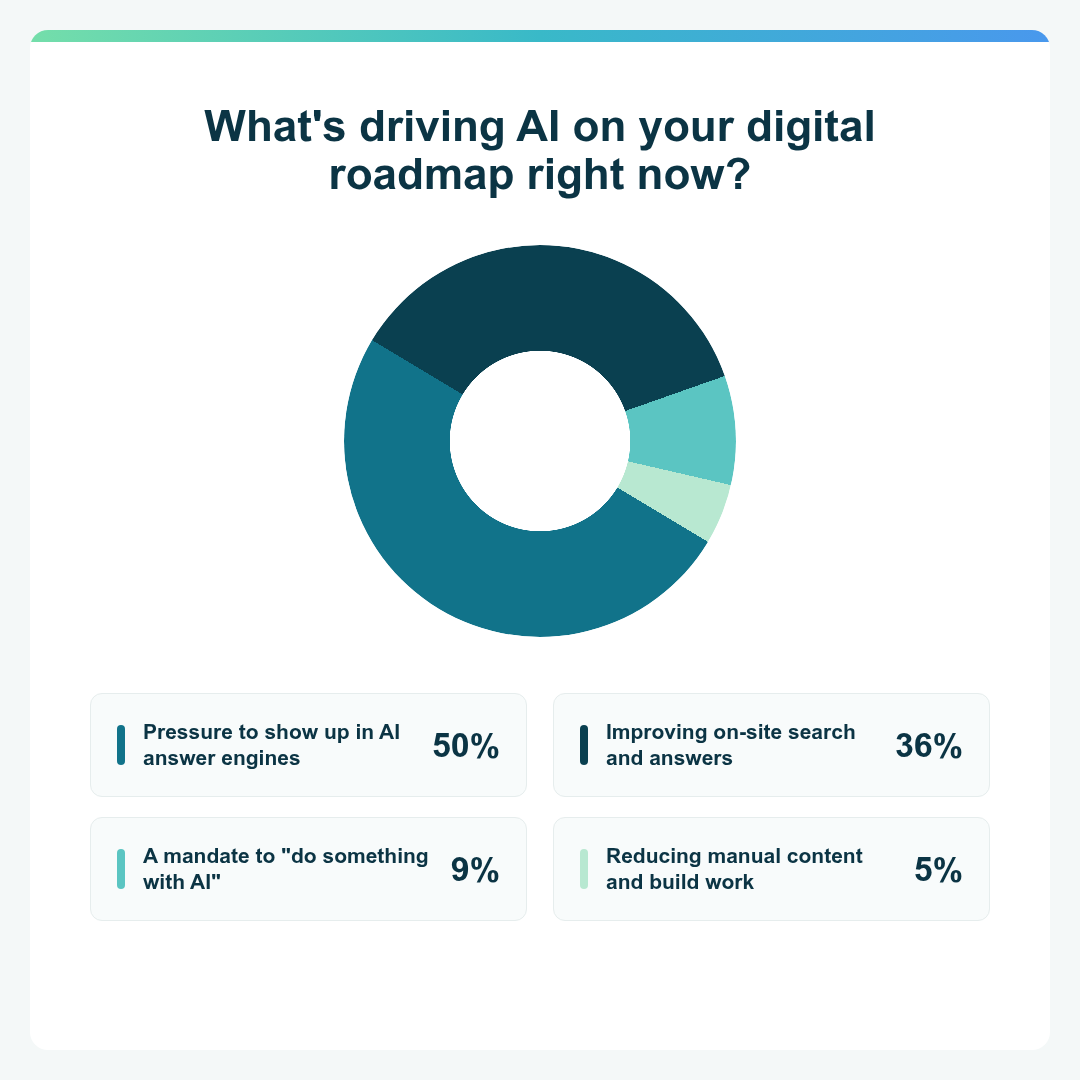
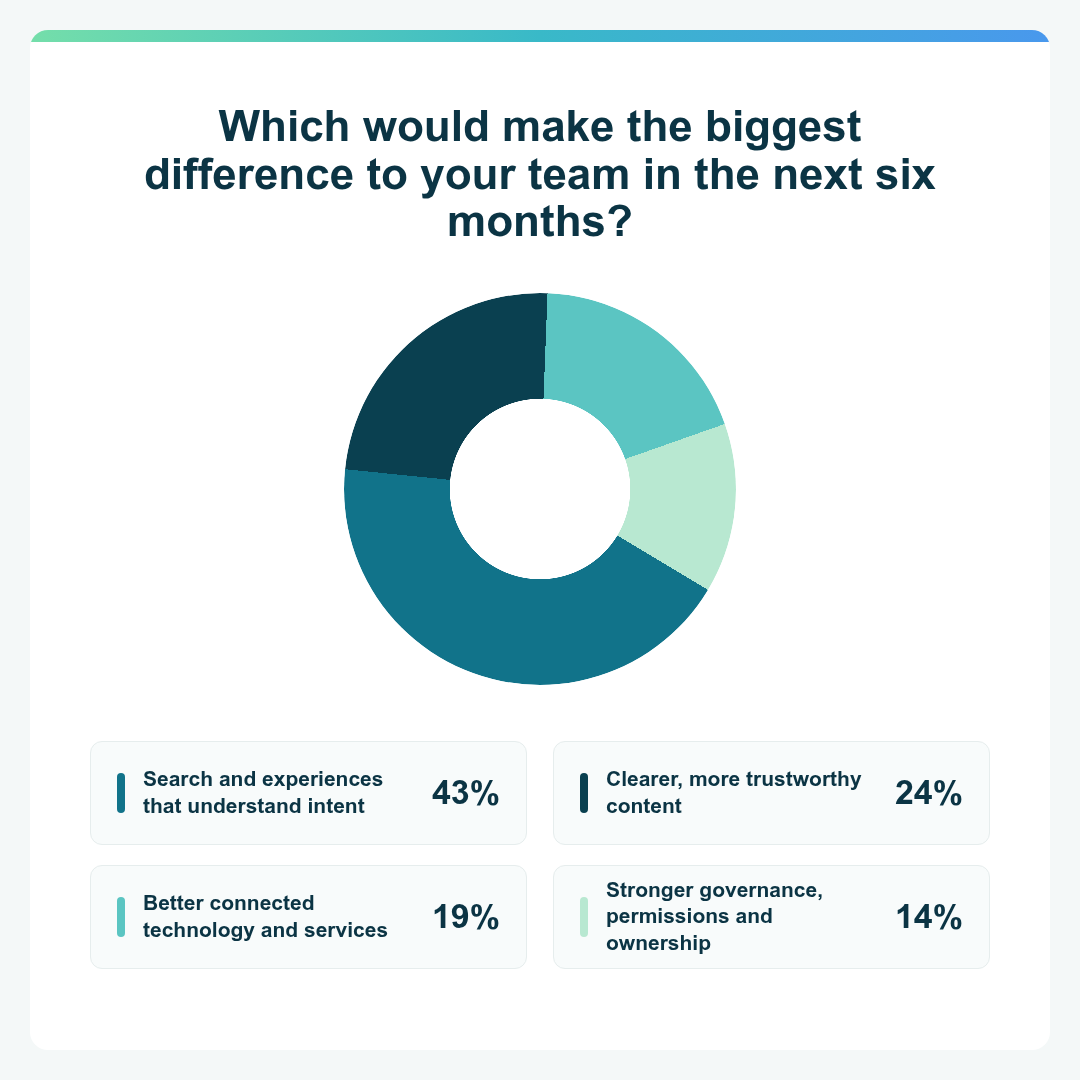
- Pressure to show up in AI answer engines – 50%
- Improving on-site search and answers – 36%
- A mandate to "do something with AI" – 9%
- Reducing manual content and build work – 5%
- Search and experiences that understand intent – 43%
- Clearer, more trustworthy content – 24%
- Better connected technology and services – 19%
- Stronger governance, permissions and ownership – 14%
Watch the US & Canada webinar
Transcript: Watch the webinar (US)
Recording transcript coming soon.
Video: Watch the webinar (US). Captions and transcript available on playback.
Poll Results

US & Canada poll results coming soon.
US & Canada poll results coming soon.
Register for the upcoming webinars in the series
How to use what AI discovery tells you about your content to decide what to improve, consolidate or create next.
How to build AI readiness into the way your firm plans, creates, approves and activates thought leadership.